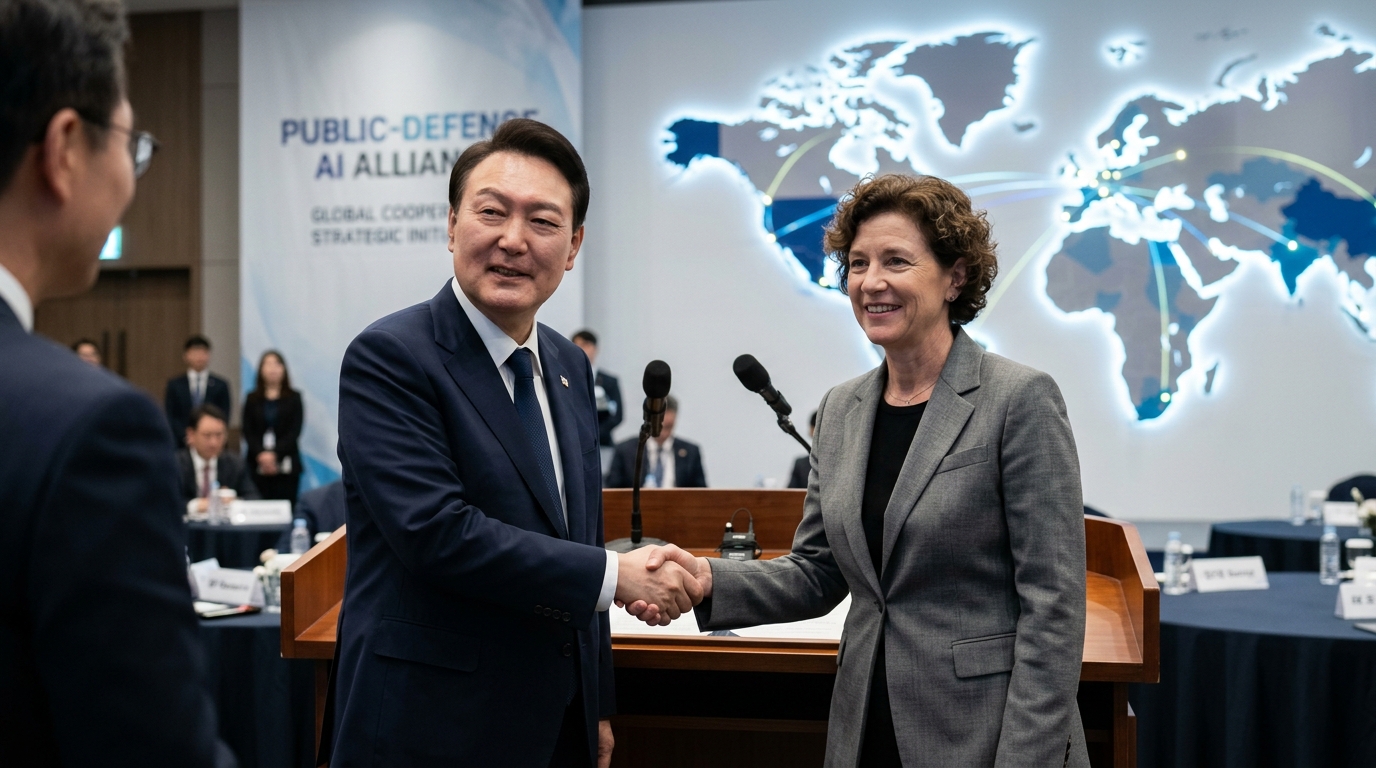
In an era where digital sovereignty is increasingly synonymous with national survival, South Korea has decided to play its boldest hand yet. The announcement of a broad 'AI Alliance for Public Defense' is not merely a business move; it is a geopolitical statement of intent. Seoul is officially targeting the third spot in the global AI hierarchy—the so-called 'AI G3'—aiming to stand shoulder-to-shoulder with the two reigning giants, the United States and China.
This initiative, spearheaded by the Ministry of Science and ICT (MSIT) in collaboration with the Ministry of National Defense, brings together the cream of the Korean tech ecosystem. Titans such as Samsung Electronics, SK Telecom, and Naver are joining forces with state research institutes to develop specialized AI models designed to transform both public administration and military operations.
The Demographic Winter and the Digital Shield
For South Korea, Artificial Intelligence is not a luxury; it is a necessity. The country faces one of the most acute demographic crises in the world, with birth rates hitting consecutive record lows. This translates directly into a shrinking pool of personnel for the armed forces, at a time when tensions with North Korea remain at a fever pitch.
- Automated Surveillance: Developing AI systems capable of monitoring borders with minimal human intervention.
- Cyber Defense: Utilizing algorithms to predict and neutralize cyberattacks from state actors.
- Logistics and Support: Optimizing the military supply chain through predictive modeling and AI-driven efficiency.
As a senior official in Seoul put it, "We can no longer rely solely on the number of our soldiers. AI will be the power multiplier that allows us to maintain our deterrent capabilities in an aging society."
The Semiconductor Edge and the 'AI G3' Goal
South Korea's strategy rests on an unshakable foundation: its dominance in semiconductor manufacturing. With Samsung and SK Hynix controlling the lion's share of the global production of High Bandwidth Memory (HBM)—essential for training large language models—the country holds the 'keys' to computational power.
"South Korea does not want to be just a component supplier for American AI. It wants to own the entire value chain, from the chip to the final defense software," notes a technology analyst based in Seoul.
The administration of President Yoon Suk Yeol has committed billions of dollars in investment, targeting not only domestic security but also export markets. Korea aspires to become the preferred partner for nations seeking advanced AI defense systems without becoming exclusively dependent on either Washington or Beijing.
Challenges and Ethical Dilemmas
Despite the optimism, the road to the top is fraught with obstacles. Competition with China is fierce, as Beijing invests astronomical sums into military AI. Simultaneously, Seoul's close alliance with the US creates a diplomatic tightrope walk, particularly regarding technology export restrictions aimed at China.
Furthermore, the integration of AI into the armed forces raises serious ethical questions. The use of autonomous weapons and the potential for algorithms to make life-and-death decisions provoke significant concern among civil society groups. The new alliance will need to establish rigorous ethical frameworks to ensure that the 'digital shield' does not evolve into an uncontrollable threat.
In conclusion, South Korea's move is a masterclass in 21st-century strategic survival. By merging its industrial prowess with the national need for security, Seoul is not just pursuing technological excellence; it is forging its new identity as an autonomous, digital pole in an increasingly fragmented world.