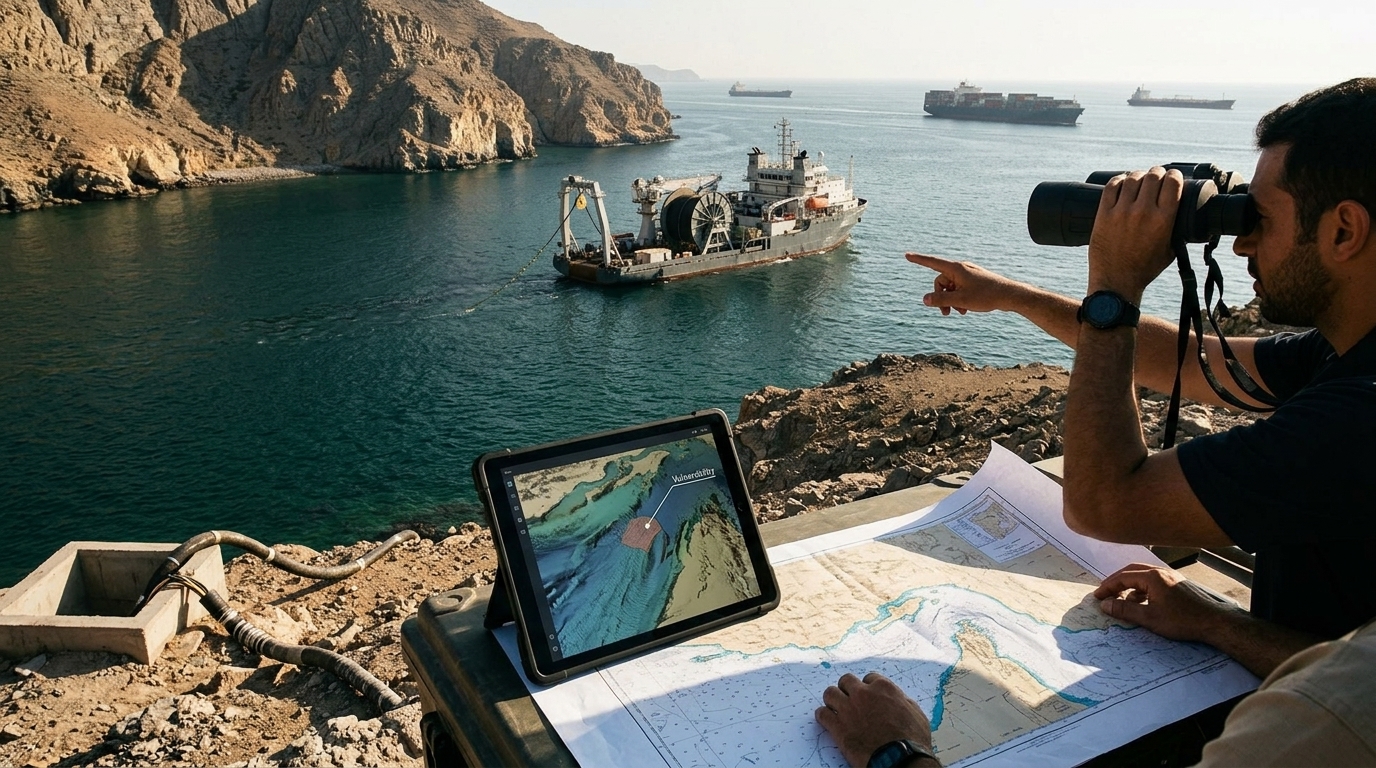
For decades, the Strait of Hormuz was considered the "jugular vein" of global energy, a narrow passage through which one-fifth of the world's oil consumption flows. However, at the dawn of the digital age and the dominance of Artificial Intelligence, a new, invisible threat is emerging from the seabed. Iran, according to recent analyses and strategic movements in the region, appears to be "brandishing" a new weapon that does not target the hulls of tankers, but the glass fibers that carry the planet's data.
The subsea fiber optic cables crossing the floor of the Gulf form the backbone of the global internet, connecting Europe with Asia and Africa. In a period of escalating geopolitical tensions, Tehran seems to realize that disrupting the flow of data could prove just as—if not more—catastrophic for the West than an oil crisis. This represents a transition from classic energy blackmail to digital strangulation.
The Strategy of the "Gray Zone"
The threat against subsea infrastructure falls into what analysts call "gray-zone warfare." These are actions that sit below the threshold of open military conflict but cause maximum disruption to the adversary. Iran now possesses the expertise and means—from unmanned underwater vehicles (UUVs) to specialized diving units of the Revolutionary Guard—to sabotage cables located in relatively shallow depths within the Strait.
The problem with subsea cables is their extreme vulnerability and the difficulty of attribution. An "accidental" anchor drag or a purported technical failure could knock out entire regions, causing economic chaos in international markets, disrupting banking transactions, and paralyzing telecommunications. For Iran, this constitutes a powerful bargaining chip against sanctions and Western pressure.
Digital Dependence and the Risk to Asia
The geographical position of the Strait of Hormuz makes it an unavoidable hub for cables connecting the technological giants of Southeast Asia with Europe's data centers. As dependence on cloud computing and AI processing power grows, the need for continuous, high-speed connectivity becomes a matter of national security for many states.
"The infrastructure supporting the global economy is no longer just gas pipelines, but the cables carrying the 'gas' of the new era: data," note cybersecurity experts.
If Iran decides to strike these networks, the consequences will extend far beyond the Gulf region. Financial hubs in Singapore, Hong Kong, and London would feel the tremors within seconds. Furthermore, repairing such damage in a conflict or controlled zone is exceptionally difficult, as specialized cable repair ships are few and could easily become targets themselves.
The Western Response and Alternative Routes
The realization of this threat has led to a race for the diversification of telecommunications routes. Projects bypassing the Strait of Hormuz are already being planned and implemented, such as Google's "Blue-Raman" cable, which connects India to Europe via Jordan and Israel. However, geopolitical instability in the Middle East makes even these alternatives precarious.
At the same time, the US and its allies are strengthening underwater surveillance in the region, using advanced sensors and AI to detect suspicious movements near critical infrastructure. Cable protection is emerging as a top priority for NATO, as the threat no longer concerns only Iran but is part of a broader doctrine of hybrid warfare also adopted by other powers, such as Russia.
In conclusion, Iran no longer needs to close the Strait to ships to cause a global crisis. Its ability to digitally "blind" entire continents represents Tehran's new doctrine of deterrence, reminding the world that in an era of total connectivity, the greatest power may lie in the ability to cut the thread of communication.