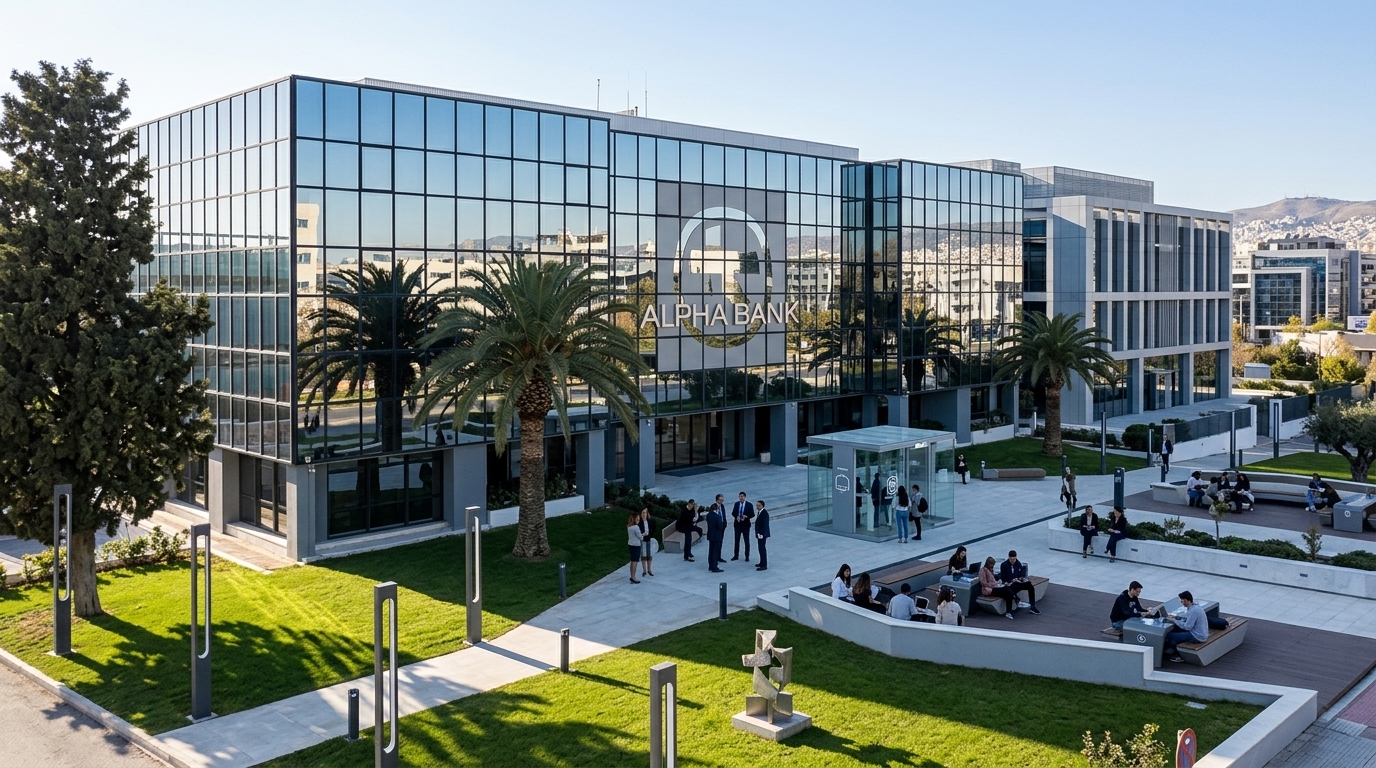
In an era where banks are transforming from traditional institutions into technology organizations, Alpha Bank is making a move that transcends the narrow boundaries of the banking sector. The "Alpha Bank Campus," the bank's new administrative center in the historic block of Athens, is an ambitious project that attempts to bridge the capital's glorious past with the digital future of the economy. It is not merely a relocation of services, but a deeply symbolic and functional intervention in the urban fabric, highlighting the importance of physical presence in the digital age.
Architecture as a Bridge of History
The central building of the Campus, located on Stadiou Street, bears the signature of the iconic architect Pericles Sakellarios. Built in the 1950s, this building served for decades as a symbol of Greek modernism and the economic rise of post-war Greece. Alpha Bank's decision to invest in the restoration and modernization of this building, as well as its neighbors, sends a powerful message: progress does not require the demolition of the past, but its reinvention.
The restoration work focused on preserving original architectural elements, such as the imposing facade and interior spaces with unique details, while simultaneously integrating cutting-edge technologies. The result is a space that inspires respect for its history while offering all the comforts of a modern, "smart" office. The conceptual connection of the buildings within the block creates a sense of unity, transforming a series of individual properties into a living organism that breathes alongside the city.
Digital Transformation and the "Phygital" Model
Inside the Alpha Bank Campus, technology is not just a tool, but the backbone of its operation. The bank implements the "Phygital" model (Physical + Digital), where the physical presence of executives is harmoniously combined with digital platforms. With the installation of artificial intelligence systems for energy management and workflow optimization, the Campus serves as a model for large-scale Internet of Things (IoT) application.
- Collaborative Spaces: The traditional structure of closed offices gives way to open, agile workspaces that foster creativity and the exchange of ideas.
- Cloud Infrastructure: The Campus infrastructure is fully interconnected with the cloud, allowing over 1,500 employees to work seamlessly from any point within the complex.
- Service Innovation: The ground floor of the complex operates as an advanced next-generation branch, where customers can experiment with new digital services under the guidance of specialized consultants.
Sustainability and ESG Criteria
One of the central pillars of the project is the commitment to the principles of Environmental, Social, and Governance (ESG) standards. Alpha Bank aimed to achieve the highest international certifications (such as LEED), proving that the renovation of historical buildings can be just as "green" as the construction of new ones. The use of eco-friendly materials, water recycling systems, and LED lighting with motion sensors drastically reduces the organization's energy footprint.
"The Alpha Bank Campus is not just an administrative building. It is the practical proof of our commitment to a bank that evolves, innovates, and respects the environment and the society in which it operates," says a senior management executive.
This investment also has a significant impact on the local economy. The concentration of thousands of employees in the heart of Athens boosts commercial activity in the area and contributes to the revitalization of the historic center, which has faced degradation challenges in recent years. The Campus acts as a magnet for further investment, turning the Stadiou-Panepistimiou "triangle" into a hub for innovation and entrepreneurship.
The Future of Work in Digital Athens
The creation of the Campus comes at a time when the debate over remote work and the future of the office remains relevant. Alpha Bank chooses a hybrid approach, recognizing that physical interaction is irreplaceable for building corporate culture and solving complex problems. The new work environment is designed to attract talent from the fields of technology and finance, offering a level of infrastructure that rivals international giants.
In conclusion, the Alpha Bank Campus represents a bold bet on the modernization of the Greek economy. By combining the aesthetics of the past with the requirements of the future, the bank is not only changing its own image but actively contributing to the transformation of Athens into a modern European metropolis. It is a project that proves technology and tradition can coexist, creating value for shareholders, employees, and society as a whole.