Human history is punctuated by moments when nature violently asserts its dominance over civilization. One of the darkest, yet often overlooked, chapters of this history was written between 1877 and 1878. It was then that a "Super El Niño" event triggered a global climatic collapse, leading to droughts, famines, and the deaths of approximately 50 million people across India, China, Brazil, and Africa. Today, scientists are sounding the alarm: the phenomenon developing in the Pacific Ocean is not merely a repeat of the past, but an amplified version fueled by anthropogenic climate change.
The 'Victorian Holocaust' and the Lessons of 1877
To understand the magnitude of the threat, we must look back to 1877. That year, sea surface temperatures in the tropical Pacific saw an unprecedented spike. The result was a chain reaction that disrupted monsoons in Asia and caused extreme droughts across three continents simultaneously. Historian Mike Davis, in his seminal work "Late Victorian Holocausts," describes how the combination of El Niño and colonial economic policies turned a natural disaster into one of the greatest humanitarian tragedies in history.
Deaths were not caused by thirst alone but by the total collapse of agricultural systems. In India, grain harvests vanished while the British administration continued to export food, adhering to the belief that market forces should not be interfered with. In China, the "North China Famine" claimed over 10 million lives. 1877 was not just a case of bad weather; it was proof of how vulnerable human society becomes when planetary cycles spiral out of control.
The Science Behind the 21st Century 'Super El Niño'
El Niño (ENSO) is a natural cycle, but what is happening now lacks "naturalness." The difference between 1877 and today lies in the sheer amount of heat stored in the oceans due to greenhouse gas emissions. The oceans have absorbed over 90% of the excess heat trapped in the atmosphere. When an El Niño begins, this energy is released, creating phenomena with an intensity that humanity has not witnessed in modern times.
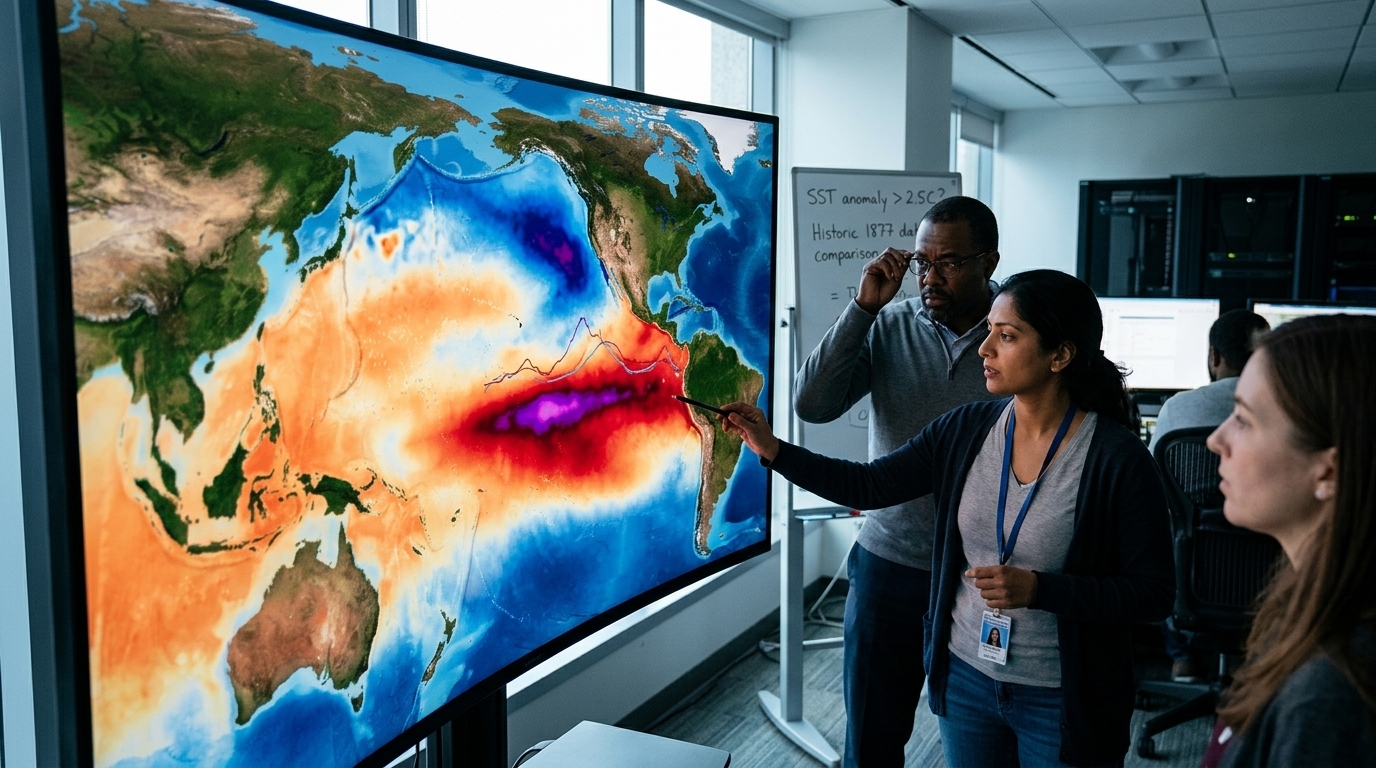
A "Super El Niño" is defined by sea surface temperatures in the central Pacific rising at least 2°C above average. However, current models suggest that "teleconnections"—the atmospheric effects carried to distant regions—are now more unpredictable. The warming of the Arctic and the weakening of the jet stream mean that the droughts caused by El Niño could become "stuck" over critical agricultural zones for much longer than in the past.
Global Security and the Food Crisis
The consequences of a modern Super El Niño will be geopolitical. In a globalized world, a drought in Brazil doesn't just affect local coffee or soy production; it sends food prices skyrocketing globally. Regions already facing instability, such as Sub-Saharan Africa and parts of Southeast Asia, are on the front lines.
- Food Inflation: Reduced production of staples can lead to social unrest, similar to the triggers of the Arab Spring.
- Migration: Climate-induced migration will intensify as entire communities lose access to potable water and arable land.
- Energy Crisis: Many nations rely on hydroelectric power; drought means less electricity and a greater reliance on fossil fuels, creating a feedback loop.
Can We Avert Disaster?
The fundamental difference from 1877 is technology and forecasting. Today, we know what is coming months in advance. However, knowledge without action is futile. Fortifying water infrastructure, investing in drought-resistant crops, and creating global food reserves are essential steps. The question is not whether the Super El Niño will happen, but whether 21st-century political systems are more capable of protecting the vulnerable than 19th-century empires were. If we fail, the ghost of 1877 will return to remind us that progress is fragile in the face of a deregulated planet's fury.