Athens returns to the epicenter of European sports today as the 2026 EuroLeague Final Four kicks off at the renovated OAKA Olympic Indoor Hall. However, this basketball celebration is accompanied by an unprecedented mobilization of security forces, reflecting the complexity of managing major sporting events in the modern era. With the clash between Olympiacos and Fenerbahce opening the tournament, Greek authorities have implemented a security plan that resembles a high-level political summit more than a sporting competition.
The Strategic Design of the Three Rings
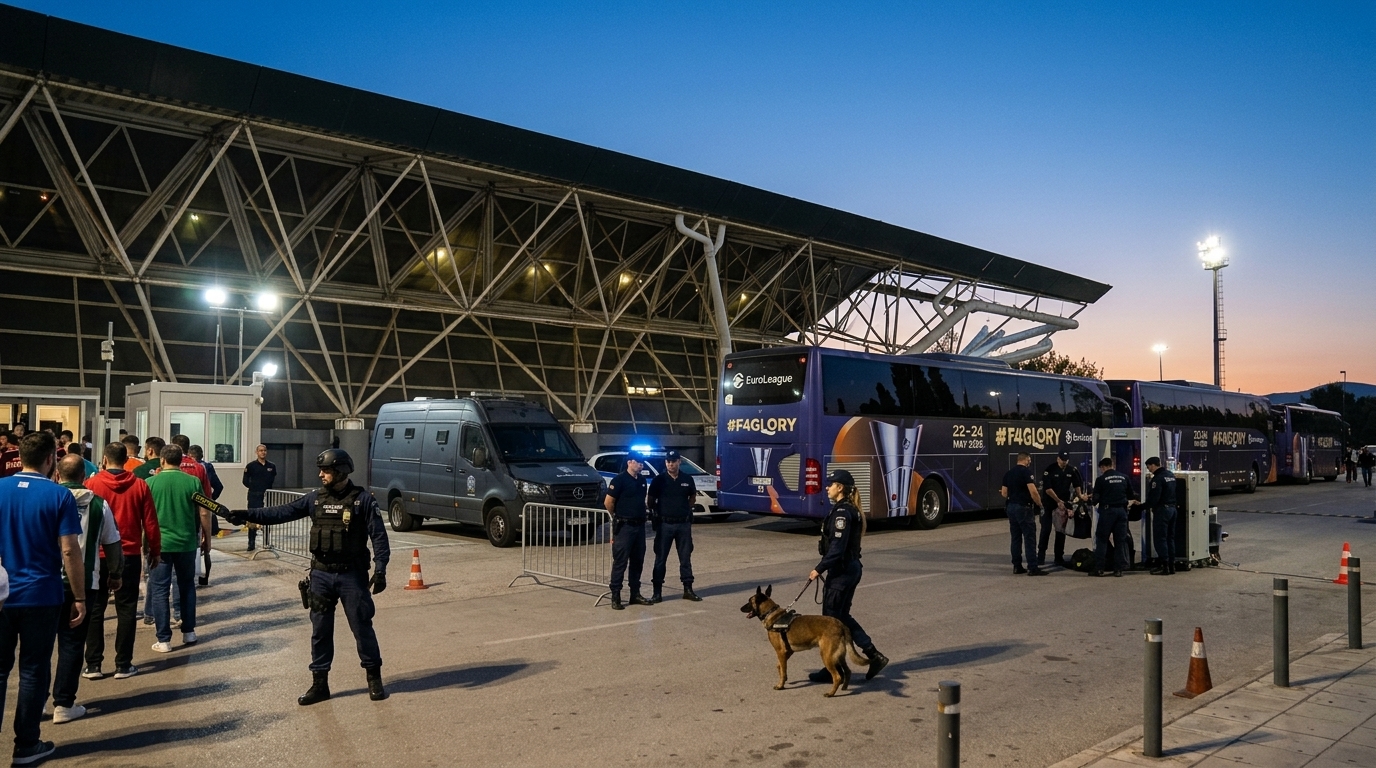
The core of the Hellenic Police's operational plan is based on the creation of three concentric security rings around the OAKA complex. The first, outermost zone begins at the perimeter of the broader Olympic complex, where initial ticket and identification checks are conducted. The second zone encompasses the stadium's surrounding plaza, where fans undergo physical searches. The third and final zone covers the arena entrances, where digital identification via the Gov.gr Wallet is mandatory for entry.
More than 4,000 police officers from various departments, including Counter-Terrorism, State Security, and Riot Police, have been deployed to ensure the smooth running of the games. Their presence is not limited to the stadium but extends to team hotels, fan meeting points, and public transport hubs. Special emphasis is placed on managing the movements of fans from the two Greek powerhouses and Turkey’s Fenerbahce to prevent accidental encounters in 'flashpoint' areas of the city.
Technology and Aerial Surveillance
A key innovation in this year's event is the extensive use of technological means. Police drones will hover continuously over Marousi and surrounding districts, transmitting real-time footage to the Operations Center. This 'eye in the sky' allows authorities to detect suspicious movements or gatherings before they escalate into incidents. Furthermore, the new high-definition CCTV system installed at OAKA as part of its recent renovation offers facial recognition capabilities, serving as a deterrent for potential troublemakers.
- Use of thermal cameras to detect prohibited items and pyrotechnics.
- Continuous monitoring of major road arteries (Kifissias, Spyrou Loui) to manage traffic flow.
- Specially trained K9 units for explosive detection at all entry points.
The Social and Political Dimension of Security
The need for such stringent measures arises not only from athletic rivalry but also from the broader climate in Greek sports over recent years. Following tragic incidents of fan violence that shocked the nation, the government and EuroLeague aim to send a message of zero tolerance. The stakes are twofold: protecting the physical integrity of spectators and safeguarding Greece's international image as a safe country capable of hosting elite events.
"The Final Four is not just a basketball tournament; it is a test for the Greek state," sources from the Ministry of Citizen Protection noted. "Success will be judged not on the court, but on our ability to guarantee the safety of every citizen at OAKA."
In conclusion, this year's Final Four represents a milestone. While fans look forward to the thrills of top-tier basketball, the shadow of 4,000 police officers serves as a reminder that the freedom of sporting enjoyment today requires a heavy armor of security. Athens must prove it can balance the passion of the stands with the discipline of the law, in a tournament that will be analyzed for years to come.