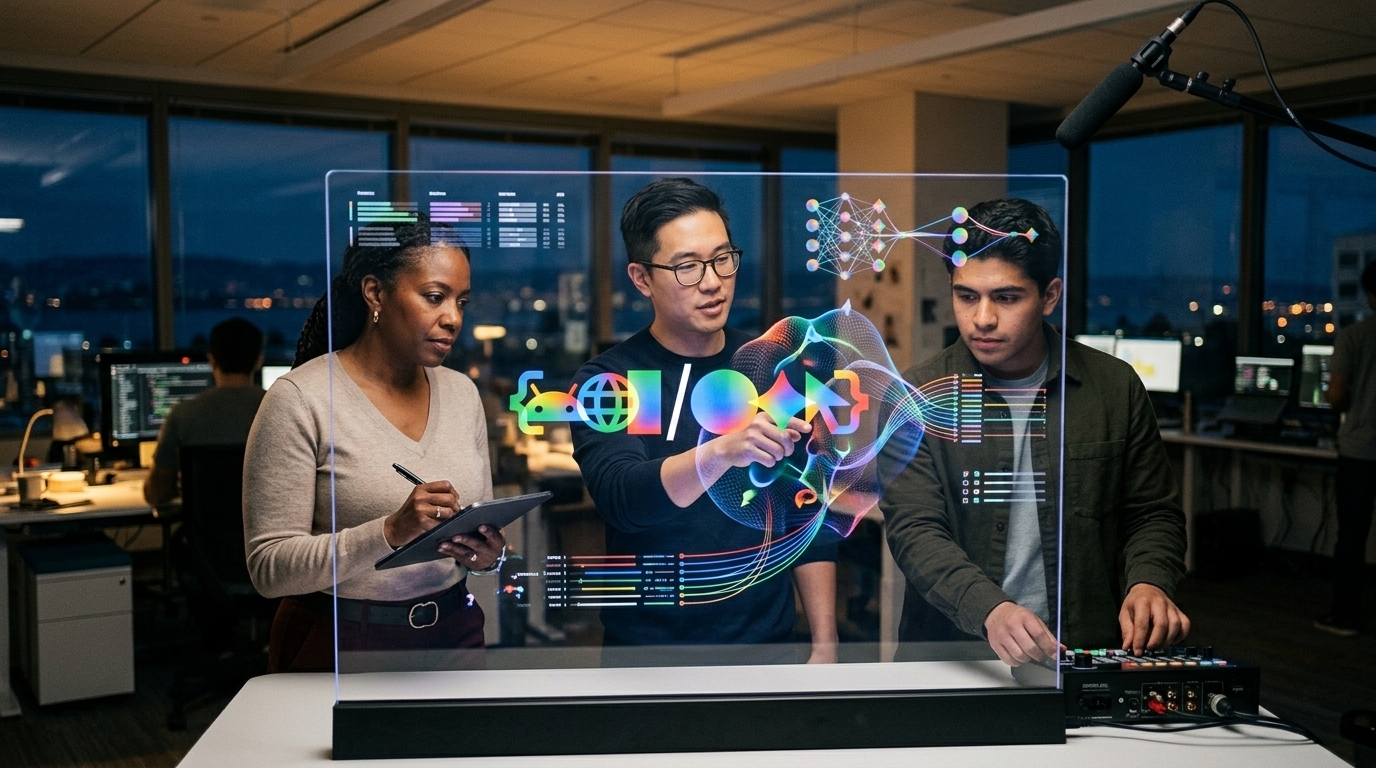
May 2026 will be recorded in technological history as the moment Google stopped treating Artificial Intelligence as a mere tool and began presenting it as an autonomous partner. In its recent announcements, the Mountain View tech giant unveiled a series of innovations that promise to radically change how we interact with the digital world, work, and information itself.
Gemini 3.0 and the Era of Reasoning
The centerpiece of the announcements was the official launch of Gemini 3.0. While its predecessors focused on natural language processing and multimodality, Gemini 3.0 introduces what Google calls the "Universal Reasoning Engine." This architecture allows the model not just to predict the next word, but to solve complex problems through logical steps, mirroring human cognitive processes.
According to Google engineers, the new model shows a 40% improvement in solving mathematical and scientific problems compared to version 2.5, while its context window has skyrocketed to 10 million tokens. This means a user can upload entire code repositories or a country's entire legal framework and receive answers with absolute precision and logical documentation.
Project Astra 2.0: The Digital Agent Has Arrived
Perhaps the most impressive demonstration involved Project Astra 2.0. Google has transformed the vision of a "personal assistant" into an "autonomous agent" (agentic AI). These new agents don’t just wait for commands; they have the ability to take initiative. During the presentation, we saw Astra booking appointments, negotiating prices with other AI agents, and organizing complete business trips, taking into account the user's personal preferences and history.
- Autonomy in decision-making within defined boundaries.
- True multimodality with real-time video and audio processing without latency.
- Integration into wearables for continuous, ambient support.
The Transformation of Search and the End of Blue Links
Google’s classic search engine, as we’ve known it for decades, is definitively giving way to Search Generative Experience (SGE) 2.0. The results page is no longer a list of links but a dynamic canvas of information. Google now uses Gemini 3.0 to synthesize answers in real-time, combining web data, YouTube videos, and user reviews into a single, cohesive narrative.
"We are no longer building a engine that finds information, but an intelligence that understands it and applies it for you," said Sundar Pichai during the keynote.
This shift brings critical questions for publishers and content creators to the forefront. If Google provides the answer directly, what is the incentive for the user to visit the source? Google addressed this with the "AI Revenue Share" program, an attempt to compensate creators whose data is used to synthesize answers, though initial reactions from the media industry remain skeptical.
Sovereign AI and Privacy: The Local Model
Recognizing data protection concerns, Google announced "Gemini Nano 3," a model that runs exclusively on-device. With the new Tensor G6 processing units in the Pixel 11, users can process sensitive data without it ever leaving their phones. This move toward "Sovereign AI" is a strategic maneuver to appease European Union regulators and offer security to corporate clients.
In conclusion, the May 2026 announcements show that Google is no longer just aiming for information dominance, but for cognitive dominance. The transition from "Search" to "Do" marks a new era where artificial intelligence becomes the operating system of our daily lives.