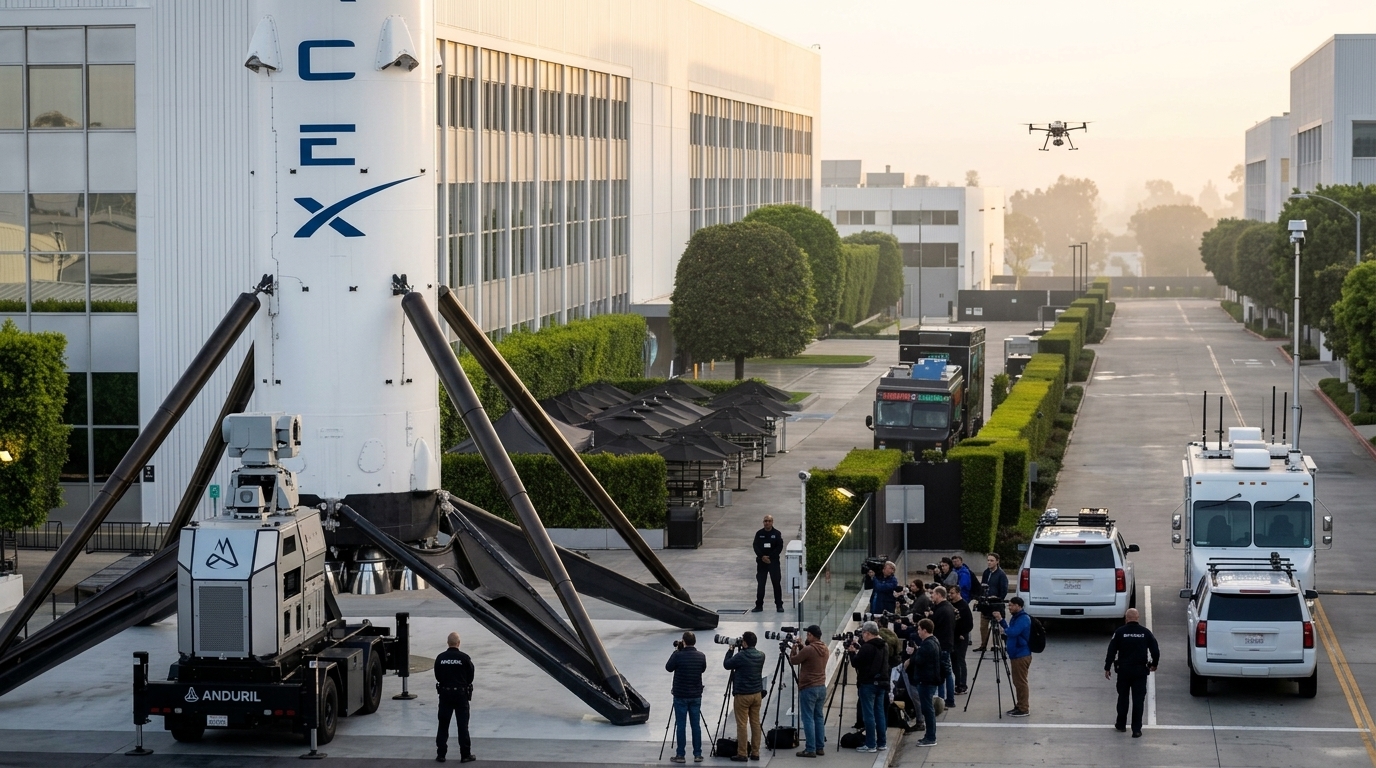
In a move reminiscent of the most intense moments of the Cold War, yet fueled by 21st-century technological prowess, the U.S. Department of Defense has announced the first contract awards for the "Golden Dome" program. This ambitious initiative aims to deploy a network of space-based interceptors capable of neutralizing hypersonic missiles and orbital threats. Among the winners are traditional giants like Lockheed Martin, Raytheon, and Northrop Grumman, but the spotlight is stolen by the industry's "disruptors": Elon Musk’s SpaceX and Palmer Luckey’s Anduril Industries.
A Shift in the Defense Paradigm
The Golden Dome program is not merely an upgrade to existing missile defenses. It represents a fundamental shift in national security philosophy. For decades, missile protection relied on ground- and sea-based systems attempting to intercept threats during their atmospheric re-entry. However, the emergence of hypersonic glide vehicles from China and Russia has rendered these systems partially obsolete. These new threats travel at speeds exceeding Mach 5 and possess maneuverability that makes their trajectories unpredictable.
The solution, according to the Pentagon, lies higher up. The space-based interceptors developed under Golden Dome will target threats in their "boost phase" or during mid-course flight in the vacuum of space. With a technology demonstration slated for 2028, the pressure for results is unprecedented. The selection of SpaceX suggests the government is leaning on reusable rocket technology (Starship) for the mass, cost-effective deployment of defense payloads, while Anduril brings AI to the table via its Lattice operating system, designed to coordinate the interceptor network with minimal human intervention.
The Alliance of Old and New Guard
The allocation of funds reveals a fascinating "hybrid" strategy. While Lockheed Martin and Northrop Grumman possess decades of experience in managing complex weapon systems, the inclusion of Anduril and SpaceX shows that the Pentagon no longer exclusively trusts the slow pace of traditional defense procurement. Anduril, in particular, has proven it can develop autonomous systems at Silicon Valley speeds, which is seen as critical to matching the pace of Chinese military technological advancement.
- SpaceX: Will focus on launch infrastructure and the "Starshield" platform, the militarized version of Starlink.
- Anduril: Will handle command-and-control software and autonomous targeting, using AI to process data from thousands of sensors in real-time.
- Lockheed & Raytheon: Will develop the kinetic kill vehicles designed to collide with enemy missiles, destroying them through pure kinetic energy.
Geopolitical Implications and the Risk of Conflict
The Golden Dome announcement has already triggered international reactions. Critics argue that placing interceptors in space violates the spirit of the 1967 Outer Space Treaty, even though the treaty explicitly bans only weapons of mass destruction (nuclear). Russia and China are likely to interpret this move as a U.S. attempt to secure "first-strike" capability without fear of retaliation, potentially sparking a new arms race in orbit.
"Space is no longer a sanctuary for scientific exploration, but the ultimate high ground. Whoever controls the orbit controls the geopolitical chessboard of the 21st century," say defense industry analysts.
The question remains whether technology can truly guarantee security. History has shown that for every defensive shield, a sharper sword is developed. However, for the companies involved, Golden Dome represents the largest financial and technological opportunity of the decade, turning science fiction into a stark, orbital reality.