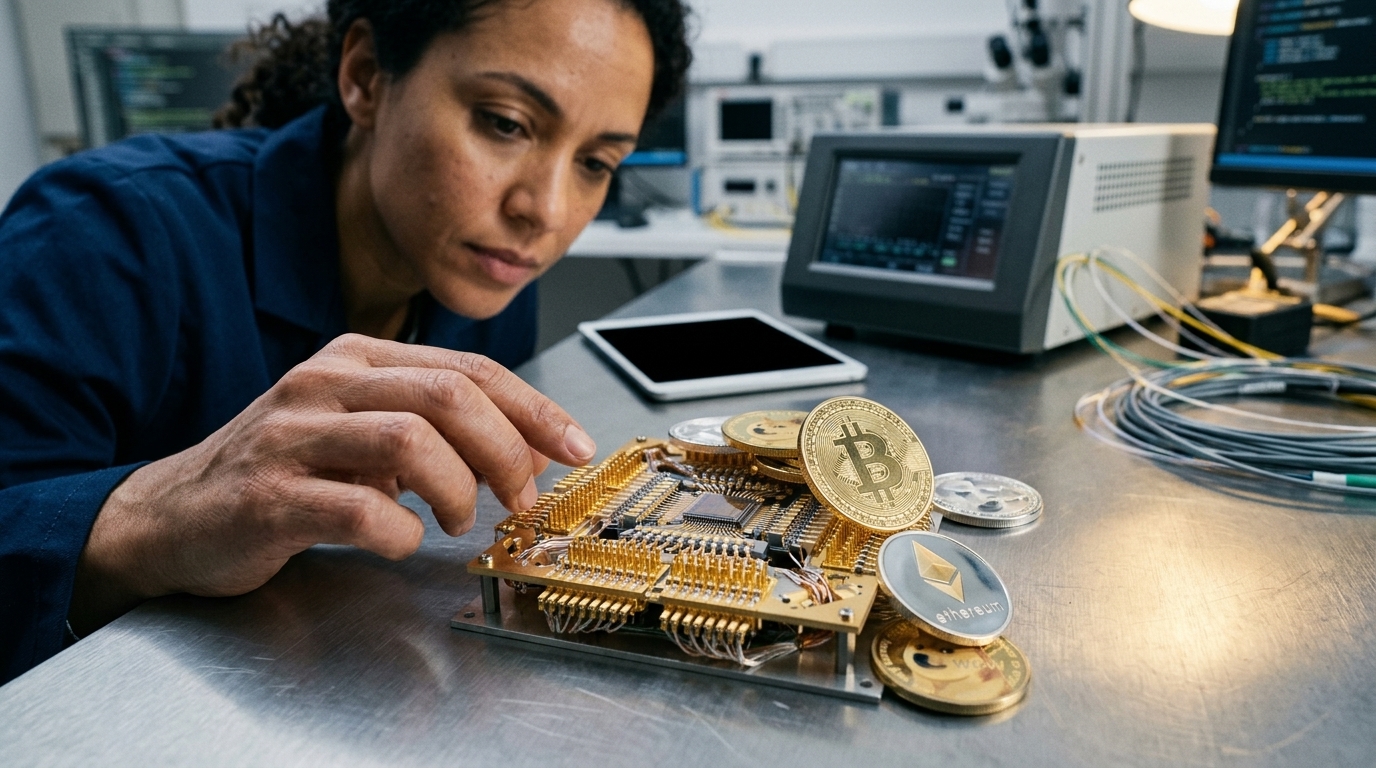
For years, the threat posed by quantum computers to the cryptocurrency ecosystem was regarded as a science fiction scenario—a theoretical exercise for the distant future. However, recent breakthroughs from giants like IBM, Google, and Baidu, combined with accelerating research into quantum supremacy, are transforming this "future threat" into an urgent, multi-billion-dollar challenge. The stakes are not merely the price of Bitcoin, but the very integrity of the cryptographic protocols that secure the global digital economy.
The Achilles' Heel of Elliptic Curve Cryptography
The core of the problem lies in how current blockchain networks, such as Bitcoin and Ethereum, protect user assets. They utilize Elliptic Curve Cryptography (ECC) to generate public and private keys. While a traditional supercomputer would take trillions of years to "crack" a private key from a public one, a quantum computer of sufficient power could achieve this in minutes using Shor's algorithm.
Shor's algorithm, formulated by mathematician Peter Shor in 1994, allows a quantum computer to factorize large numbers at an exponentially faster rate than any classical system. Since the security of cryptocurrencies relies on the mathematical difficulty of this factorization, the emergence of a quantum computer with a few thousand stable logical qubits would signify the end of privacy and security for digital wallets as we know them today.
The Timeline to 'Q-Day' and the Arms Race
Experts refer to the day quantum computing renders current cryptography obsolete as "Q-Day." Until recently, the estimate was that we were at least two decades away. However, progress in quantum error correction and increased qubit density has forced analysts to revise their timelines. Some now predict that a quantum system capable of threatening Bitcoin could exist within the next 5 to 10 years.
This evolution is creating a new geopolitical arms race. The United States, through NIST (National Institute of Standards and Technology), has already begun standardizing Post-Quantum Cryptography (PQC) algorithms. Simultaneously, China is investing billions in quantum communication networks, seeking to shield its own infrastructure while potentially gaining the ability to unlock foreign secrets. For the crypto industry, this race is not academic; it is an existential threat to assets exceeding $2 trillion.
The Challenge of Migration and 'Orphaned' Assets
The solution seems simple in theory: upgrade blockchain networks with quantum-resistant algorithms. In practice, however, this is a massive technical and social hurdle. Such a transition would require a "hard fork" of the network, where every user would need to move their funds to a new, secure address.
The most significant problem lies in "static" or "lost" funds. Approximately 3 to 4 million Bitcoins are considered lost, including the 1.1 million coins belonging to Bitcoin’s creator, Satoshi Nakamoto. These coins are stored in older address types (P2PK) that expose the public key on the blockchain. If their owners cannot or will not move them, a quantum attacker could seize them, triggering a total collapse in market trust and price.
Conclusion: A New Era of Digital Shielding
The quantum threat should not be viewed as the death of cryptocurrency, but as the next great test of its adaptability. Projects that successfully integrate post-quantum cryptography early will be the ones to survive and dominate the new economic reality. However, complacency is the greatest enemy. The complexity of upgrading decentralized networks means that preparations must begin today, before quantum processors leave the labs and enter the arena of global economic dominance.