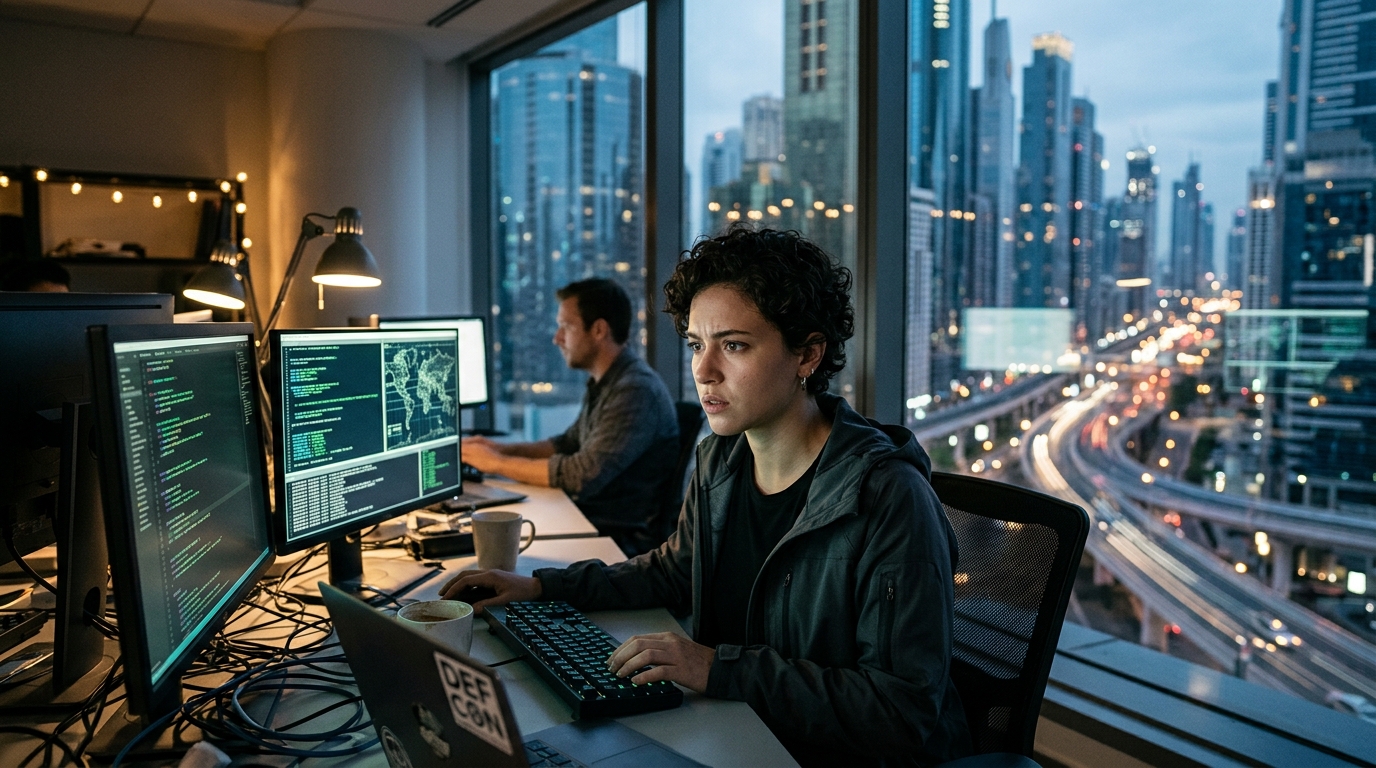
The world's digital security is at a critical crossroads. For decades, the discovery of so-called 'zero-day' vulnerabilities—software bugs unknown even to their creators—was the exclusive domain of an elite group of human hackers. These 'bug hunters' would spend months analyzing code, searching for a tiny crack in the digital armor of operating systems. Today, according to recent reports and analyses from the Atlantic Council, this process is being automated using Large Language Models (LLMs) and specialized AI agents. The successful discovery of a zero-day by AI is no longer a theoretical scenario; it is a reality that is sending shivers through governments and generating excitement within the dark industry of commercial spyware.
The Automation of the Digital Arsenal
The use of AI in cybersecurity is not new, but its ability to identify primary flaws in complex systems like the Linux kernel or iOS represents a qualitative leap. AI models can now 'read' millions of lines of code in seconds, identifying patterns that suggest vulnerabilities in memory management or logic errors that would escape the human eye. What once required a team of experts and a multi-million dollar budget can now be achieved with a few dollars worth of compute power.
This evolution radically changes the economics of cybercrime. When the cost of discovering a zero-day drops dramatically, the 'supply' of these digital weapons increases. This leads to a democratization of offensive cybersecurity, where not only major powers (USA, China, Russia) but also smaller states or even criminal organizations gain access to tools that can paralyze critical infrastructure or surveil high-profile individuals.
The Spyware Industry and the Role of Zero-Days
The commercial spyware industry, featuring companies like NSO Group and Intellexa, relies on possessing zero-day vulnerabilities to offer its services to government clients. A zero-day in WhatsApp or iMessage allows for the installation of surveillance software without any action from the victim (a zero-click exploit). The emergence of AI as a 'discovery tool' means these companies can now refresh their arsenals faster than tech giants can issue patches.
"AI isn't just changing the rules of the game; it's changing the players and the speed at which the game is played," note analysts from the Atlantic Council.
The problem is exacerbated by the fact that defense remains reactive. While AI can also be used to fortify code, the asymmetry persists: an attacker needs only one hole, while a defender must close them all. The spyware industry is watching these developments closely, investing in its own AI models to maintain its edge over the protection mechanisms of Apple, Google, and Microsoft.
Geopolitical Implications and the Need for Regulation
At a geopolitical level, the automated discovery of zero-days by AI constitutes a new form of arms race. A nation's ability to produce digital weapons at scale through AI could define its power in the 21st century. Already, there are reports that state actors are training specialized models on closed datasets that include historical exploits, effectively teaching the machine to think like a hacker.
The international community is now called upon to establish rules. The debate over controlling the export of 'dual-use' AI technology is intensifying. However, the nature of software makes control extremely difficult. If a researcher develops an AI that finds bugs to help developers, how can we prevent them from selling it to a zero-day broker? The answer may lie in 'Defensive AI'—systems that patch code in real-time, before an attacker can even exploit the vulnerability.
Conclusion: The Battle of the Algorithms
As we move into the latter half of the 2020s, cybersecurity is transforming into a battle between algorithms. Human intervention will remain necessary for strategic decision-making, but tactical execution—the finding and exploiting of bugs—will belong to the machines. Society must prepare for a world where our digital privacy and infrastructure face continuous, automated attacks from entities that never sleep. Transparency, international cooperation, and investment in defensive technology are the only levees against a spyware industry that has just gained superpowers.