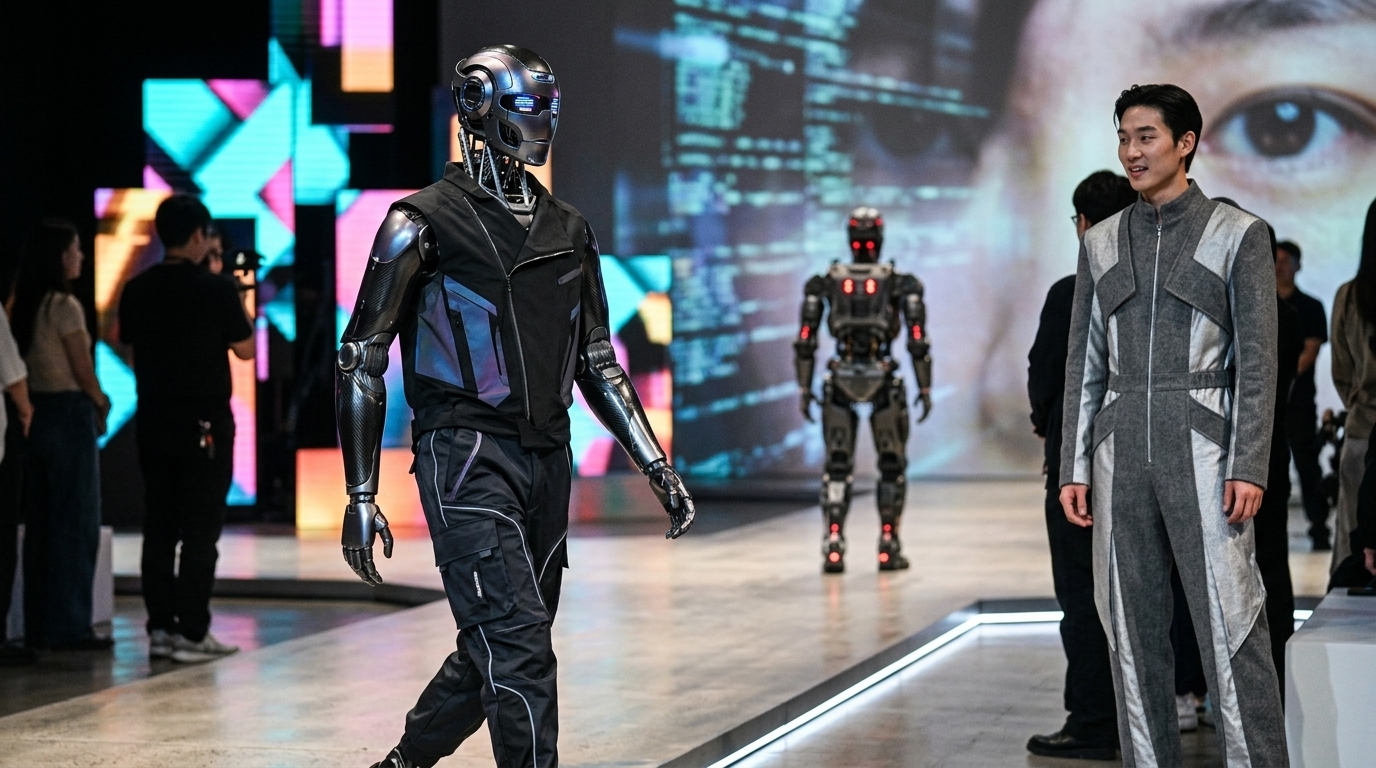
Seoul, a city often described as the laboratory of the future, recently became the stage for an event that seemed ripped from the pages of Isaac Asimov. In the heart of the South Korean capital, humanoid robots were not merely exhibits behind protective glass; they were the stars of a show covering the entire spectrum of human activity, from high fashion to the brutal confrontation of the boxing ring.
The event, which garnered global attention, highlighted the staggering progress made in the kinematics and balance of machines. Robots walked the runway with a grace approaching human levels, wearing designer creations that integrated technological elements. But the spectacle didn't stop there. The transition from the elegance of fashion to the violence of sport was abrupt yet revealing: robots equipped with advanced sensors and AI systems faced off in boxing matches, demonstrating reaction speeds and real-time strategic thinking.
South Korea’s Technological Hegemony
It is no coincidence that this demonstration took place in Seoul. South Korea has for years held the world record for robot density per worker. The government and domestic giants like Hyundai (which now owns Boston Dynamics) and Samsung are investing billions in the development of General Purpose Robots. These machines are not programmed for a single task, like an arm on a car production line, but are designed to learn and adapt.
The use of Large Language Models (LLMs) as the "brain" of these robots now allows for direct communication with humans. At the Seoul event, we saw robots dancing with attendees, interpreting their partner's movements and adjusting their rhythm. This ability for "emotional" and kinetic alignment is the holy grail of robotics, as it transforms the machine from a tool into a companion.
From Entertainment to Economic Reality
Despite the phantasmagoric nature of the event, the Seoul demonstration has deep economic and social implications. South Korea is facing one of the most severe demographic crises in the world, with the lowest fertility rate globally. For the country, humanoid robots are not an expensive toy but a necessary solution for economic survival. The ability of a robot to perform tasks in an environment designed for humans—without requiring costly infrastructure changes—is key.
In the boxing ring, we saw durability and power. On the runway, we saw precision and aesthetics. Combined, these traits herald the entry of humanoids into the service sector, elderly care, and the supply chain. Critics, of course, point to the danger of the "Uncanny Valley," where excessive resemblance to humans causes discomfort. However, the audience's reaction in Seoul was largely enthusiastic, suggesting that social acceptance of robots may arrive faster than we expected.
The Future of Coexistence
The question arising from the streets of Seoul is clear: Are we ready to share our space with entities that look like us but do not feel? Technology has reached a tipping point. The integration of Generative AI into robotic bodies now allows for the creation of "physical agents" that can understand natural language commands and execute them in three dimensions.
- Autonomy: The robots in Seoul were not remote-controlled but made decisions based on their environment.
- Versatility: The same platform can be used for entertainment, security, or heavy labor.
- Social Integration: Fashion and dance serve as bridges to make technology less intimidating.
As the lights dim in Seoul, the echo of metallic footsteps on the runway remains. It wasn't just a fashion show or a boxing match; it was a preview of a world where the "artificial" and the "natural" will be indistinguishably intertwined.