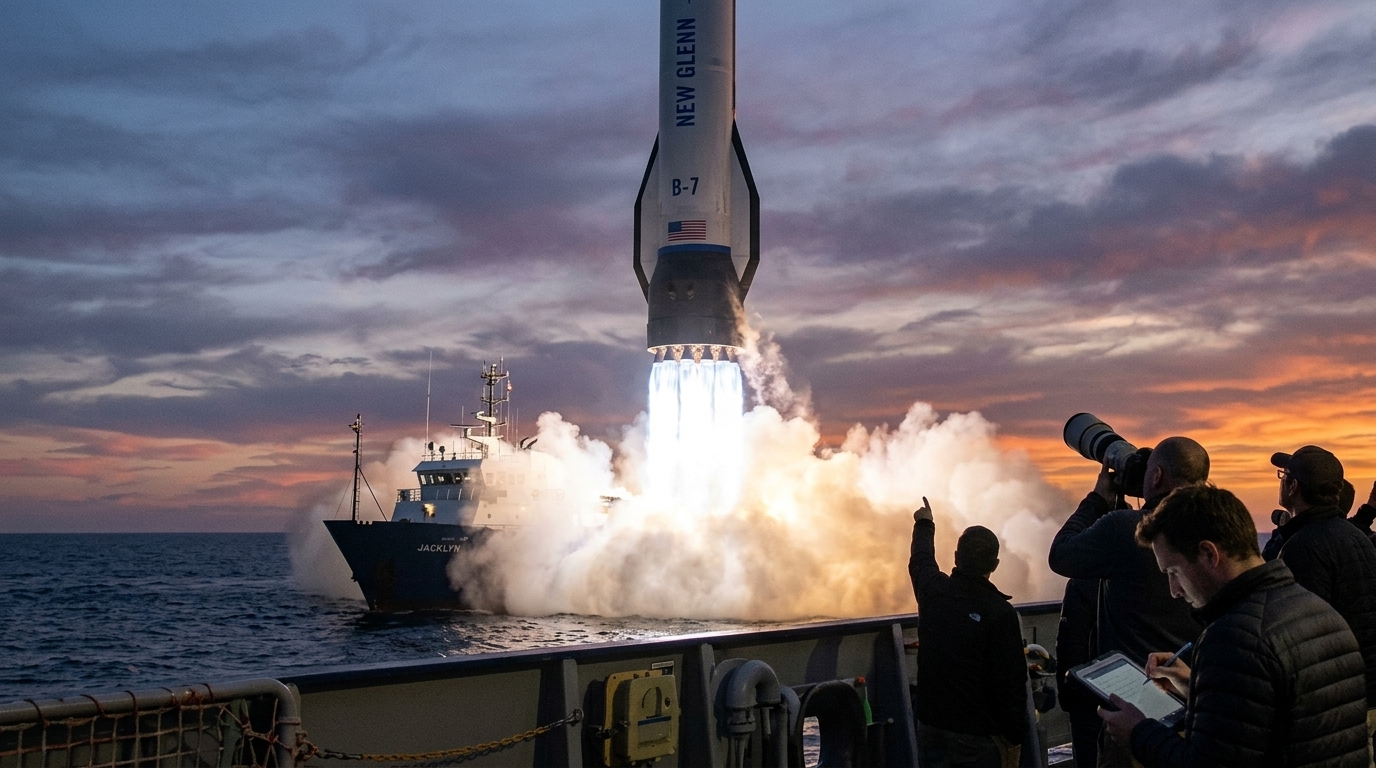
Space exploration has never been a linear path of progress; it is a series of expensive lessons written in fire and steel. For Jeff Bezos’ Blue Origin, the recent maiden flight of the New Glenn rocket epitomizes this dual reality. On one hand, the company achieved what only SpaceX had managed until now: the successful launch and landing of a heavy-lift booster on its first attempt. On the other, the failure of the payload to deploy successfully left a bittersweet aftertaste, reminding the world that in orbit, a "partial success" is often indistinguishable from a mission failure.
The Engineering Triumph of New Glenn
New Glenn is not just another rocket; it is Bezos’ strategic answer to Elon Musk’s dominance. Standing 98 meters tall and powered by seven BE-4 engines burning liquefied natural gas (LNG) and liquid oxygen, this vehicle was designed to redefine the economics of commercial launches. The successful landing of the first-stage booster on the drone ship "Jacklyn" in the Atlantic Ocean is a technical marvel that validates years of painstaking research and development.
The BE-4 engines, which also power United Launch Alliance’s (ULA) Vulcan rocket, performed flawlessly during the ascent phase. The rocket's stability during atmospheric reentry and its pinpoint landing accuracy demonstrate that Blue Origin now possesses the sophisticated guidance and control systems necessary for reusability. This is the "win": proof that the New Glenn platform is flight-capable and structurally sound.
The Blue Ring Anomaly and Payload Loss
However, the celebration at Blue Origin’s headquarters was tempered by the fate of the "Blue Ring." This innovative orbital transfer vehicle was designed to provide refueling, data processing, and transportation services for other satellites. While the rocket reached the intended altitude, a malfunction—likely in the upper stage or the deployment sequence—resulted in the loss of the payload's operational capacity.
Blue Ring was intended to be the centerpiece of Blue Origin’s orbital services portfolio. Capable of carrying up to 3,000 kg of payload, its failure highlights the immense challenges of the "last mile" in space. Reaching orbit is only half the battle; surviving and functioning in that environment is where the true difficulty lies. For Bezos, this failure means potential delays in high-stakes contracts with the Pentagon and NASA, both of which were closely monitoring the Blue Ring’s performance.
Strategic Implications: The Kuiper Factor
The timing of this mission is critical. Amazon, Bezos’ other empire, is preparing Project Kuiper, a constellation of thousands of satellites intended to compete with Musk’s Starlink. New Glenn is the primary vehicle tasked with deploying these satellites. Any failure, even a partial one, jeopardizes the strict timelines set by the Federal Communications Commission (FCC).
- Project Kuiper: Amazon must launch half of its constellation by 2026. Without a reliable New Glenn, this target becomes nearly impossible.
- NASA Artemis: Blue Origin is contracted to build the Blue Moon lunar lander. The reliability of New Glenn is a prerequisite for NASA’s long-term confidence.
- Commercial Market: Major telecommunications firms have already booked slots on New Glenn, seeking a viable alternative to SpaceX’s near-monopoly.
The Road Ahead
Blue Origin is no longer a company that merely "promises"; it is a company that "delivers," albeit with hurdles. The success of the booster landing covers 80% of the technical risk. The remaining 20%—payload reliability—is what separates industry leaders from the rest of the pack. Jeff Bezos, adhering to his motto "Gradatim Ferociter" (Step by step, ferociously), understands that the Blue Ring failure provides vital data for future iterations. However, in the 21st-century space race, time is the only fuel that cannot be replenished. The pressure is now on for the second flight to prove that Blue Origin can not only launch, but also deliver.