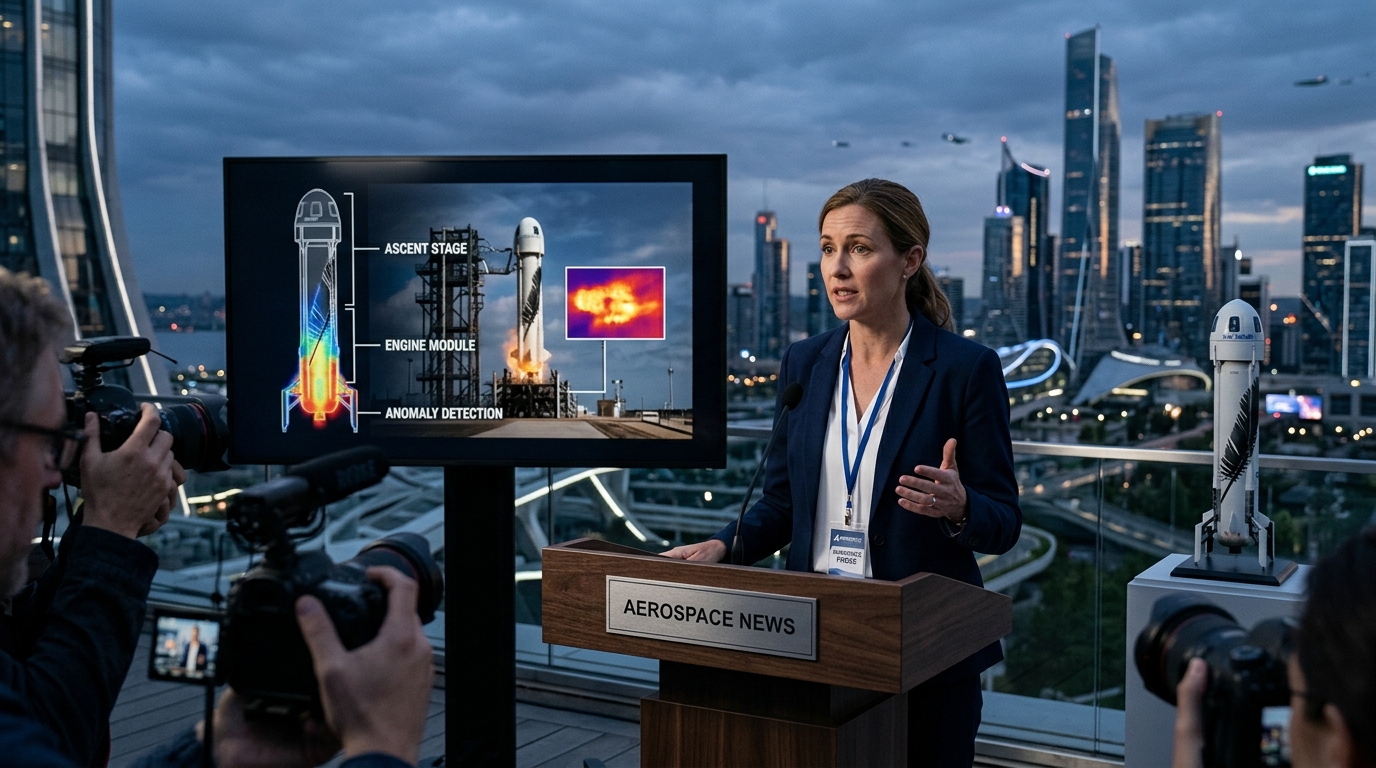
Thursday, May 28, 2026, will be recorded as one of the darkest days in the history of Blue Origin. At Launch Complex 36 (LC-36) at Cape Canaveral, the massive New Glenn rocket—the crown jewel of Jeff Bezos’s space venture—was engulfed in a fireball during a critical static fire test. The explosion, which lit up the Florida sky, was not merely a technical failure; it was a symbolic and strategic setback at a time when the private space industry is moving at breakneck speed.
The Anatomy of a Catastrophe
According to preliminary reports and footage, the explosion occurred seconds after the ignition of the seven BE-4 engines that power the rocket’s first stage. The BE-4 engines, which utilize liquefied natural gas (LNG) and liquid oxygen, are the heart of Blue Origin’s vision for heavy-lift reusable rockets. While the company has yet to issue a detailed statement on the cause, analysts suggest that a fuel leak or a failure in the oxygen pump could be the culprit.
New Glenn is no ordinary rocket. Standing over 98 meters tall, it was designed to compete directly with SpaceX’s Falcon Heavy and Starship. The loss of this prototype means not only the destruction of hardware worth hundreds of millions of dollars but also the delay of a program already plagued by years of postponement. Blue Origin, which follows the motto "Gradatim Ferociter" (Step by step, ferociously), now finds itself stuck in a step that proved fatal.
Impact on the Rivalry with SpaceX
While Elon Musk’s SpaceX has adopted a "fail fast, learn fast" philosophy, Blue Origin has always been more conservative, attempting to avoid public failures. This strategy appears to be crumbling. With SpaceX already dominating satellite launches and crewed missions to the International Space Station, Blue Origin desperately needed New Glenn to prove it can play in the big leagues of space exploration.
The explosion raises questions about the reliability of the BE-4 engines, which also supply United Launch Alliance’s (ULA) Vulcan Centaur rocket. If the issue is a structural flaw in the engine design, the repercussions will ripple across the entire U.S. defense and commercial space infrastructure. ULA relies on these engines for national security missions, and any delay could force the Pentagon to lean even more heavily on SpaceX, further cementing Musk’s near-monopoly.
Project Kuiper and NASA: On Edge
The consequences of the explosion reach as far as Amazon’s headquarters. Project Kuiper, Bezos’s answer to Starlink, relies heavily on New Glenn to carry thousands of satellites into orbit. With the Federal Communications Commission (FCC) imposing strict deadlines for network deployment, Amazon is now in a race against time. Without New Glenn, Amazon might be forced to swallow its pride and purchase more launch slots from its direct competitor, SpaceX.
Furthermore, NASA is watching with growing concern. Blue Origin has secured billion-dollar contracts for the Artemis program, including the development of a lunar lander. Although New Glenn does not directly carry astronauts, it is the vehicle intended to transport the necessary components for lunar infrastructure. Thursday’s failure could trigger a risk reassessment by the space agency, potentially jeopardizing the timeline for humanity’s return to the Moon.
Conclusion: The Price of Ambition
Space remains an inhospitable and unforgiving environment for errors. The New Glenn explosion serves as a stark reminder that rocket engineering is one of humanity’s most daunting challenges. For Jeff Bezos, this moment is a test of character for his company. Will he choose to accelerate and take more risks, or retreat into an even slower development pace? The answer will determine whether Blue Origin remains a serious contender or becomes an expensive footnote in the history of space exploration.