The video game industry has always been at the vanguard of technological innovation, but the current integration of Artificial Intelligence (AI) is not merely an upgrade; it is a total reinvention of the medium. As we navigate through 2026, the traditional method of game development, which relied on static scripts and manually designed environments, is giving way to dynamic, self-evolving ecosystems. The promise of AI in gaming is no longer just about sharper graphics, but about creating experiences that are unique to every single player.
The Collapse of the 'Fourth Wall': Dynamic Characters and Dialogue
For decades, interaction with non-player characters (NPCs) was limited to predetermined dialogue trees. If you asked a villager in an RPG something off-topic, the response was usually a repetitive phrase. Today, with the integration of Large Language Models (LLMs), NPCs are gaining an awareness of their environment and the player's history. Technologies like NVIDIA ACE now allow characters to conduct natural, real-time conversations, adjusting their tone and content based on the user's actions and previous choices.
This evolution is radically changing narrative design. Writers are no longer scripting linear stories; they are defining 'personality parameters.' The challenge is shifting from writing lines to ensuring that the AI remains within the boundaries of the game's lore, avoiding hallucinations that could break the player's immersion.
Procedural Content Generation (PCG) and the Era of Infinite Worlds
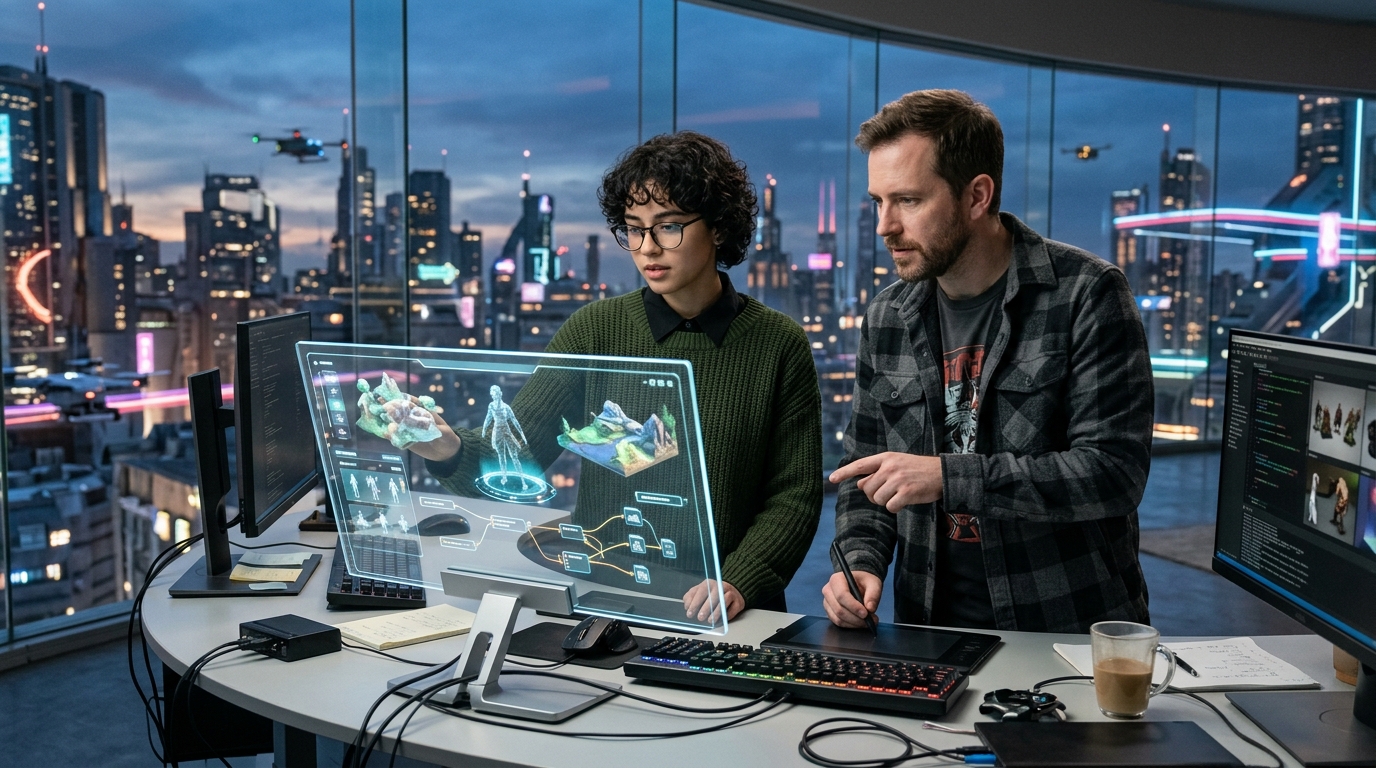
Creating assets—from trees and buildings to complex cave systems—has always been the most time-consuming and expensive part of development. AI through Procedural Content Generation (PCG) has evolved to such an extent that it can generate entire planets with unique geology and ecosystems in seconds. Tools like Unreal Engine 5.4+ utilize machine learning algorithms to place objects naturally, mimicking the laws of biology and physics.
- Automated Texturing: AI can transform a simple photo into a high-fidelity 3D model with full reflective and depth properties.
- Dynamic Physics: Environmental destruction is no longer pre-calculated ('baked') but computed in real-time by neural networks.
- Personalized Leveling: Games can now analyze your playstyle and generate challenges that perfectly match your skill level, preventing both boredom and frustration.
The Economic Reality and the Crisis of Creativity
Despite the excitement, the use of AI brings intense ethical and labor concerns. The production costs of AAA titles have skyrocketed into hundreds of millions of dollars, and corporations view AI as the only solution to maintain profitability. However, this has led to waves of layoffs in concept art and QA testing departments. The concern is twofold: the loss of livelihoods and the risk of 'homogenized' art.
"AI can paint a forest, but it cannot understand why the loneliness of that forest is vital to the story," says a veteran designer from Ubisoft.
The industry is now tasked with finding the golden ratio between algorithmic efficiency and the human soul that makes a game memorable. AI is a powerful brush, but the artist must remain human. In the future, 'Indie' studios might be the biggest winners, as AI democratizes access to tools that once required armies of developers to manage.