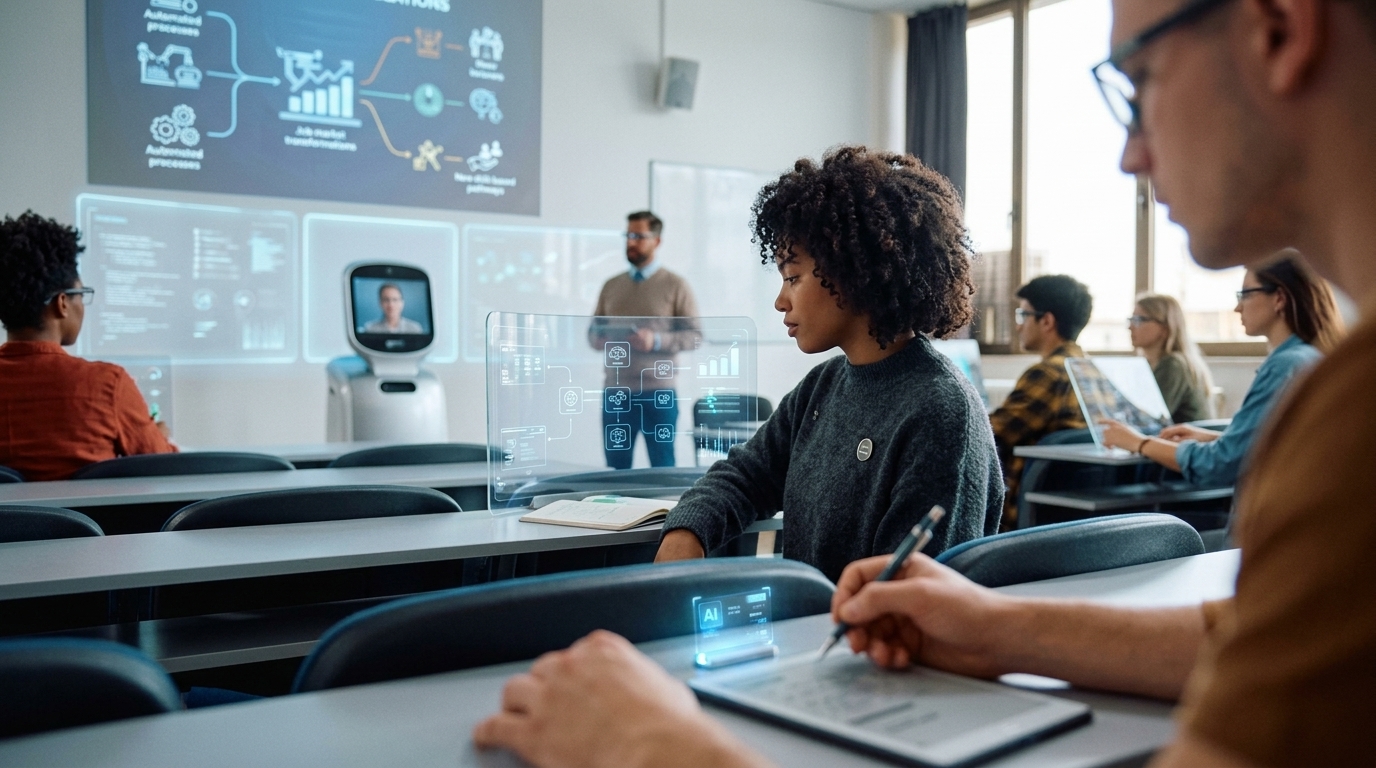
Humanity stands on the precipice of a technological revolution that promises to redefine the very concept of work. While previous industrial revolutions replaced physical labor with machines, Artificial Intelligence (AI) now targets the core of human uniqueness: cognitive function, creativity, and decision-making. Recent analysis highlights a stark yet hopeful reality where millions of jobs are at risk, but simultaneously, the need for a radical reform in education is born.
The End of Work as We Know It?
According to international organizations such as the IMF and the OECD, nearly 40% of jobs globally are exposed to AI. In advanced economies, this figure reaches 60%. The difference this time is that the threat does not only concern unskilled workers or repetitive manual tasks. On the contrary, Generative AI is invading sectors previously considered "safe," such as law, programming, content writing, and data analysis.
Automation is no longer a static process. Algorithms can now compose texts, generate code, and make strategic decisions with a speed that surpasses any human capability. This creates a skills gap that threatens to widen social inequalities. As analysts point out, the danger is not necessarily the total elimination of jobs, but the devaluation of human labor and the reduction of wages for those who cannot keep pace with technological evolution.
Education as an Antidote to Obsolescence
Faced with this challenge, the existing educational system appears anachronistic. Rote memorization and specialization in narrow subject areas are no longer sufficient. Education must shift from the mere transfer of knowledge to the cultivation of skills that AI finds difficult to mimic: critical thinking, ethical judgment, emotional intelligence, and interdisciplinary synthesis.
- Transformation of Curricula: Schools and universities must integrate AI not as a plagiarism tool, but as a collaborator. Teaching "how to ask" (prompt engineering) becomes as important as "what to answer."
- Lifelong Learning: The concept of a degree that lasts a lifetime is dead. Workers will need to continuously retrain (reskilling and upskilling) to remain relevant in a market that changes every six months.
- Focus on "Human" Skills: Empathy, leadership, and the ability to manage complex human relationships are becoming the new "hard" skills in the job market.
Social and Political Implications
This transition will not be bloodless. History teaches us that the Luddites failed to stop the machines, but the societies that adapted fastest were those that prospered. Governments are now called upon to establish safety nets, such as Universal Basic Income or subsidized retraining programs, to prevent a massive social explosion.
"AI will not replace humans, but humans who use AI will replace those who do not."
This phrase reflects the essence of the new era. The challenge for many economies is even greater. Investing in digital literacy is no longer an option but a condition for survival. The radical change in education is the only way to transform the threat of AI into an opportunity for a more creative and less clerical human existence.
In conclusion, the advent of AI in the labor market is an "intelligence test" for society itself. If we persist in obsolete models of production and learning, devaluation is certain. But if we embrace the change and redefine the value of human contribution, we can build a future where technology serves the well-being of all, rather than just a select few.