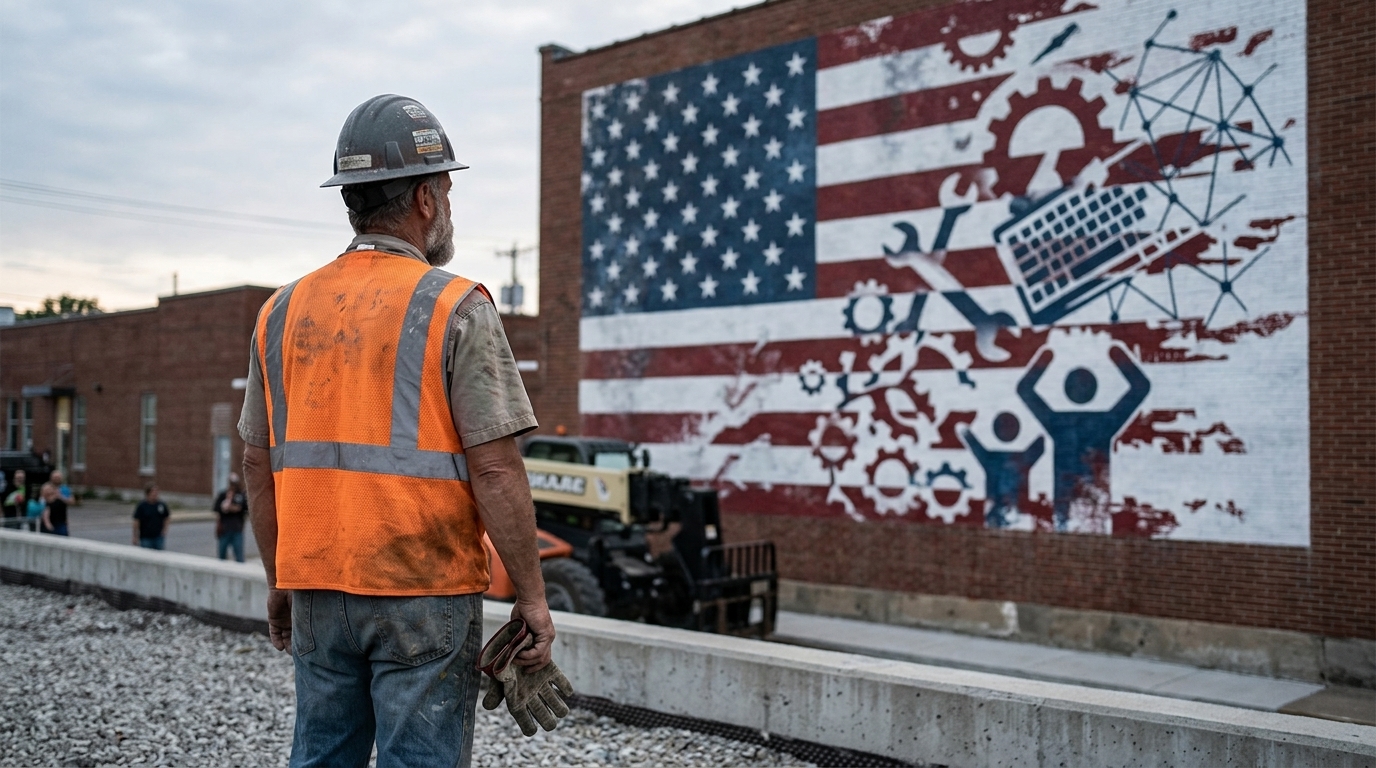
As the United States celebrates its 250th anniversary this July 2026, the nation faces an existential crisis that transcends political polarization or economic fluctuations. For two and a half centuries, American identity has been inextricably linked to one's profession. The question "What do you do?" was never just a social pleasantry; it was a search for an individual's worth within society. Today, the advent of advanced Artificial Intelligence (AI) is dissolving this foundation, signaling the end of an era where toil was the primary means of self-definition.
The Legacy of Toil and the Protestant Work Ethic
American history is built on the idea that hard work leads to prosperity and moral fulfillment. From the pioneers of the frontier to the industrial workers of Detroit and the software engineers of Silicon Valley, work was considered the ultimate duty. This "Protestant work ethic" served as the glue for a nation of immigrants, offering a universal language of success. However, the rapid evolution of large language models and robotics between 2024 and 2026 has made it clear that productivity no longer depends solely on human effort. When a machine can perform in seconds what once required weeks of cognitive labor, the traditional relationship between time, effort, and value collapses.
AI as a Catalyst for Deconstruction
According to recent analyses, such as that by Keith Ferrazzi in Fortune, AI is not merely an automation tool but an "identity destabilizer." The first phase of the digital revolution replaced manual labor; the current phase targets the core of white-collar professions. Lawyers, analysts, content creators, and managers are seeing their skills digitized. This creates a vacuum: If my work is no longer necessary, or if my contribution is negligible compared to an AI's, then who am I? The social status, self-esteem, and daily routines of millions are now in flux.
- The decoupling of productivity from billable hours.
- The urgent need to redefine "value" beyond economic output.
- The psychological strain of perceived "uselessness" in an algorithmic world.
The Identity Void and the Search for New Meaning
The transition to a post-work society is not just an economic issue; it is deeply psychological. In America, work often fills the existential void. Without the structure of a forty-hour week, many feel adrift. Experts warn that unless new forms of social participation are found—such as volunteerism, the arts, community service, or lifelong learning—social cohesion will fray. The challenge for the next 250 years is to build a civilization where dignity does not stem from a paycheck, but from human essence and creativity.
"We must move from an economy of labor to an economy of meaning," analysts suggest.
Toward a New Social Contract
Political leadership is now forced to consider radical solutions like Universal Basic Income (UBI) and shorter work weeks without pay cuts. However, money alone does not solve the identity crisis. An educational reform is required—one that teaches the youth how to "be" rather than just how to "do." America at 250 stands at a crossroads: it will either cling to an obsolete labor model that breeds misery or lead a global shift toward a life centered on humanity rather than the corporate clock.