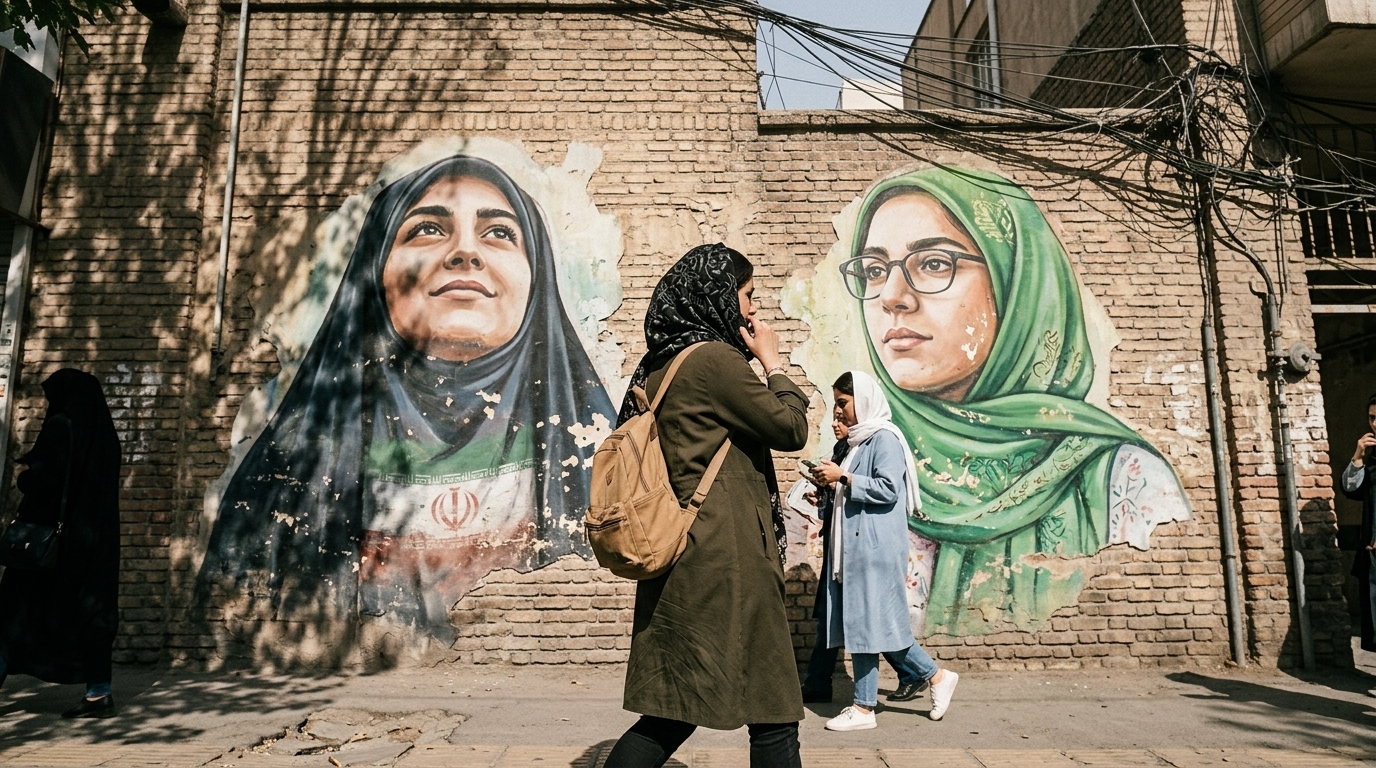
In the dawn of a new era where geopolitics meets digital illusion, the recent case of eight Iranian women whom President Donald Trump claimed to have 'saved' from execution serves as a pivotal turning point. The news, which dominated social media and international news networks, is not just about the fate of these women, but about how Artificial Intelligence (AI) is now being used to construct or amplify political narratives. The case of Bita Hemmati and the other seven women highlights a disturbing reality: in the age of post-truth, salvation can be just as 'artificial' as the image that announces it.
The Anatomy of a Post: Truth Social as a Battlefield
It all began with a post on the Truth Social platform. Trump shared a collage of eight women, claiming that his intervention had prevented their imminent execution by the Iranian regime. However, journalistic investigation quickly revealed that these images were not simple photographs. They were products of AI manipulation, transforming real activists into 'idealized' versions of themselves, or in some cases, creating entirely synthetic faces based on real features. This 'beautification' of pain and danger raises serious ethical questions. Why did these women have to look like models to gain the West's attention?
The use of AI in this context is not merely an aesthetic issue; it is a strategic choice. AI-generated images tend to go viral more easily because they touch on specific psychological archetypes of beauty and vulnerability. In Trump's case, the use of these images functioned as a mechanism to reinforce his role as a 'savior.' When reality is complex and diplomatic processes are slow, AI offers an immediate, visually appealing victory, even if that victory lacks depth or absolute accuracy.
Bita Hemmati: The Real Woman Behind the Pixels
One of the women in the collage, Bita Hemmati, is a real person. Her story is filled with the actual dangers faced by protesters in Iran following the 'Woman, Life, Freedom' movement. However, the image of her circulated by Trump's team had undergone such heavy processing that it rendered her almost unrecognizable. Human rights activists point out that this practice dehumanizes victims. Instead of seeing the fatigue, fear, and determination on the face of a woman facing the gallows, we see a digital mask that fits Instagram standards.
Furthermore, the claim of 'salvation' is being scrutinized for its accuracy. While it is true that international pressure can delay executions, attributing exclusive credit to Trump ignores the work of dozens of organizations and the continuous pressure from the grassroots of Iranian society. AI was used here to simplify a multi-layered geopolitical conflict into a black-and-white scenario of heroes and villains, where the hero is always the user of the platform.
The Dangers of 'AI-fied' Activism
This case opens a Pandora's box for the future of information. If world leaders begin using AI to create visual evidence of their successes, how will citizens be able to distinguish fact from fabrication?
- The erosion of trust: When an image is revealed to be AI-generated, the public tends to doubt the entire news story, even its factual parts.
- Risk to victims: The use of manipulated images can give authoritarian regimes the pretext to claim that all accusations of human rights violations are 'fake news.'
- The commodification of activism: People are turned into digital assets to serve political agendas.
Conclusion: Truth in the Age of AI
The story of the Iranian women and Donald Trump is not just a news item about US foreign policy. It is a warning. Artificial Intelligence has the power to make the invisible visible, but it also has the power to replace reality with a convenient lie. As we move deeper into 2026, our ability to critically analyze the images we consume will be our only defense against a propaganda that knows no bounds, neither ethical nor digital. The women of Iran deserve to be seen exactly as they are: fighters, not digital avatars in a political campaign.