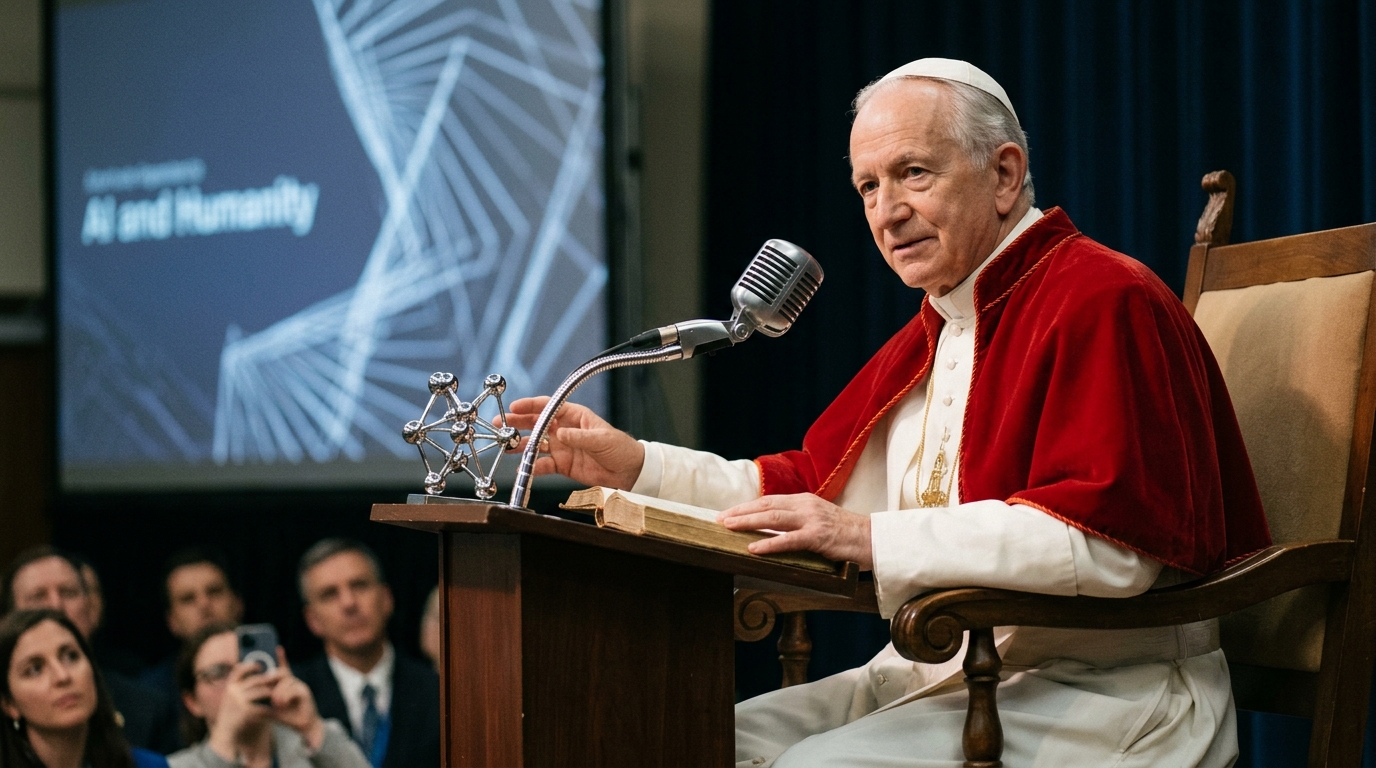
In an era where technological advancement is often conflated with moral progress, the recent intervention by Pope Leo has sent ripples through the global community. With a message described by analysts as 'profound and prophetic,' the Pontiff expressed deep concern over how Artificial Intelligence (AI) could lead to a gradual but irreversible dehumanization of our society. His address, directed at both world leaders and tech titans, was not a mere critique of technology but an existential plea for the preservation of human uniqueness.
The Threat of Dehumanization and the Technocratic Paradigm
Pope Leo centered his critique on what he termed the 'technocratic paradigm'—a worldview where efficiency and optimization take precedence over human value. According to the Pontiff, when decisions concerning life, work, health, and even justice are delegated exclusively to algorithms, the human person risks being reduced to a mere data set. 'A human being is not a data point; they are a mystery,' he remarked, emphasizing that mechanical logic lacks the capacity for mercy, compassion, and moral judgment.
Dehumanization, in the Pope's view, does not occur through a violent upheaval but through the slow erosion of human agency. As people become accustomed to following machine prompts without critical reflection, they lose the ability to choose the good and the just based on conscience. This 'spiritual lethargy' fostered by excessive reliance on AI constitutes, according to the Vatican, the greatest challenge of the 21st century.
'Algoretics': The New Ethics of Machines
One of the most compelling points of the intervention was the introduction and endorsement of the term 'Algoretics.' Pope Leo proposed a framework where ethics are embedded into the very design of algorithms. It is not enough, he argued, to regulate AI use after its creation; ethics must be the 'genetic material' of the technology. Algoretics requires developers and corporations to ask questions about justice, transparency, and inclusion from the earliest stages of model development.
- Transparency in algorithmic decision-making processes.
- Ensuring human oversight (human-in-the-loop).
- Protecting vulnerable groups from algorithmic bias.
- Accountability of creators for the social impact of their tools.
The Pontiff called for an international treaty binding states to these principles, stressing that technology must always serve humanity and not the other way around. His call resonated with many academics and activists who see AI already being used for surveillance and population control in various parts of the world.
The Digital Divide and Global Inequality
Beyond philosophical concerns, Pope Leo focused heavily on the socio-economic implications of AI. He warned that the unchecked development of technology risks widening the gap between rich and poor nations. While developed countries reap the benefits of automation, the Global South may face a new form of 'digital colonialism,' where its resources and data are extracted to train models that do not benefit its people.
Work, as a fundamental element of human dignity, is also under threat. The Pope argued that replacing workers with machines should not be treated solely as an economic issue but as a social crisis. The loss of work means a loss of meaning and participation in the common good. Consequently, he urged governments to invest in education and worker reintegration, ensuring that technological progress leads to a fairer distribution of wealth rather than its concentration in a few hands.
Conclusion: A Call for Hope and Vigilance
Concluding his message, Pope Leo did not appear as an opponent of technology but as a defender of humanity. Artificial Intelligence, he said, is a gift of human intelligence, but every gift carries a massive responsibility. His 'prophetic' warning serves as a compass in an age of uncertainty, reminding us that the heart of progress must remain the human heart. The challenge for humanity is not to defeat the machines, but to avoid becoming machines ourselves in the process.