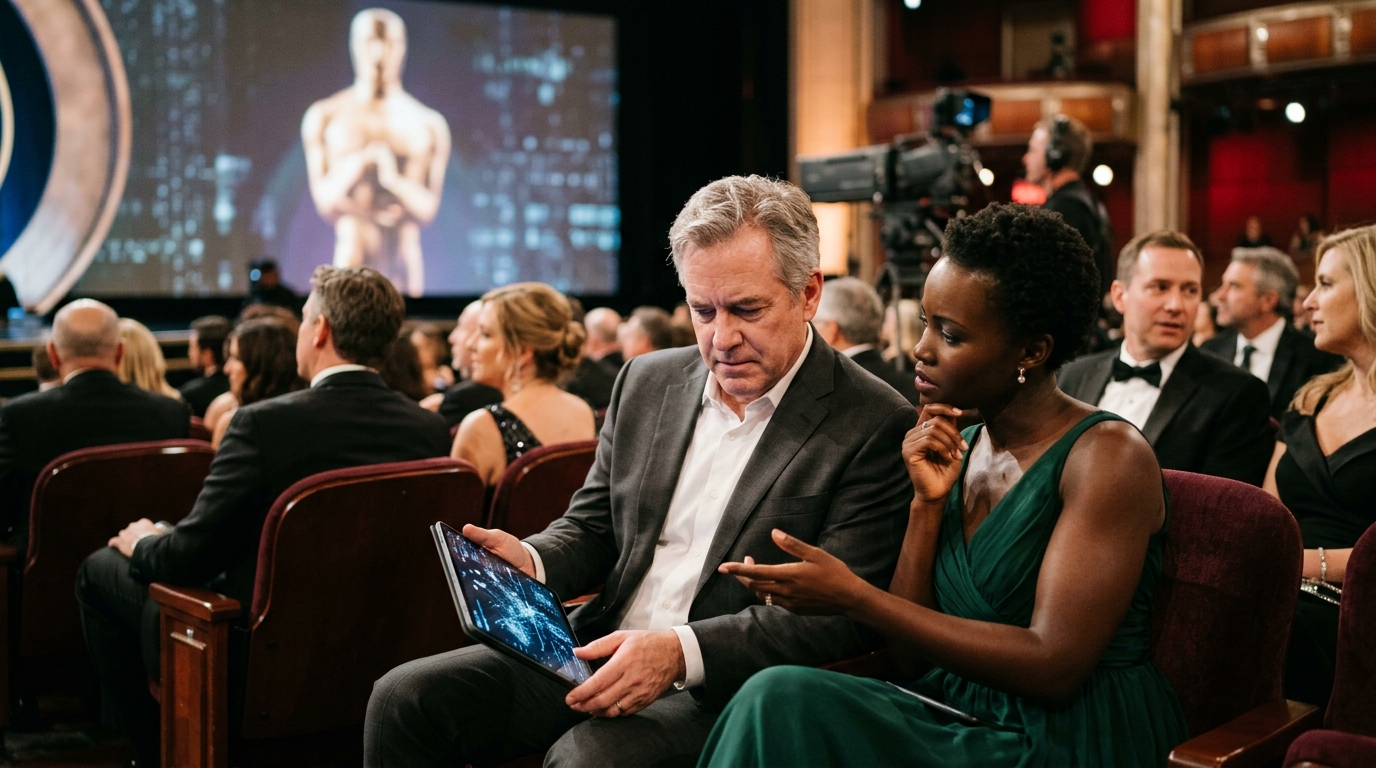
In an era where the digital revolution threatens to blur the lines between reality and simulation, the Academy of Motion Picture Arts and Sciences (AMPAS) has taken a historic stand. With the announcement of new regulations for the 97th Academy Awards, Hollywood is erecting a moral and artistic rampart, signaling that the golden statuette remains the exclusive domain of the human experience. The decision to exclude scripts and performances generated entirely by Artificial Intelligence (AI) from major categories is not merely a bureaucratic adjustment, but an existential declaration about the very nature of art.
Human Primacy in Acting and Writing
The new rules are clear and categorical: to be eligible for acting categories, a nominee must be a human being. This means that digital actors, "synthetic" performers, or characters created entirely through Generative AI are ineligible. The Academy defines acting as a process requiring emotional intelligence, lived experience, and physical presence—elements that an algorithm, no matter how sophisticated, can only mimic, never possess.
Similarly, in the writing categories, the Academy clarifies that only human creators can be credited as screenwriters for award purposes. While the use of AI tools as assistive technology is not explicitly forbidden, the final work must be a product of human intellect. A screenplay written by a Large Language Model (LLM) without significant human intervention will not be deemed eligible. This "filter" aims to protect intellectual property and authenticity, ensuring that storytelling remains an act of communication between humans.
The Legacy of Strikes and Political Pressure
This move by the Academy did not happen in a vacuum. It is the direct result of the epic 2023 strikes by the Screen Actors Guild (SAG-AFTRA) and the Writers Guild of America (WGA). Hollywood's creators fought hard to secure guarantees against the unchecked use of AI, fearing that studios would use the technology to cut costs and replace the workforce with digital clones.
The Academy's new rules essentially institutionalize the gains of those strikes at the level of prestige. If a studio chooses to use a "digital actor" to save money, it must now accept that its film will be automatically disqualified from the industry's most prestigious awards. This creates a powerful economic and reputational disincentive for over-reliance on automated content creation.
The Gray Zone of Visual Effects and Technical Support
Despite the strict prohibitions in "creative" categories, the Academy recognizes that AI is already an integral part of film production, especially in the field of Visual Effects (VFX). Here, the stance is more flexible but requires absolute transparency. Productions using AI tools for de-aging actors (as seen in "The Irishman" or the latest "Indiana Jones") or for creating crowds and environments must explicitly disclose it.
The question that remains is where the "tool" ends and the "creator" begins. If a director uses AI to manipulate an actor's performance at the level of micro-expressions, is it still considered a human performance? The Academy promises to review these cases on a case-by-case basis, establishing a special committee to evaluate the degree of technological intervention. Transparency is becoming the new currency of credibility in the industry.
Conclusion: Art as a Human Sanctuary
The Academy's decision is a victory for empathy. Cinema, at its best, is a mirror of the human condition. Algorithms can analyze patterns, predict hits, and synthesize images, but they cannot feel the pain, joy, or uncertainty that form the core of a great performance. With these new rules, the Oscars remind the world that technology should serve the artist, not replace them. In a world increasingly flooded by the "synthetic," authenticity is becoming the ultimate luxury.