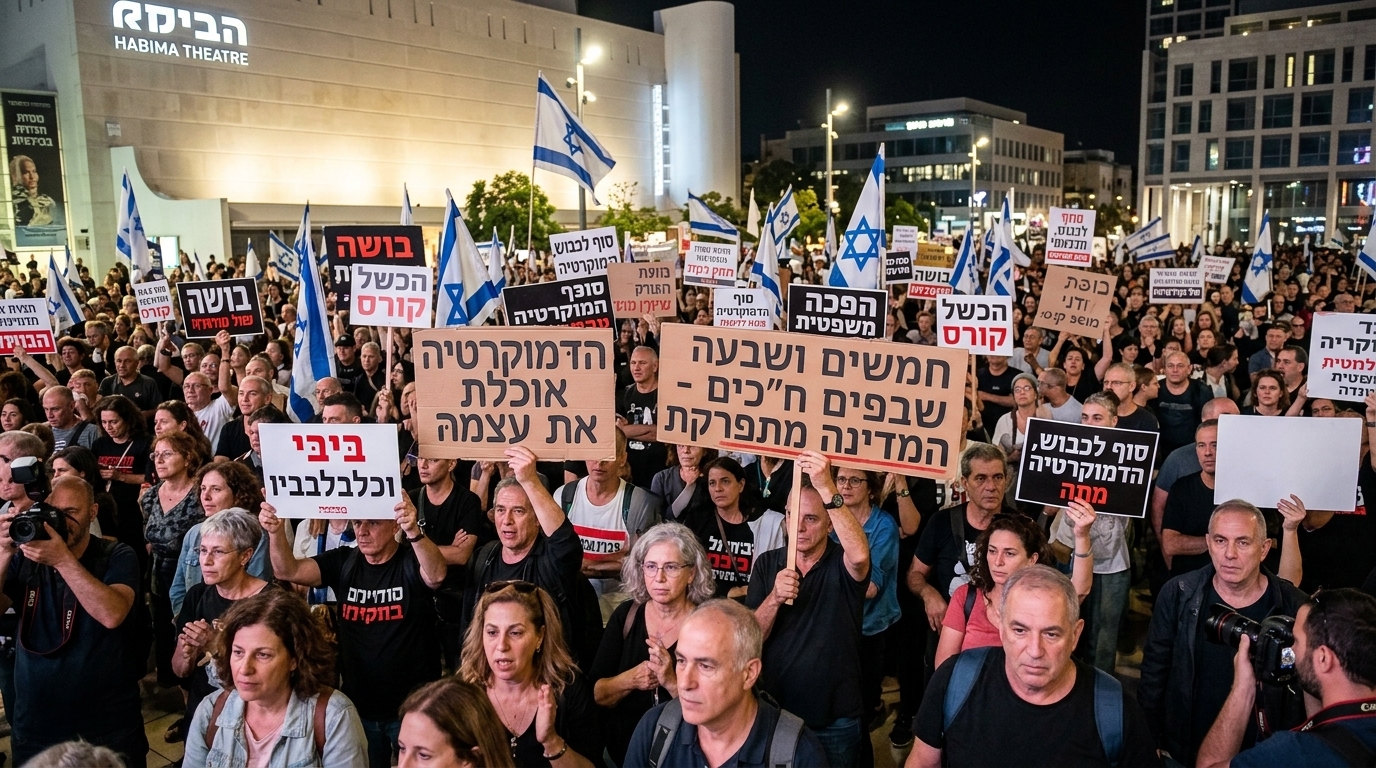
In the heart of Tel Aviv, where Habima Square traditionally serves as the barometer of Israeli democracy, the atmosphere last Saturday was more than just electric. Approximately one thousand citizens—a mosaic of army reservists, students, and relatives of hostages—gathered to express a simmered rage that has boiled for decades but has now taken the form of an existential crisis for the State of Israel. The cause? The Benjamin Netanyahu government's attempt to codify the exemption of Ultra-Orthodox Jews (Haredim) from mandatory military service, at a time when the nation remains in a perpetual state of war.
The 'Equality of Burden' Crisis
For the average Israeli, military service is not merely a legal obligation; it is the bedrock of the social contract. In a country surrounded by hostile fronts, the idea that a large and rapidly growing segment of the population can abstain from national defense for religious reasons is causing irreparable fractures. Protesters at Habima Square were not just chanting against Netanyahu, but against an injustice they feel threatens the very viability of the state. "We cannot be the only ones sending our children to battle," read a banner held by a reservist who had recently returned from the front lines.
The legal dimension of the issue is equally complex. Israel's Supreme Court has repeatedly ruled that mass exemptions for Yeshiva (religious school) students are discriminatory and unconstitutional. However, Netanyahu, whose political survival depends entirely on the support of ultra-Orthodox parties like Shas and United Torah Judaism, is attempting a legislative maneuver to maintain the status quo. This political "hostage-taking" of the Prime Minister by his religious partners has become the central point of friction with the country's liberal and secular base.
Political Survival on a Tightrope
Israel's coalition government resembles an architect trying to build a house of cards in the middle of a storm. On one side, the Haredim threaten to topple the government if forced into conscription. On the other, centrist ministers like Benny Gantz face immense pressure from their constituents to quit the cabinet unless there is a fair distribution of the national burden. The Tel Aviv demonstration is merely the tip of the iceberg of a broader discontent that also includes the perceived failure to secure a deal for the release of hostages held by Hamas.
Analysts point out that Netanyahu is in the most precarious position of his long career. His "divide and rule" strategy appears to be hitting a wall, as social pressure shifts from the streets into the cabinet room itself. The government's refusal to call for early elections, despite polls showing a crushing defeat for Likud, reinforces the protesters' belief that the Prime Minister is prioritizing personal survival over national interest.
The Social Dimension and the Future
The issue of Haredi conscription is not just military; it is deeply economic and cultural. Ultra-Orthodox communities have the highest birth rates in Israel, meaning that in a few decades, they will constitute a quarter of the population. If this group remains outside the workforce and the military, the economic and defensive backbone of the country risks collapse. The protesters in Tel Aviv are acutely aware of this. Their mobilization is not just a political protest but a cry of anguish regarding the identity of Israel in 2030 and 2040.
In conclusion, the hundreds who gathered at Habima Square represent a significant portion of society that feels betrayed. The Netanyahu government is tasked with squaring the circle: satisfying its religious partners without leading the country into an internal civil schism. With the memories of October 7th still fresh and casualties on the front rising, tolerance for inequality has reached its nadir. The coming weeks will be decisive in determining whether the government can withstand the tremors or if the streets of Tel Aviv will become the harbinger of a new political era.