As we navigate the landscape of 2026, humanity faces a profound epistemological crisis: the total collapse of the "seeing is believing" paradigm. The rapid proliferation of deepfakes—synthetic media generated by Artificial Intelligence—has transcended being a mere technological curiosity or entertainment tool. It is now an existential threat to informational integrity, democratic stability, and social cohesion. Recent reports, including analysis from Vietnam.vn, highlight a stark reality: the race to fight fire with fire in the digital realm has entered a new, aggressive phase.
The Technological Escalation: From Lab to Living Room
Only a few years ago, creating a convincing deepfake required specialized programming knowledge and immense computational power. Today, the production of hyper-realistic video and audio is accessible to anyone with an internet connection and a mid-range smartphone. The democratization of Generative AI tools has acted as a catalyst for an explosion of content that blurs the lines between reality and fabrication.
The problem is no longer confined to "face-swapped" celebrity parodies. The threat has migrated to far more dangerous territories:
- Political Manipulation: During the election cycles of 2024 and 2025, deepfakes were weaponized to defame candidates, spread false statements attributed to world leaders, and suppress voter turnout through targeted misinformation.
- Financial Fraud: Corporations are losing billions to enhanced Business Email Compromise (BEC) attacks, where cloned voices of executives are used in phone calls or video conferences to authorize fraudulent transfers.
- Social Engineering: The use of deepfakes for non-consensual synthetic imagery remains one of the most heinous applications of the technology, devastating lives and undermining human dignity.
Fighting Fire with Fire: The Rise of AI Detection
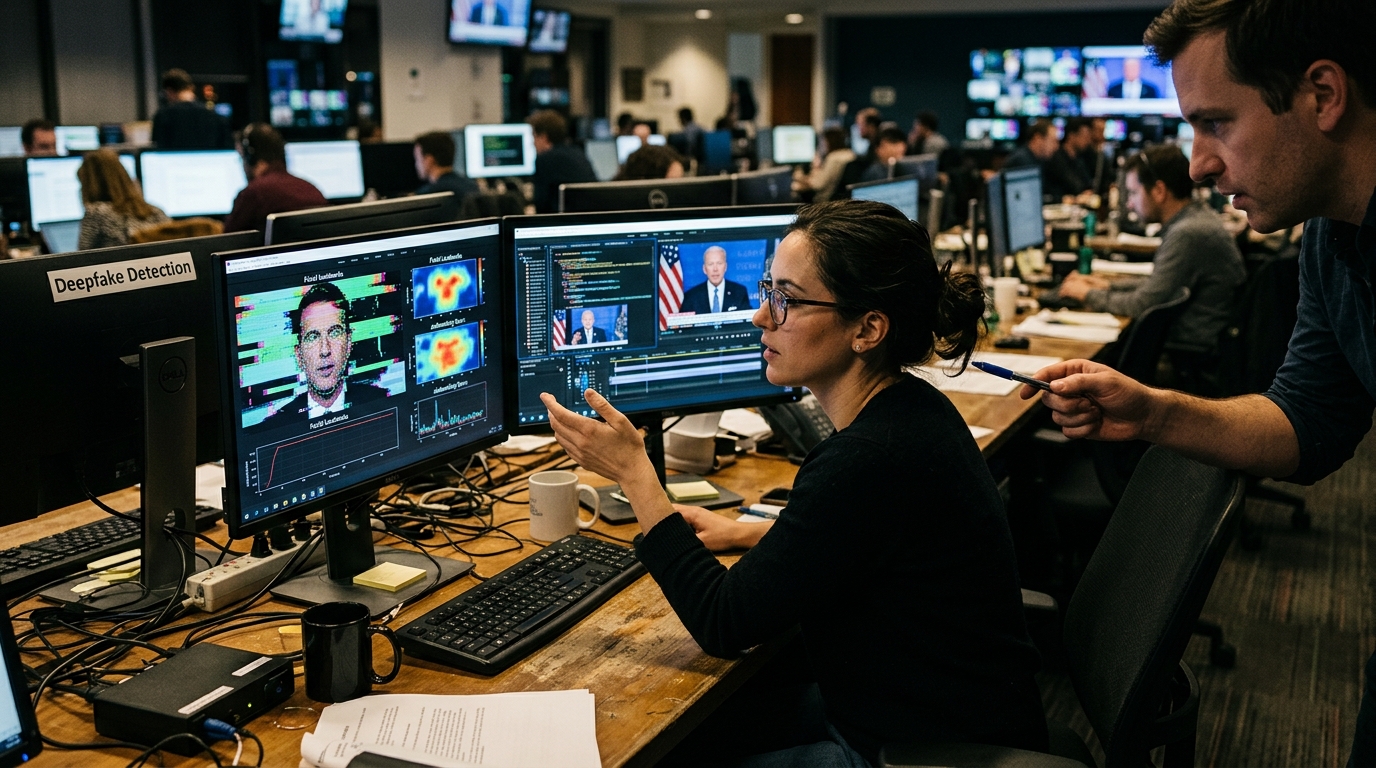
The response to the deepfake threat cannot be manual. The sheer volume of data generated daily means that only AI itself can hope to identify the microscopic anomalies that betray a synthetic creation. We are witnessing an algorithmic "War of the Roses," where generative models (GANs) strive to deceive detection algorithms, which in turn become increasingly sophisticated.
New detection techniques focus on details the human eye cannot perceive. For instance, they analyze blood flow in the face (photoplethysmography) which causes subtle skin color changes, or examine inconsistencies in light reflections within the cornea. However, the cat-and-mouse game persists: the moment a detector becomes effective, deepfake creators train their models to bypass those specific checkpoints.
Institutional Safeguards and the C2PA Protocol
Beyond pure technology, a solution is being sought in provenance transparency. The Coalition for Content Provenance and Authenticity (C2PA) promotes the use of digital watermarks and metadata that record a media file's history from the moment of capture. Tech giants like Adobe, Microsoft, and Google have begun integrating these standards, allowing users to verify if a file has been altered by AI.
"We are no longer in a battle for what is real, but in a battle for what is trustworthy. Trust is the new global currency," say digital ethics analysts.
The European Union, through the AI Act, imposes strict labeling obligations for AI-generated content. However, legislation often lags behind technological leaps, and malicious actors rarely comply with ethical frameworks or voluntary standards.
The 'Liar's Dividend' and Societal Resilience
One of the most insidious consequences of the deepfake surge is the so-called "Liar’s Dividend." As the public becomes aware that anything can be faked, actual wrongdoers can claim that genuine evidence—such as a video showing them committing a crime—is actually a deepfake. This erosion of objective truth is perhaps more dangerous than the fake content itself.
The final line of defense remains the human element. Digital literacy and critical thinking are essential for navigating this new landscape. We must learn to question the source, cross-reference information, and resist reacting impulsively to content designed to trigger high emotional states. The fight against deepfakes will not be won solely in computer labs; it will be won in classrooms and newsrooms where the value of verified truth is upheld.