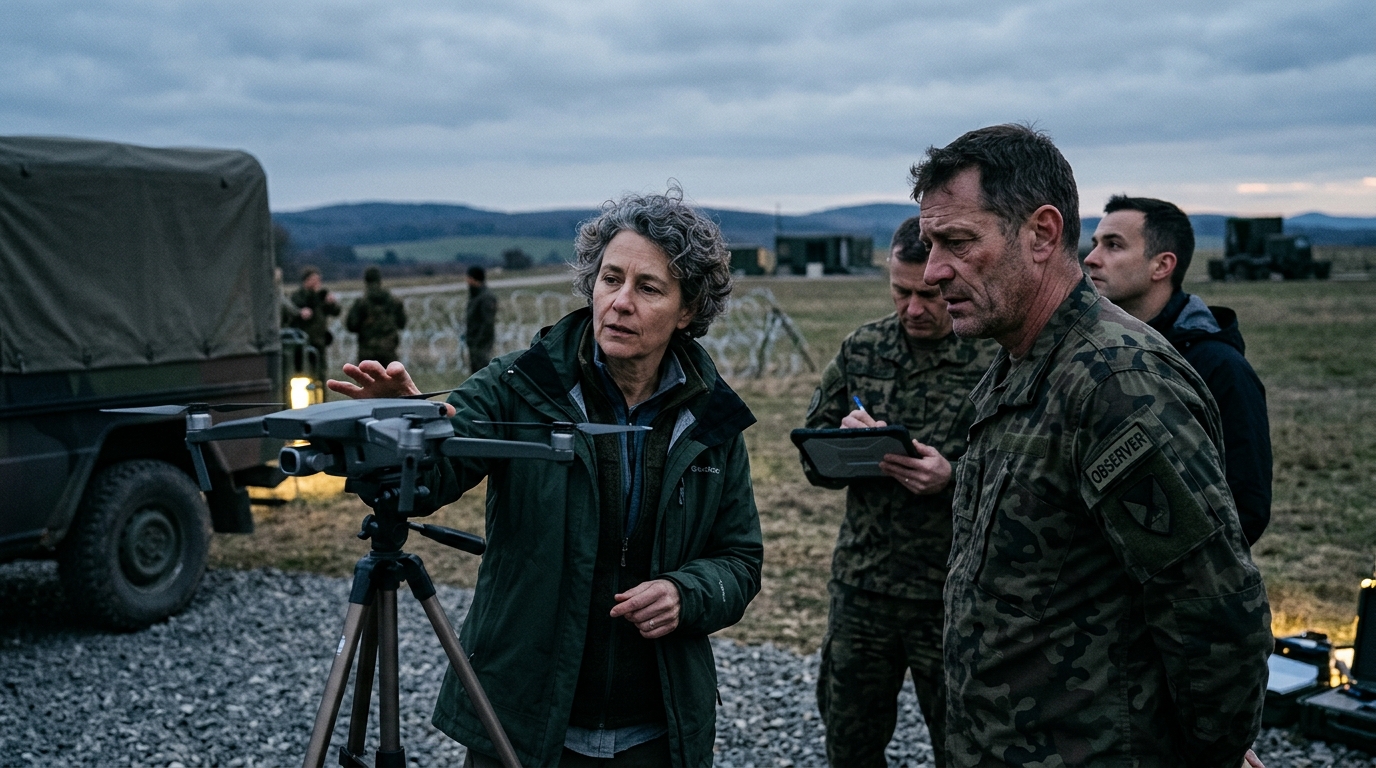
The dawn of the third revolution in warfare—following gunpowder and nuclear weapons—is now upon us. Unmanned aerial vehicles (drones) enhanced by Artificial Intelligence (AI) are no longer a science fiction scenario but a harsh reality reshaping battlefields from Ukraine to the Middle East. However, the speed of technological evolution has far outpaced the ability of international legal frameworks to regulate their use, creating a dangerous accountability gap.
From Remote Control to Autonomy
Traditionally, drones operated on the principle of "human-in-the-loop." A pilot, often thousands of miles away, made the final decision to use force. Modern AI drones, however, are moving toward "human-on-the-loop" or even "human-out-of-the-loop" models. These systems use machine learning algorithms and computer vision to detect, identify, and target enemy forces without direct human intervention.
Their operation is based on vast databases of images and behavioral patterns. The drone is "trained" to recognize the silhouette of a battle tank, the thermal signature of a radar station, or even specific facial features. In electronic warfare conditions, where communications with the base station are often disrupted by jamming, autonomy becomes a necessity for the asset's survival, but simultaneously a source of immense risk.
The Challenge of International Humanitarian Law
The foundation of International Humanitarian Law (IHL) rests on three core principles: distinction, proportionality, and precaution. AI drones face massive difficulties in all three. The principle of distinction requires belligerents to distinguish between combatants and civilians. Can an algorithm distinguish a soldier holding a rifle from a farmer holding a tool? Can it recognize the difference between a wounded soldier surrendering and one in a fighting position?
Proportionality is even more complex. It requires a subjective judgment on whether the expected military advantage outweighs the potential collateral loss of civilian life. This balancing of values is inherently human and context-dependent, something current algorithms—no matter how sophisticated—fail to fully simulate. The result is warfare conducted with statistical probabilities instead of moral judgment.
The Accountability Gap and the "Black Box"
One of the most disturbing issues is the assignment of responsibility in the event of a war crime. If an autonomous drone strikes a refugee camp due to an algorithmic error, who is to blame? The programmer who wrote the code? The company that manufactured the hardware? The commander who ordered the system's deployment? Or the machine itself, which is legally impossible?
Deep learning algorithms often function as "black boxes." Even their creators cannot always explain why the system made a specific decision at a given moment. This lack of transparency makes the delivery of justice nearly impossible, undermining international law and encouraging impunity.
Geopolitical Competition and the Need for a Treaty
Despite calls from the "Stop Killer Robots" campaign and numerous scientists, major powers (USA, China, Russia) resist a full ban on autonomous weapons. The fear that an adversary will gain a technological advantage is driving a new arms race. In Ukraine, we have witnessed the first wide-scale use of AI-enabled drones to counter jamming, proving that the "genie is out of the bottle."
The international community must urgently agree on a legally binding framework that mandates "meaningful human control" over every attack. Technology must serve humanity, not replace it in its most critical and darkest moments. Without clear rules, the warfare of the future risks becoming a mechanical process of extermination without a trace of humanism.