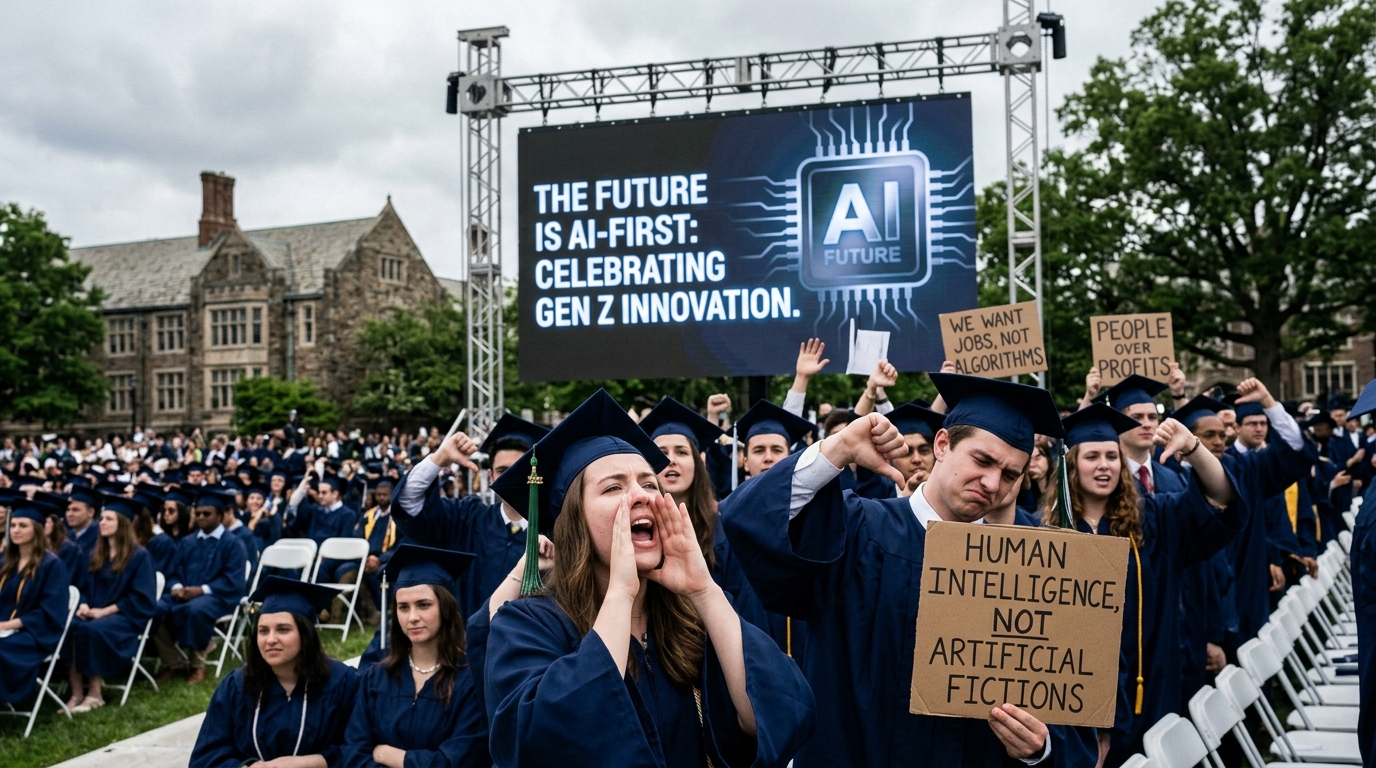
The scene is a familiar one: thousands of students in caps and gowns, ready to celebrate the culmination of years of hard work. However, this year, the traditional applause has frequently been replaced by a loud, collective boo. The object of this ire? Not necessarily the speaker themselves, but the underlying message: the relentless promotion of Artificial Intelligence (AI) as the singular solution for the future. What began as a technological revolution is evolving into an existential crisis for a generation that sees its degrees threatened by algorithms before the ink is even dry.
The Crisis of Authenticity and the Loss of Ritual
For the Class of 2026, AI is not an abstract concept but a tool that has already begun to reshape their education. When a university president or a commencement speaker delivers a speech that sounds like it was 'written by ChatGPT,' or suggests that creativity will soon be replaced by 'prompt engineering,' the backlash is immediate. Students feel that the very essence of a liberal arts education—critical thinking and original expression—is being reduced to a series of data points.
The boos at commencement ceremonies, seen recently at major institutions across the U.S. and Europe, represent a symbolic rejection of this technocratic worldview. Young people are demanding authenticity. In an era dominated by deepfakes and automated content, the graduation ceremony remains one of the few 'sacred' human milestones. The intrusion of AI into this space is viewed by many as a desecration of their personal journey and effort.
Economic Anxiety and the Threat of Automation
Beyond the ethical and philosophical concerns lies a much harsher reality: the job market. Gen Z is the first generation to enter a workforce where entry-level positions are rapidly being automated. Fields like writing, coding, graphic design, and data analysis—traditional havens for new graduates—are under immense pressure from Large Language Models (LLMs).
- A decrease in internship opportunities as routine tasks are automated.
- A perception that employers prioritize cheap AI over investing in new human talent.
- Widespread uncertainty regarding the long-term value of specialized academic knowledge.
When commencement speakers praise AI without acknowledging these visceral fears, they appear dangerously out of touch. Students do not view AI merely as an 'assistant' but as a competitor that never sleeps and requires no salary, making their struggle for career stability feel rigged from the start.
The Ethical Responsibility of Academic Institutions
Universities are caught in a difficult bind. On one hand, they must prepare students for a tech-dominated world. On the other, their rush to adopt AI often bypasses crucial ethical debates. The use of AI in student assessments or the encouragement of its use in essay writing has created an environment where 'excellence' is increasingly measured by one's ability to manipulate a machine, rather than the depth of their intellect.
"We didn't study for four years to become editors for machine-generated text. We studied to learn how to think," remarked one Duke graduate following a recent protest.
The challenge for the future is finding a balance. Artificial Intelligence is not going away, but its integration into society must occur on terms that respect human dignity and intellectual property. The commencement boos are a flare in the night: if technology continues to be pushed at the expense of the human experience, the resistance will only grow more defiant.