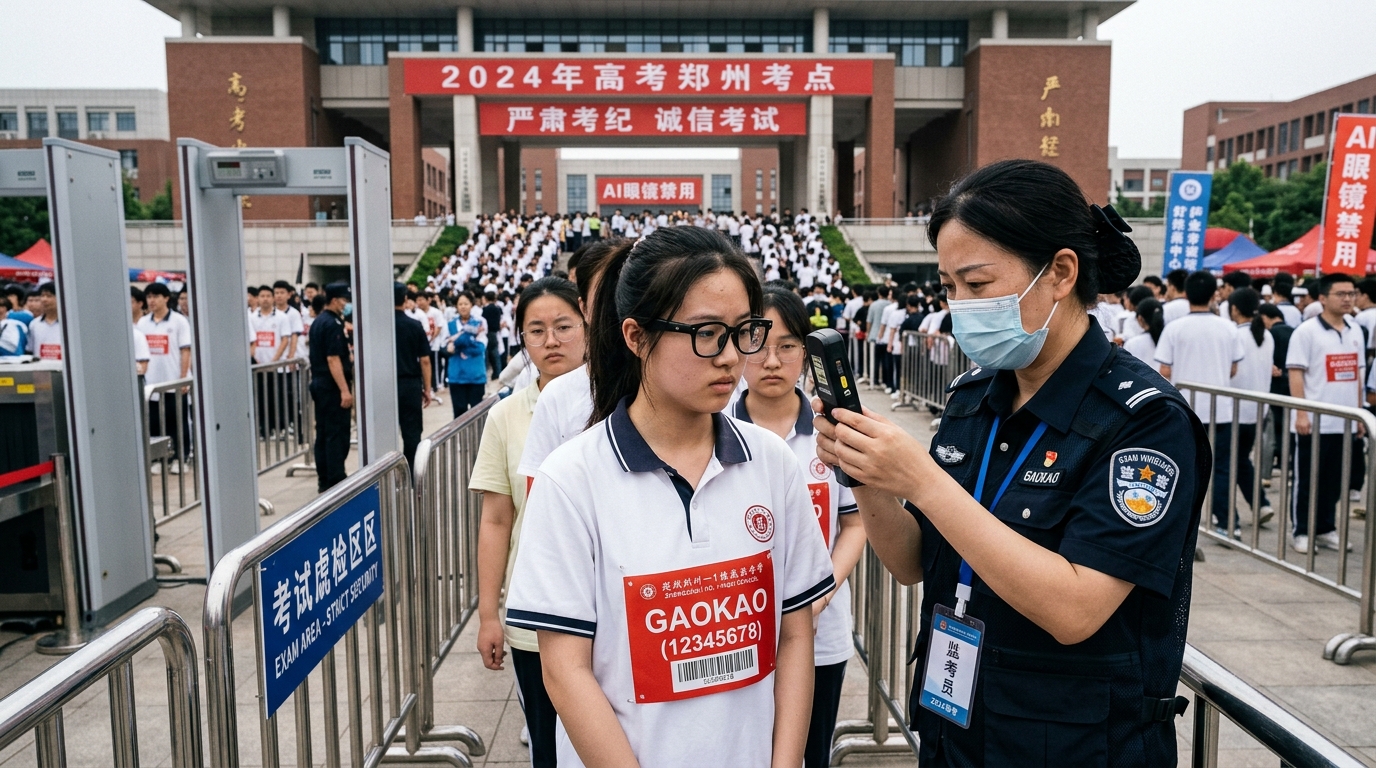
In China, the Gaokao is not merely an exam; it is a rite of passage, a national destiny-shaping event that determines the social and economic trajectory of millions of young people. As the country enters the 2026 examination season, a new threat has put the Ministry of Education on high alert: AI-powered smart glasses. The news that examination centers across the country are now implementing mandatory physical inspections of candidates' prescription eyewear highlights the escalation of a technological "arms race" between authorities and those seeking to bypass the system.
The Miniaturization of Deception
For decades, combating cheating in the Gaokao involved metal detectors, signal jammers, and facial recognition cameras. However, rapid advancements in multimodal artificial intelligence have shifted the paradigm. Modern AI glasses, which are indistinguishable from ordinary eyewear, now integrate microscopic 4K cameras, bone-conduction speakers, and direct links to Large Language Models (LLMs). A candidate can simply glance at the exam paper, and the device, via Optical Character Recognition (OCR), sends the query to an AI server, receiving an answer in seconds through whispers that only the wearer can hear.
Reports from Asia indicate that the market for exam "aids" has moved to the dark web, where glasses that bypass traditional radio frequency detectors using encrypted low-power protocols are openly advertised. This development has forced authorities in provinces like Guangdong and Shandong to establish physical checkpoints where proctors examine the weight, temple thickness, and the presence of hidden charging ports on students' glasses.
Ethical and Social Pressure
The issue transcends simple technological policing. At the heart of the problem lies the crushing pressure exerted by the Chinese educational system. With youth unemployment remaining high and competition for spots at top-tier universities becoming more cutthroat, ethical boundaries often crumble in the face of desperation. The use of AI glasses is no longer seen by some as "theft," but as a necessary "weapon" in an unequal war.
However, the ethical dimension of universal suspicion is problematic. Thousands of students with genuine vision impairments feel humiliated by the inspection process. "We are treated as potential criminals before we even sit at the desk," one candidate wrote on a Chinese social media platform. The balance between ensuring integrity and respecting the dignity of students is becoming increasingly fragile.
The State's Response
Beijing has responded with a "zero tolerance" policy. Penalties for cheating in the Gaokao include not only bans from future exams but also criminal prosecution, which can lead to imprisonment for up to seven years. Furthermore, the use of AI to monitor the exams themselves has intensified. AI systems now analyze the eye and body movements of candidates in real-time via security cameras, looking for "abnormal behavior patterns" that could indicate the use of smart devices.
- Rigorous inspection of frame structures for hidden circuits.
- Deployment of AI surveillance to detect gaze patterns directed at unauthorized points.
- Stricter legislation regarding the sale of spy-grade electronic equipment.
- Enhanced signal jamming to cover 5G and Wi-Fi 6 frequencies.
The Future of Academic Assessment
The AI glasses crisis in the Gaokao raises a broader question: Can traditional memorization-based exams survive in a world where knowledge is instantly accessible through wearable tech? Many analysts argue that instead of investing in increasingly repressive surveillance measures, we should redesign the way we assess intelligence. If AI can solve Gaokao questions in seconds, then perhaps the value we place on these specific skills is becoming obsolete.
In conclusion, the inspection of eyewear in China is just the tip of the iceberg. As technology becomes part of our bodies—from smart contact lenses to neural interfaces—the concept of a "closed exam hall" will soon seem like an anachronism. China, acting as a laboratory for the future, is showing us today the challenges the entire world will soon face.