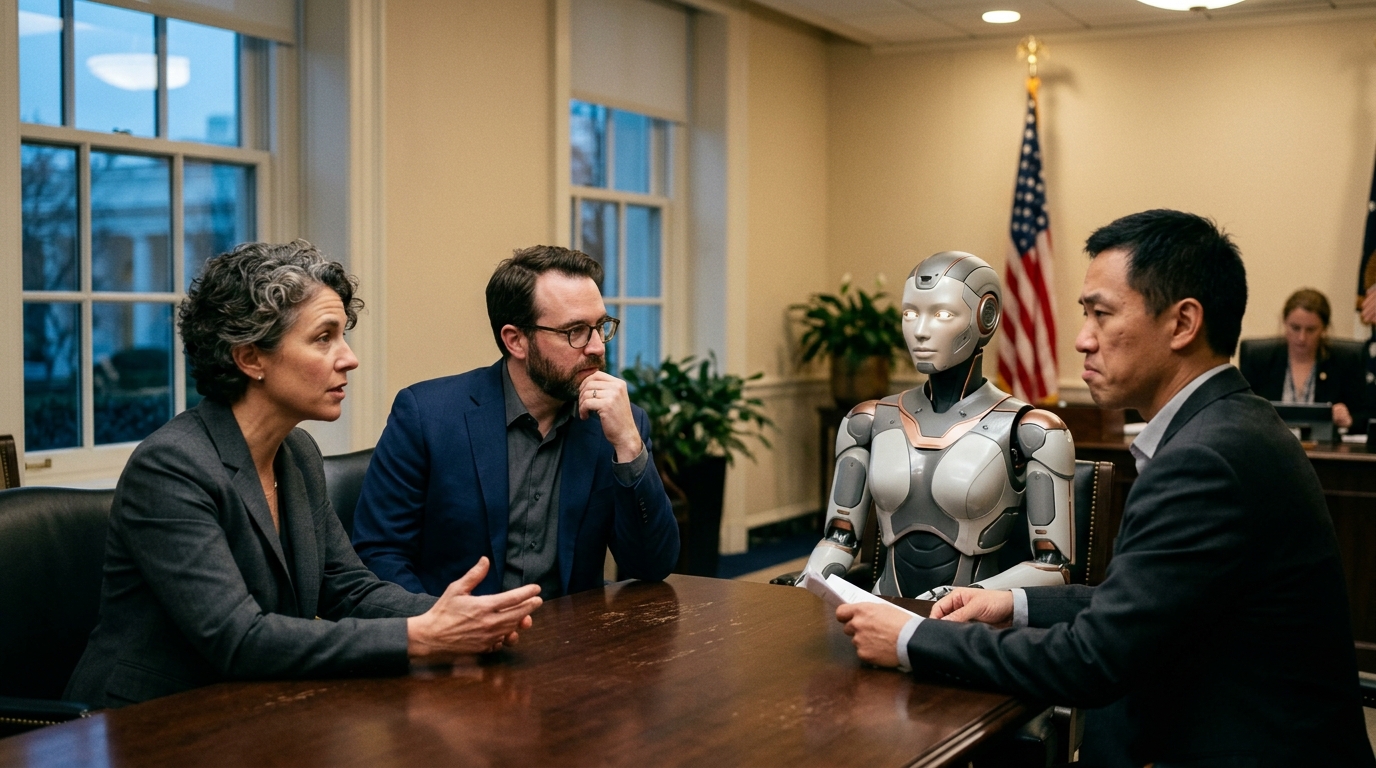
In the corridors of power in Washington D.C., the atmosphere surrounding Artificial Intelligence (AI) has shifted from awe to apprehension and, now, to the necessity of a structured coexistence. The upcoming meeting between Anthropic executives and White House representatives is not merely a routine briefing; it represents an attempt to "make peace" in a field where innovation consistently outpaces legislation. Anthropic, the company behind the Claude model, which bills itself as the industry's "safety-first" player, finds itself at a critical crossroads, attempting to balance government demands for transparency with the survival instincts required in a hyper-competitive market.
The Political Backdrop and the Urge to Regulate
The Biden-Harris administration has made it clear, via the 2023 Executive Order, that AI is a top-tier national security priority. However, the relationship with tech firms has remained fraught with tension. On one hand, the White House is pushing for more rigorous testing of "dual-use" models—those capable of being used for both beneficial purposes and malicious ends, such as cyberattacks or the synthesis of biological agents. On the other hand, companies like Anthropic fear that over-regulation could stifle innovation, handing a decisive lead to global rivals, most notably China.
Friday's meeting aims to smooth over these frictions. According to sources close to the matter, the focus will be on the implementation of voluntary commitments made by AI labs, as well as the transition toward a more binding oversight framework. Anthropic, founded by former OpenAI researchers who left specifically over safety concerns, is seen as a natural interlocutor for the government. Yet, even this "ethical" positioning does not exempt them from the scrutiny of regulators demanding deeper access to source code and training datasets.
Constitutional AI vs. State Oversight
A central point of discussion is Anthropic’s proprietary approach known as "Constitutional AI." This method involves training a model to follow a set of principles—a constitution—to self-regulate its outputs. While this sounds reassuring, government officials are increasingly asking: Who writes this constitution? Are the values of a private corporation inherently aligned with the public interest? The meeting is expected to touch upon how much state involvement is necessary in defining these foundational principles.
- Algorithmic transparency and pre-release access for the AI Safety Institute.
- Copyright protection and the ethical sourcing of training data from the public web.
- Preventing the use of AI in generating sophisticated disinformation during election cycles.
Anthropic has already committed to external audits, but the administration is looking for something more permanent. The "peace" being sought is not just about avoiding fines; it is about building an ecosystem where government funding and legal frameworks move in lockstep with technological breakthroughs.
Geopolitics and the Silicon Shield
One cannot analyze the Anthropic-White House dynamic without considering the geopolitical landscape. Washington views AI as the "new nuclear weapon" of the digital age. There is a pervasive fear that if American companies are tied down by red tape, China will fill the void, developing powerful models without any ethical constraints. This provides companies like Anthropic with a powerful bargaining chip: "Let us innovate, or the West falls behind."
"Safety is not an obstacle to progress, but a prerequisite for it. If the public loses trust in AI, the entire industry will collapse," an Anthropic executive recently stated.
This rhetoric aligns with the White House's desire for America to lead in setting global AI standards. Friday's meeting will determine whether this alignment is substantive or merely a temporary truce before a new wave of regulatory clashes.
Conclusion: Toward a New Social Contract?
The outcome of this meeting will send a signal across Silicon Valley. If Anthropic manages to "make peace" with the White House, it will create a blueprint for how AI companies can operate under state oversight without losing their competitive edge. If disagreements persist, however, we may see an escalation in legal and legislative pressure.
Ultimately, what is at stake is the democratic governance of technology. As AI models become more capable, the need for an arbiter representing the public interest becomes undeniable. Anthropic and the White House must prove that technology and democracy can coexist, ensuring that the future of intelligence is not only artificial but also human-centric.