As we navigate the academic landscape of June 2026, Artificial Intelligence (AI) has transitioned from a disruptive novelty to an omnipresent utility in higher education. Yet, beneath the veneer of efficiency and the democratization of information, a more insidious crisis is brewing. A recent analysis by Times Higher Education suggests that AI is not merely automating tasks; it is systematically eroding the intellectual confidence of the modern student.
The Paradox of Frictionless Learning
For centuries, the 'blank page' served as the first crucible of intellectual development. The struggle to articulate a complex thought, the frustration of a failed draft, and the eventual breakthrough were not just obstacles to be overcome—they were the very mechanisms of growth. This 'cognitive friction' is what builds intellectual self-efficacy: the belief in one's capacity to execute the behaviors necessary to produce specific performance attainments.
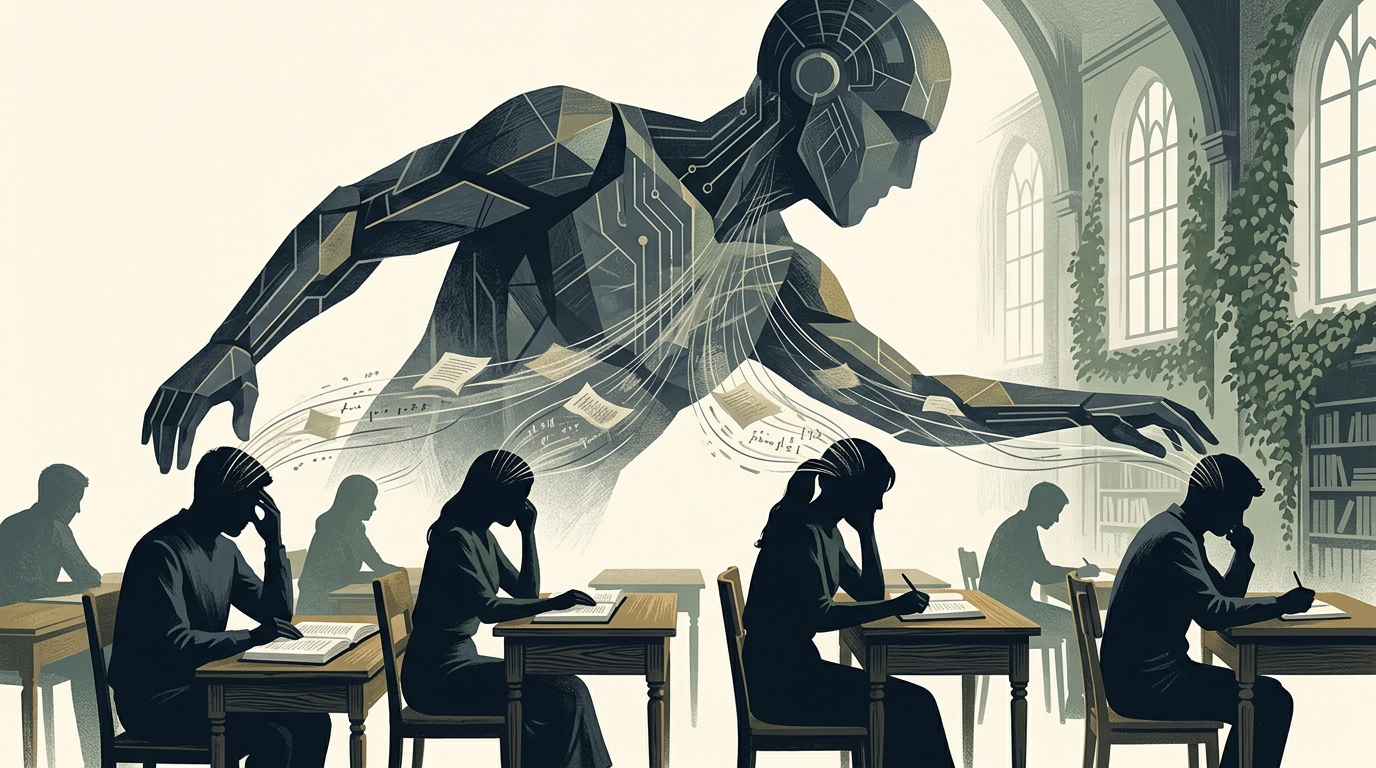
With the advent of sophisticated Large Language Models, this friction has been largely eliminated. Students can now bypass the messy, iterative process of thinking by prompting a machine to generate a structured argument. While this increases output, it diminishes the sense of agency. When a student submits a paper heavily assisted by AI, a psychological disconnect occurs. They may receive an 'A,' but they know, at a fundamental level, that the brilliance was borrowed. This fosters a pervasive form of imposter syndrome that can haunt a student's entire professional career.
The Atrophy of the Inner Voice
Intellectual confidence is closely tied to the development of an 'inner voice'—that internal dialogue used to parse complex information and form independent judgments. The Times Higher Education report highlights a disturbing trend: students are increasingly outsourcing their internal dialogue to AI tools. Instead of wrestling with a difficult text by Kant or a complex theorem in physics, they ask the AI for a summary.
- The loss of struggle leads to a fragile understanding of subject matter.
- Reliance on AI creates an 'illusion of competence,' where students mistake access to information for the mastery of knowledge.
- The ability to handle intellectual ambiguity and confusion—essential for innovation—is being sacrificed for the sake of speed.
The result is a generation of graduates who possess credentials but lack the core belief that they can solve a problem from first principles without digital assistance. They are becoming 'curators' of machine-generated thought rather than 'originators' of human insight.
The Editing Trap: Why Prompting is Not Thinking
There is a popular narrative in 2026 that we are moving toward a 'prompt engineering' economy, where the skill lies in directing the AI. Proponents argue that students should focus on high-level oversight rather than the 'drudgery' of writing or calculating. However, this argument ignores a fundamental pedagogical truth: you cannot effectively edit what you do not deeply understand.
"AI gives us the answer but robs us of the question. In education, the process of arriving at the answer is infinitely more valuable than the answer itself," notes a senior academic in the Times Higher Education feature.
When students use AI as a starting point, they are confined by the probabilistic boundaries of the model. They lose the opportunity to make the unique, idiosyncratic connections that define human genius. Intellectual confidence is forged in the fire of independent effort; by removing the heat, we are left with a cold, hollow imitation of learning.
Reclaiming the Academic Spirit
How must universities respond to this erosion of confidence? The challenge is not technological, but cultural and pedagogical. We must redefine what it means to be an 'educated person' in the age of AI. This requires a shift away from output-oriented assessment toward process-oriented learning.
- Reintroducing high-stakes oral examinations and in-class, handwritten assessments.
- Valuing the 'provenance of thought'—requiring students to show the evolution of their ideas through drafts and reflective journals.
- Creating assignments that demand lived experience, local context, and primary research that cannot be hallucinated or synthesized by an LLM.
The goal of education has never been the mere production of documents; it has been the cultivation of the mind. If we allow AI to become the primary architect of student thought, we risk creating a future where human intelligence is a secondary, decorative element to algorithmic processing. To restore intellectual confidence, we must restore the necessity of the struggle.