The recent discourse in the Los Angeles Times letters section has illuminated one of the most pressing issues of our time: the integration of Artificial Intelligence (AI) within the classroom. While initial panic led many educational institutions to impose hasty bans, public opinion and experts are beginning to converge on a more nuanced approach. AI is not merely a tool for plagiarism; it is a technological revolution that demands a fundamental rethink of our educational model.
The Failure of Prohibition in the Digital Age
Historically, every new technology that threatened the status quo of learning was met with suspicion. From the invention of the printing press, which was feared to destroy memory, to the introduction of pocket calculators in the 1970s, the first reaction of the educational establishment has often been to ban. However, history teaches us that technology does not retreat. Today, attempting to keep Generative AI out of schools is akin to trying to hold back the tide with one's bare hands.
Students are already using these tools outside of school hours. A total ban within institutional walls creates a dangerous disconnect between academic theory and social reality. Furthermore, it exacerbates social inequalities: privileged students will learn to master AI at home with private guidance, while the less fortunate will remain digitally illiterate, following rules that will soon be obsolete in the professional world.
Ethical Dilemmas and the Challenge of Integrity
We cannot, of course, ignore the risks. The ethical dimension of AI usage is multi-layered. Plagiarism is the most obvious concern, but there is something deeper: the erosion of critical thinking. If a student delegates the synthesis of their ideas to an algorithm, they lose the process of intellectual "fermentation" required for character development. As many letter writers point out, AI can provide correct answers, but it cannot teach the value of the question.
"Education is not the filling of a pail, but the lighting of a fire. AI can be the fuel, but the educator must remain the spark."
Moreover, there is the issue of algorithmic bias. AI models are trained on datasets that often contain racial, social, and cultural prejudices. If schools do not teach students how to critically approach AI outputs, we risk creating a generation that accepts algorithmic "truth" as gospel. The ethical use of AI requires what we call "Critical AI Literacy."
Redefining the Teacher's Role
Integrating AI into schools does not mean replacing the teacher; it means liberating them from bureaucratic and repetitive tasks. AI can function as a personal tutor for every student, offering personalized support that a teacher in a class of 25 is humanly unable to provide. It can explain a mathematical concept in ten different ways until it clicks, or help a student with learning disabilities structure their thoughts.
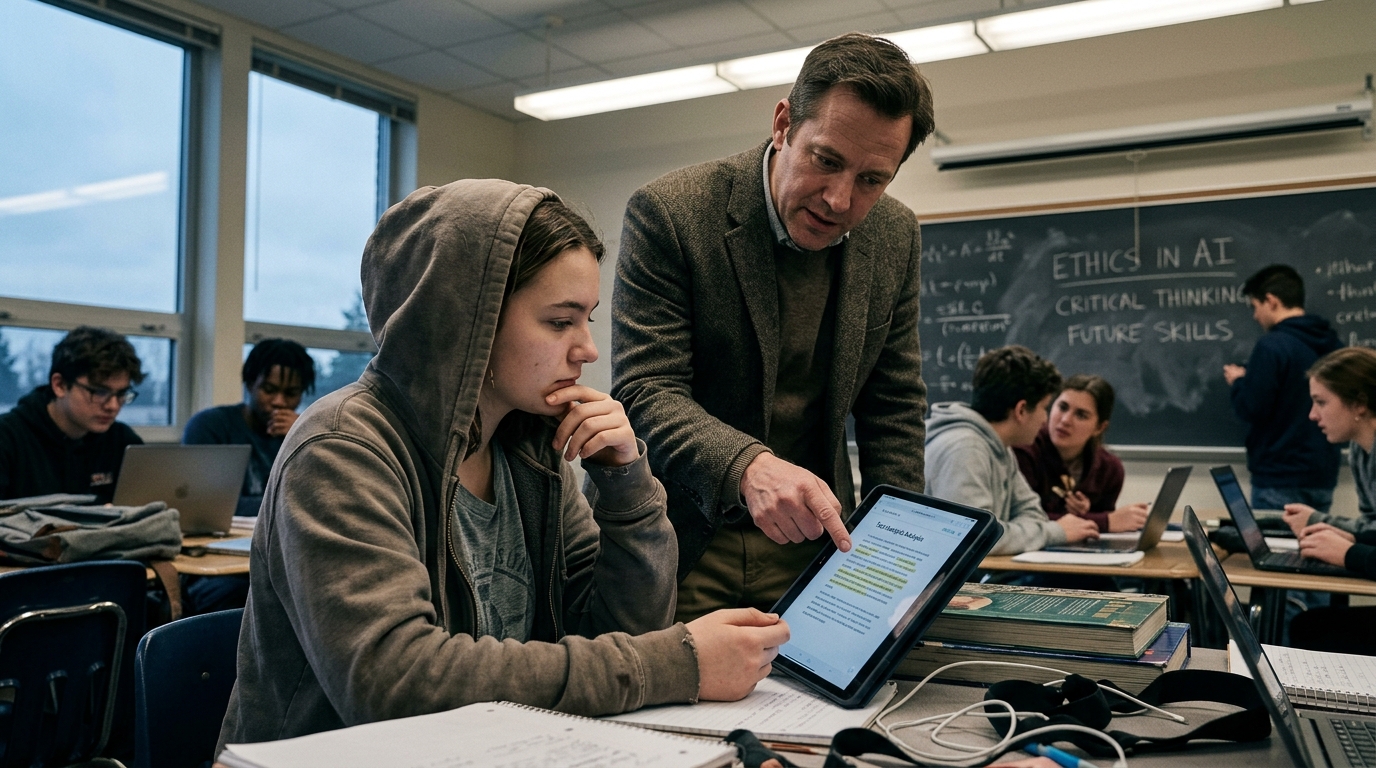
The role of the educator is shifting from a mere transmitter of knowledge to a guide and mentor. Assessment methods must also evolve. Instead of assignments that can be generated by a bot in seconds, evaluations should focus on the process, oral presentations, and the student's ability to synthesize information from multiple sources, including AI. The challenge is not to defeat AI, but to learn to collaborate with it in a way that enhances human creativity.
Conclusion: A New Pedagogical Compact
Closing our eyes to technological progress is not a strategy. Schools must become the laboratory where future citizens learn to use AI responsibly, ethically, and effectively. Artificial Intelligence has drawbacks, but the greatest threat is an educational anachronism that leaves our children unprepared for a world that is already changing. The solution lies in teacher training, the redesign of curricula, and the cultivation of an ethical compass that will guide humanity through the digital ocean.