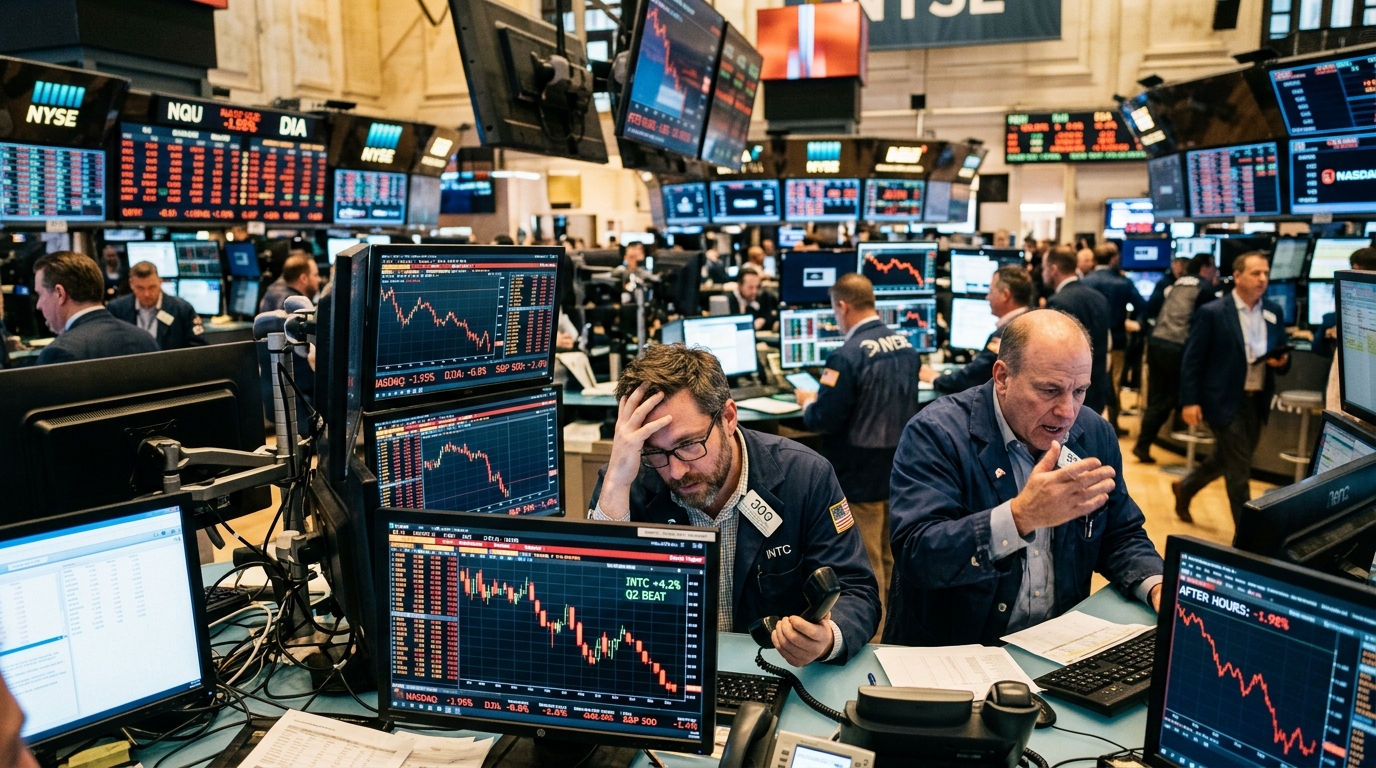
The trading session of April 23, 2026, will be remembered by investors as a classic duel between strong economic fundamentals and persistent geopolitical risks. While the technology sector attempted to celebrate Intel’s impressive return to profitability, headlines from the Middle East—specifically escalating tensions involving Iran—triggered a wave of selling that pushed major indices into the red by the closing bell.
Geopolitical Jitters and the Flight to Quality
In 2026, markets remain hypersensitive to any disruption of stability in the Gulf region. Reports of potential military maneuvers or state-sponsored cyberattacks from Iran prompted investors to pivot toward safe-haven assets. Zachary Griffiths of CreditSights noted that fixed income markets began to feel the heat as inflationary concerns were reignited by the potential spike in crude oil prices. This uncertainty acts as a significant drag on the market euphoria that had built up following the Federal Reserve's recent stabilization of interest rates. The 'soft landing' narrative is once again being tested by external shocks that no central bank can fully control.
Intel’s Redemption and the Semiconductor Landscape
In stark contrast to the geopolitical gloom, Intel delivered earnings that surpassed even the most bullish analyst estimates. After years of painful restructuring under the IDM 2.0 strategy, the company finally seems to be reaping the rewards of its massive investment in advanced lithography (18A) and its burgeoning foundry services business. Intel’s beat is not merely a corporate milestone; it is a signal that the U.S. strategy to reclaim semiconductor dominance is yielding tangible results. McKinsey’s Kate Smaje highlighted that the integration of Artificial Intelligence at the hardware level is now the primary growth engine, with Intel positioning itself at the very core of this epochal shift.
Cybersecurity and Financial Resilience
Given that modern geopolitical threats often manifest as digital warfare, the cybersecurity sector was a focal point of the day's analysis. Zscaler CEO Jay Chaudhry emphasized during the broadcast that global enterprises no longer view security as a discretionary expense but as a prerequisite for operational continuity. The transition toward 'Zero Trust' architectures is accelerating as state-sponsored actors become increasingly sophisticated. Meanwhile, Raymond James CEO Paul Shoukry observed that wealth management clients remain cautious yet invested, seeking refuge in sectors that demonstrate resilience during periods of heightened volatility.
- Crude oil prices rose 2.5% on fears of disruptions in the Strait of Hormuz.
- Intel reported a gross margin expansion of 400 basis points, signaling operational efficiency.
- The cybersecurity sector traded inversely to the broader market decline.
- The VIX volatility index jumped 12%, reflecting renewed investor anxiety.
In conclusion, the market close on April 23 highlights the fragile equilibrium of the global economy in 2026. On one hand, technological breakthroughs and the AI revolution promise unprecedented productivity gains. On the other, age-old geopolitical rivalries continue to serve as a reminder that economic prosperity is never decoupled from international security. For investors, diversification and a laser focus on innovation remain the only constants in a world moving at the speed of light. The 'Intel beat' proves that companies can innovate their way out of trouble, but the 'Iran jitters' prove that the macro environment can still dictate the final score.