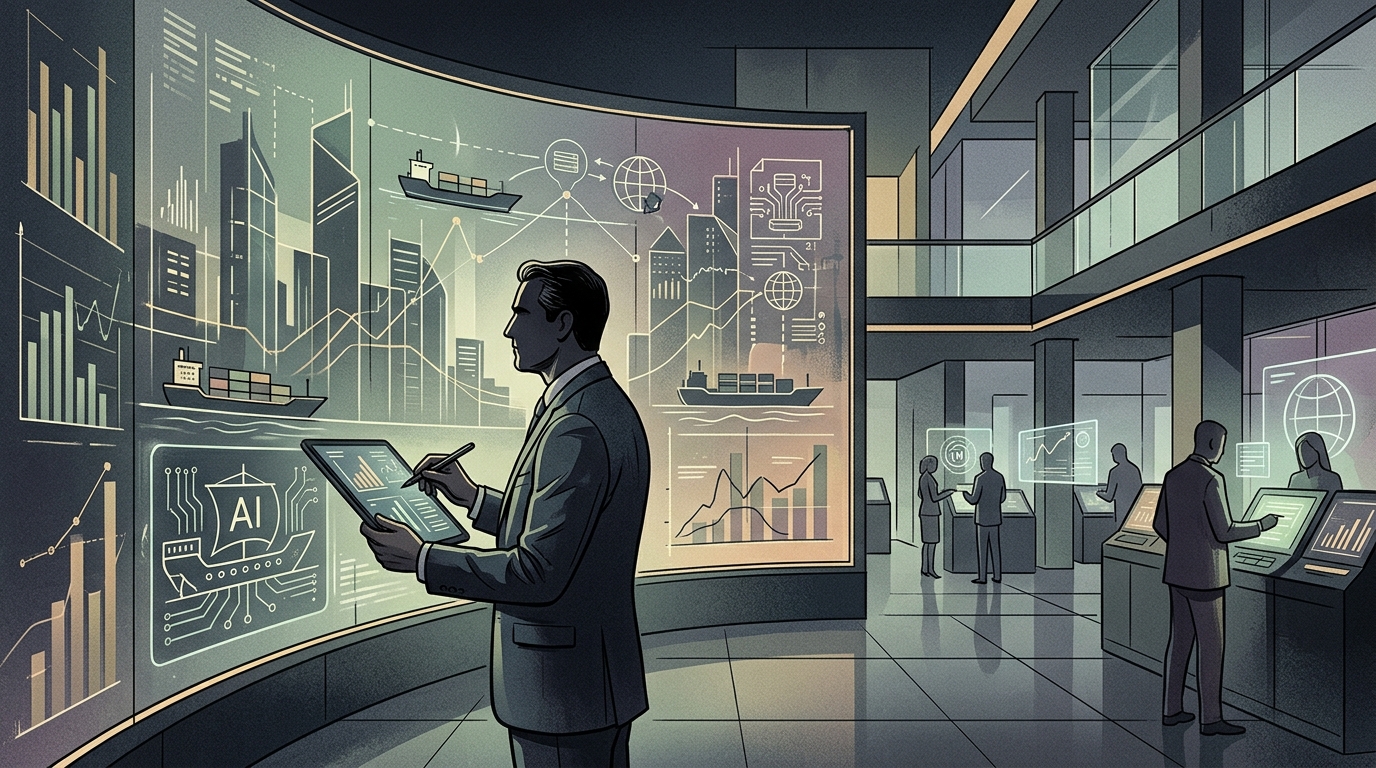
The recent Mythos meeting, which convened the world’s most powerful financial actors and AI pioneers, left behind a sense of urgency, but perhaps for the wrong reasons. As central bankers and regulators spent hours debating theoretical doomsday scenarios—where AI triggers a global flash crash or a systemic market meltdown—the real crisis was already unfolding on the screens of everyday consumers. AI-enabled fraud, specifically Authorized Push Payment (APP) fraud, is evolving into a threat that doesn't target bank firewalls, but the human element itself.
The Obsession with Systemic Risk vs. Micro-Collapse
Inside the Mythos conference rooms, the dialogue was dominated by the concept of the 'black swan.' Regulators fear that an over-reliance on shared AI algorithms for trading could lead to uniform market behavior, causing a sudden and uncontrollable spiral. However, as the Wagman Defense report highlights, this macro-level focus ignores the granular erosion of trust caused by hyper-personalized fraud. AI doesn’t need to crash the stock market to destroy a financial system; it only needs to make it impossible for a customer to distinguish a legitimate communication from a predatory one.
Banks have invested billions in cybersecurity, but AI provides criminals with the tools to bypass these systems without cracking a single code. Through deepfake voice cloning and real-time social data analysis, fraudsters convince users themselves to authorize transactions. This is the paradox of modern banking: the system functions perfectly, the transaction is 'legal' and 'authorized,' yet the money ends up in criminal networks.
The Failure of Traditional Defenses
Traditional authentication methods, such as two-factor authentication (2FA) and security questions, are becoming obsolete. AI can now synthesize the voice of a bank manager or even a family member with terrifying precision. At the Mythos meeting, minimal time was devoted to how banks will bear the liability for these losses. In Europe, new directives (like the evolution of PSD3) are beginning to push for mandatory victim reimbursement, but banks are resisting, fearing it will open the floodgates for moral hazard.
- Deepfake voice cloning allows for real-time deception, making phone banking extremely vulnerable.
- Big data analysis enables fraudsters to know exactly when a customer is expecting an invoice, intervening at the perfect psychological moment.
- The speed of Instant Payments means stolen funds vanish in seconds, long before a bank can react.
Toward a New Architecture of Trust
The solution does not lie in returning to the past, but in adopting the 'Wagman Defense'—a strategy where AI is used not just to detect data anomalies, but to analyze the behavioral psychology of the transaction. If a customer who typically makes small purchases suddenly transfers a large sum while on an unusually long call, the bank's AI must be able to intervene, even if the customer insists the transaction is valid.
“Trust is the only currency a central bank cannot print,” remarked an analyst on the sidelines of Mythos.
If banks fail to address this fraud epidemic, the cost will not just be financial. It will be the total alienation of consumers from digital banking systems. The Mythos meeting may have focused on the 'big' risks, but the small, daily tragedies of AI fraud are what will define the industry’s future. Regulators must stop staring at the horizon for a hypothetical flood and start fixing the leaks that are already sinking the ship.