Italy, the Eurozone's third-largest economy, finds itself once again at a critical crossroads as Giorgia Meloni’s government confronts the harsh reality of fiscal mathematics. The recent release of budgetary data by Eurostat has confirmed analysts' deepest fears: Rome has failed to keep its deficit within the bounds set by the newly reinstated Stability and Growth Pact rules, triggering a wave of concern across international markets and within the corridors of Brussels. This situation is far more than a technical accounting dispute; it is a profound political and economic challenge that threatens to undermine the image of a 'responsible' leader that Meloni has painstakingly cultivated since taking office.
The Ghost of the Superbonus and Fiscal Derailment
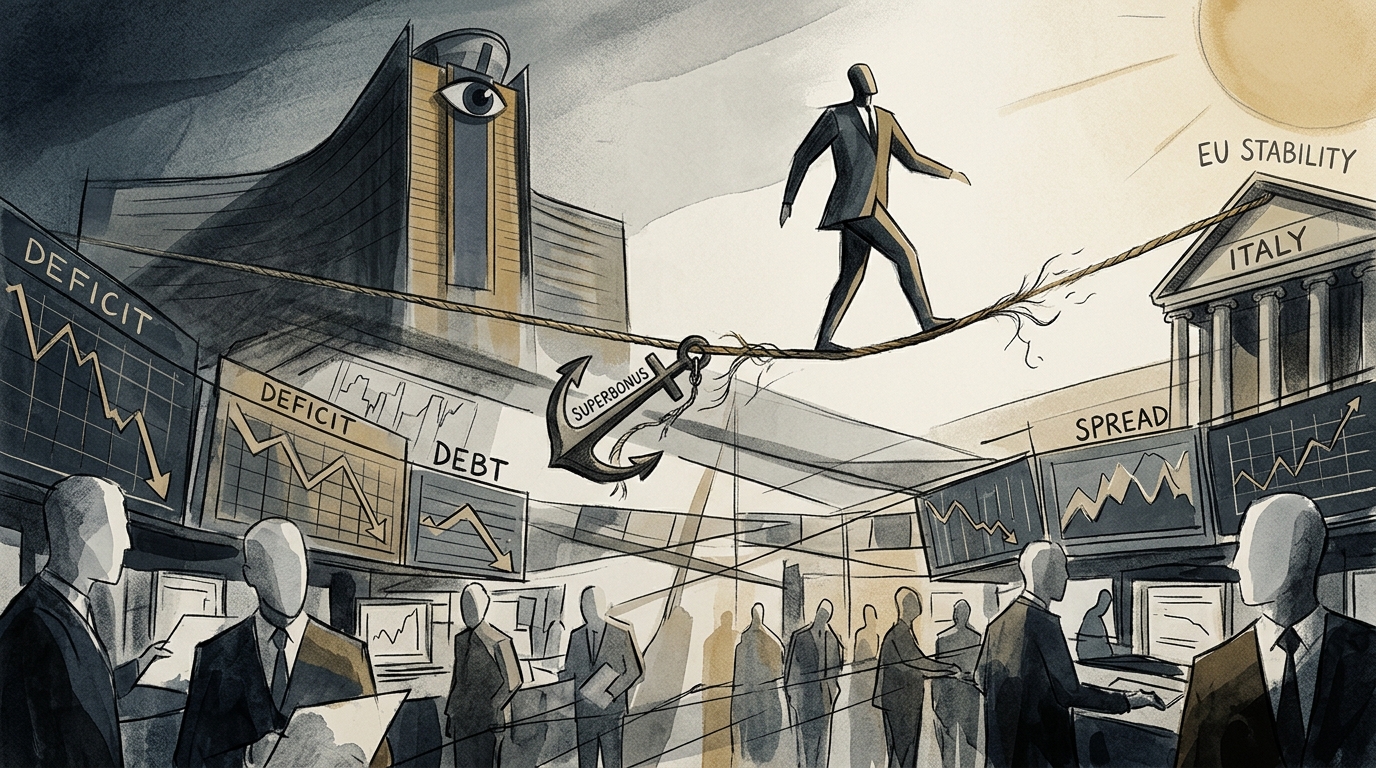
The primary culprit behind Italy’s recent fiscal slippage is none other than the notorious '110% Superbonus.' This exceptionally generous tax credit scheme for energy-efficient building renovations was introduced by Giuseppe Conte’s government during the pandemic. While the measure aimed to stimulate construction activity and accelerate the green transition, its ultimate cost proved astronomical, and oversight was woefully inadequate. The Meloni administration inherited this fiscal 'time bomb,' which continues to detonate across the 2024 and 2025 budgets, pushing the deficit well above the 3% GDP threshold.
Eurostat has been uncompromising in its assessment, forcing Italy to record these expenditures in a manner that directly impacts the public deficit. This puts Rome on a collision course with the European Commission’s Excessive Deficit Procedure (EDP). At a time when interest rates remain relatively high and Eurozone growth is anemic, Italy is being called upon to implement a rigorous adjustment program. This austerity will inevitably limit Meloni’s ability to deliver on campaign promises, such as tax cuts and direct support for households struggling with the cost of living.
The Energy Crisis and Erosion of Competitiveness
Beyond internal accounting woes, Italy remains acutely vulnerable to international energy volatility. Despite significant efforts to diversify energy sources and reduce dependence on Russian gas, energy costs for Italian industry remain among the highest in Europe. This directly erodes the competitiveness of Italian exports, the historical engine of the nation's economy. The government has been forced to spend billions of euros on subsidies to shield businesses and consumers, further depleting its fiscal buffers.
The green transition, while necessary, requires massive investments that Italy struggles to finance without inflating its already staggering public debt, which hovers near 140% of GDP. Pressure from Brussels to meet climate targets, combined with the mandate for fiscal discipline, creates a 'Scylla and Charybdis' scenario for Rome. Meloni must balance the demands of the EU with the needs of a domestic industrial sector that is desperately calling for cheaper energy to survive global competition. The structural reforms required by the Recovery and Resilience Facility (RRF) are also lagging, adding another layer of complexity to the fiscal outlook.
Political Implications and the Future of the Coalition
On the domestic political front, fiscal constraints are causing friction within the governing coalition. Matteo Salvini of the League and the heirs of Silvio Berlusconi in Forza Italia are pushing for more expansionary policies, fearing a backlash in the polls. However, Finance Minister Giancarlo Giorgetti, viewed as the voice of reason and the primary liaison with global markets, insists on the necessity of sobriety and strategic cuts.
Giorgia Meloni understands that any sign of fiscal indiscipline could lead to a spike in BTP-Bund spreads, making debt servicing unsustainable. Her strategy thus far has been to present herself as a reliable European partner, staunchly supporting Ukraine and adhering to core EU directives. However, with the deficit widening and social discontent rising due to inflation, her political survival will depend on her ability to negotiate a 'soft landing' with Brussels. The lingering question is whether Europe will exhibit the necessary flexibility or if Italy will once again become the 'weak link' that jeopardizes the stability of the entire continent.