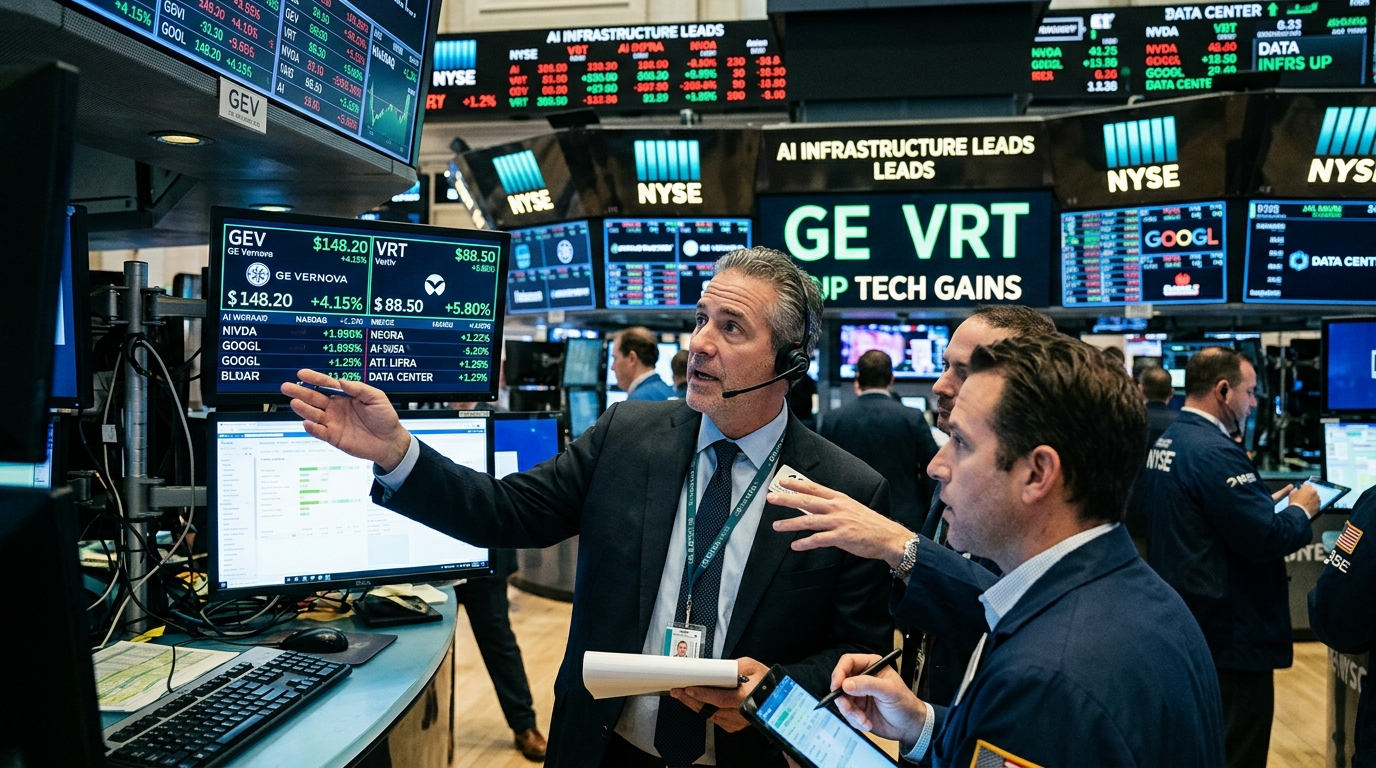
In the history of economic revolutions, the protagonists are rarely those who appear at first glance. While global attention remains fixed on software giants and semiconductor manufacturers, a quiet but colossal shift of capital is taking place at the foundations of our digital world. GE Vernova and Vertiv Holdings have emerged as the ultimate market arbiters, capitalizing on the staggering investments made by "Hyperscalers"—Microsoft, Google, Amazon, and Meta—in data centers.
The Thirst for Power and the End of Abundance
As we move through the first quarter of 2026, the reality of Artificial Intelligence (AI) has fundamentally changed. We are no longer talking about experimental chatbots, but about an industrial infrastructure that consumes energy on the scale of small nations. GE Vernova, which spun off from parent company General Electric in 2024, found itself in the right place at the right time. With its expertise in electrical grids, gas turbines, and renewable energy, the company is the core pillar upon which Big Tech relies to keep its data centers running.
The problem these companies are called to solve is twofold: availability and stability. Power grids in the US and Europe, aging and designed for another era, are unable to cope with the sudden surge in demand. GE Vernova doesn't just sell equipment; it sells the ability for companies like Amazon to build data campuses requiring gigawatt-scale power. Orders for transformers and grid management systems have skyrocketed, with lead times now reaching two or even three years, creating a massive economic moat around its profitability.
Vertiv: The Art of Cooling in a Scorching World
If GE Vernova brings power to the data center door, Vertiv ensures its internal operations don't lead to spontaneous combustion. New generations of processors from Nvidia and AMD generate heat that makes traditional air cooling obsolete. Enter Vertiv, which has become the undisputed leader in liquid cooling systems and power management.
- Liquid Cooling: The transition from air to liquid is the biggest technological shift in infrastructure in the last 20 years.
- Modular Data Centers: Vertiv offers prefabricated solutions that allow Hyperscalers to expand in weeks rather than months.
- Energy Efficiency: In a world of strict ESG regulations, Vertiv's ability to reduce PUE (Power Usage Effectiveness) is the key to securing permits for new projects.
Vertiv's stock reflects this dominance, having outperformed even many high-flying tech titles. Analysts point out that for every dollar spent on AI chips, a significant—and growing—percentage must be directed toward supporting infrastructure. Vertiv is no longer a mere component supplier but a strategic partner determining the speed at which AI can be deployed globally.
The Geopolitics of Infrastructure and the Road Ahead
The rise of these "Powerhouses" is not just a business success story; it's a geopolitical statement. The need for energy autonomy in data centers is leading to a new form of "digital sovereignty." We are now seeing Hyperscalers invest directly in nuclear power and small modular reactors (SMRs), areas where GE Vernova holds a leading position.
"We are no longer in the era of software-as-a-service, but in the era of infrastructure-as-a-destiny," says a senior market executive.
The question remains whether supply can keep up with demand. Shortages in raw materials like copper and limited manufacturing capacity for critical grid components are the only real risks for GE Vernova and Vertiv. However, with order books filled through the end of the decade, these two companies have turned the AI energy crisis into the greatest profit opportunity of the 21st century.