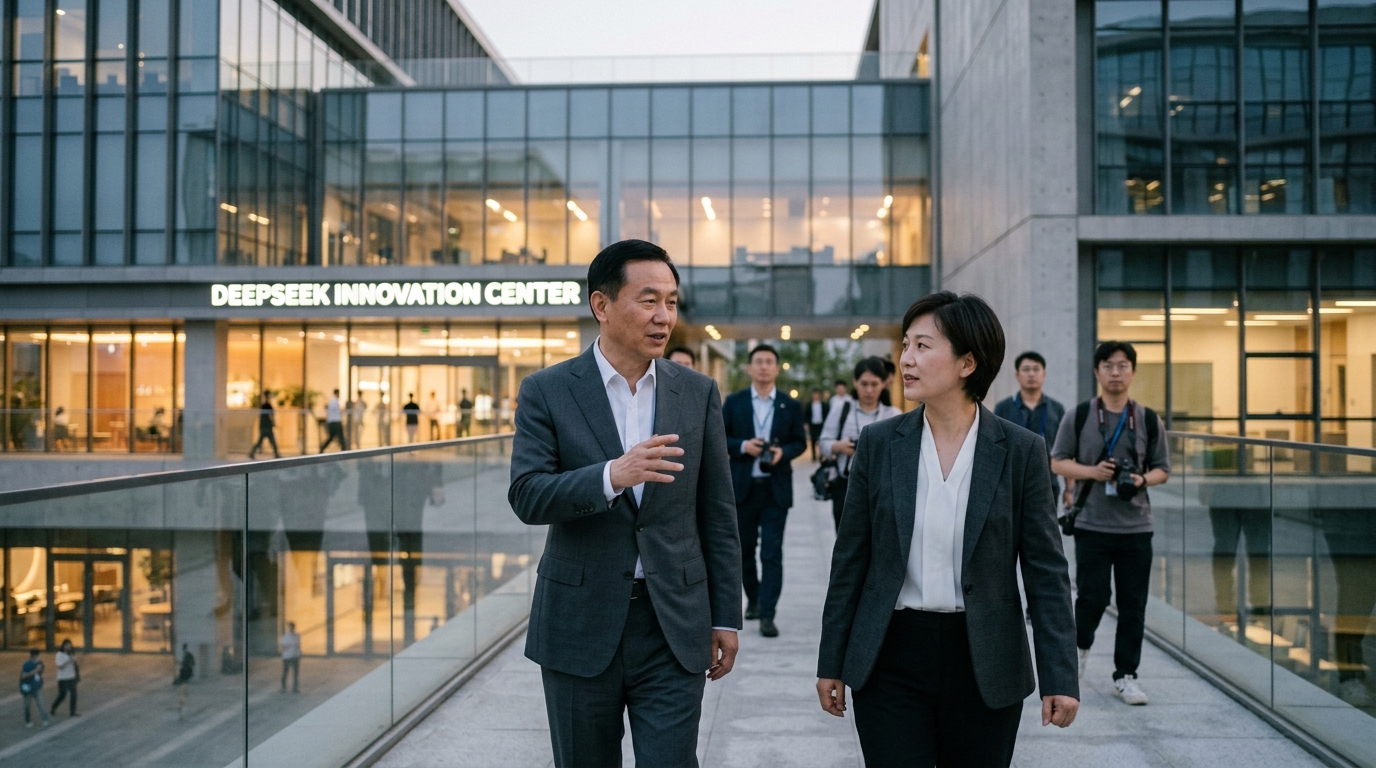
The global AI chessboard is experiencing a seismic shift. According to reports from AASTOCKS, China’s two preeminent tech conglomerates, Tencent and Alibaba, are in advanced discussions to lead a massive funding round for DeepSeek. The startup’s valuation is expected to soar past the $20 billion mark, cementing its status among the world’s elite AI unicorns and validating its position as China’s national champion in the Large Language Model (LLM) race.
The Strategy of Efficiency-Driven Innovation
DeepSeek is not just another player in the crowded AI field. While Silicon Valley giants like OpenAI and Google rely on brute-force computing power and billions of dollars worth of Nvidia GPUs, the Hangzhou-based startup has proven that intelligence can be achieved through elegance rather than just scale. With the release of DeepSeek-V3 and the reasoning-focused DeepSeek-R1, the company demonstrated performance levels comparable to OpenAI’s GPT-4o and o1, but at a mere fraction of the training and inference costs.
This "algorithmic efficiency" is what has captivated the tech titans. For Tencent and Alibaba, DeepSeek represents more than just a financial asset; it is a strategic fortress. In an era where U.S. export controls on high-end semiconductors (such as Nvidia’s H100 and B200 chips) are tightening around Beijing, DeepSeek’s ability to deliver top-tier results on less powerful hardware is the "holy grail" of Chinese technological sovereignty.
The Convergence of Rivals
It is a rare sight to see Tencent and Alibaba co-investing in the same entity. Historically, these two have operated as rival ecosystems, locked in a battle for dominance over China’s digital life. However, the meteoric rise of ByteDance (the owner of TikTok), which currently dominates the domestic AI market with its Doubao model, has forced these old adversaries into a pragmatic alliance. Alibaba seeks to integrate DeepSeek’s cutting-edge capabilities into Alibaba Cloud, while Tencent aims to fortify its WeChat ecosystem and gaming empire with more sophisticated generative AI.
The $20 billion valuation reflects the market's conviction that DeepSeek has cracked the code for "cost-per-token" optimization. If China can democratize access to affordable, high-performance AI, it could fundamentally disrupt the global software market, providing a viable alternative for emerging economies that cannot sustain the high subscription costs associated with American AI APIs.
Geopolitical and Economic Implications
This move comes at a critical juncture. Washington is closely monitoring DeepSeek’s ascent, as the startup has inadvertently proven that chip sanctions might have a counterproductive effect: forcing Chinese engineers to become more resourceful and creative in their software architecture. The backing from Tencent and Alibaba sends a clear message to the West that Chinese capital is ready to support domestic innovation, regardless of external market pressures or geopolitical headwinds.
Furthermore, DeepSeek has adopted an aggressive open-source strategy for many of its models, making it immensely popular within the global developer community. Support from the two giants will allow the startup to scale its infrastructure and compete directly with Meta’s Llama in the open-source arena, creating an alternative pole of influence that remains independent of Silicon Valley’s control.
- DeepSeek-R1 proved that advanced reasoning in AI models does not strictly require billions in Nvidia hardware.
- Alibaba’s involvement signals a definitive shift toward "AI-first" cloud computing strategies.
- Tencent is eyeing B2B dominance by leveraging DeepSeek’s hyper-efficient architecture.
In conclusion, this investment is about far more than the capital involved. It is a statement of intent. China is no longer merely attempting to catch up with the West; it is attempting to rewrite the rules of the game by prioritizing efficiency and accessibility. If DeepSeek maintains its momentum with the backing of Tencent and Alibaba, 2026 will be remembered as the year the center of gravity in AI began to shift decisively toward the East.