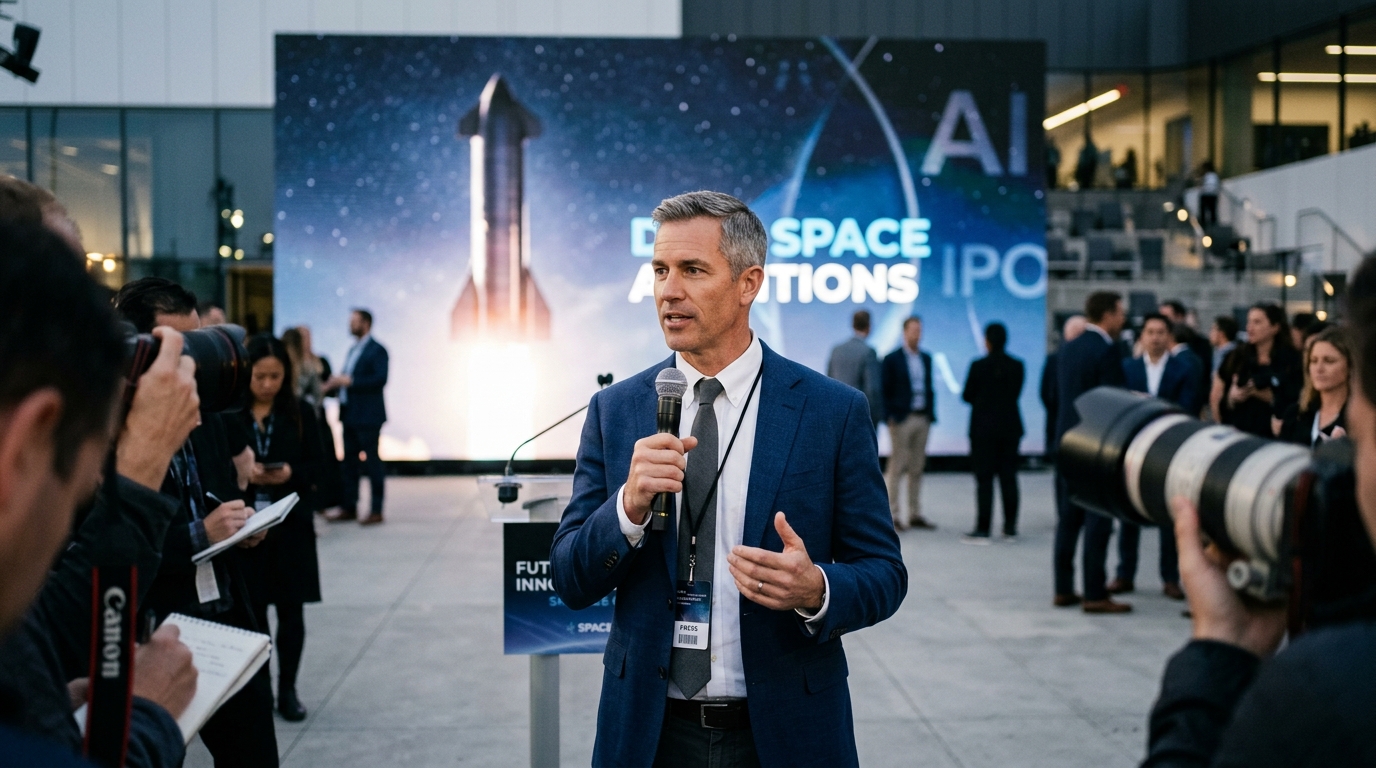
In a move poised to redraw the map of global capital markets, Elon Musk’s SpaceX is preparing for a historic Initial Public Offering (IPO). According to reports emerging on June 3, 2026, the company is seeking to raise an astronomical $75 billion. If successful, this would stand as the largest public offering in history, eclipsing the record-breaking figures of Saudi Aramco and Alibaba. This strategic maneuver is not merely about financial liquidity; it serves as the foundational pillar for the next phase of human evolution: the convergence of space infrastructure and advanced Artificial Intelligence.
The Strategic Pivot to Artificial Intelligence
For years, SpaceX was primarily viewed as a logistics and transportation company—a "trucking service" for orbit. However, 2026 marks its transformation into a data and computational powerhouse. The funds from the IPO are largely earmarked for the development of "StarAI," a new division dedicated to integrating large-scale AI models directly into the Starlink satellite constellation. The premise is revolutionary: processing data in orbit to slash latency and enable autonomous systems on Earth to communicate at speeds previously deemed impossible.
AI is also becoming indispensable for managing the expanding Starship fleet. As the complexity of lunar and Martian missions grows, the need for real-time autonomous decision-making is critical. "We cannot rely on human controllers in Houston when a vessel is millions of miles away," noted a source close to the company. SpaceX is investing heavily in neural networks that allow its spacecraft to self-repair and navigate uncharted environments with surgical precision. This integration of silicon intelligence and heavy-lift rocketry is what differentiates SpaceX from its legacy competitors.
"This IPO isn't just a financial transaction; it is the fuel for the engine that will take us to the stars, guided by the most advanced intelligence humanity has ever conceived."
Starship Dominance and the Starlink Cash Cow
A significant portion of the $75 billion will be funneled into the finalization of the Starship program. The vehicle, central to Musk’s vision of a multi-planetary civilization, requires massive investment in launch and production infrastructure. SpaceX plans to build a world-class "Spaceport" in Texas, capable of supporting daily launches. The economic scale of this endeavor exceeds the capacity of any private investor group, making a transition to public markets an inevitability.
Simultaneously, Starlink continues to serve as the company's primary revenue driver. With over 15,000 satellites in orbit by mid-2026, the service provides high-speed internet to every corner of the globe. The IPO will allow SpaceX to accelerate the deployment of second-generation satellites, featuring direct-to-cell connectivity and onboard AI processors for military and commercial applications. The geopolitical significance of Starlink has already been demonstrated in global conflicts, and its further expansion cements SpaceX as a de facto global power player.
Challenges and Governance: The Musk Factor
Despite Wall Street’s fervor, a public listing brings intense scrutiny. Investors are wary of the governance structure of a company so tightly bound to the polarizing persona of Elon Musk. Transitioning from a private firm, where Musk exercised absolute control, to a public entity with fiduciary duties and SEC transparency requirements will be a complex transition. Questions remain regarding how the company will balance long-term, high-risk Martian ambitions with shareholder demands for quarterly profitability.
Furthermore, the integration of AI raises significant ethical and regulatory hurdles. SpaceX will sit atop a mountain of global communication data. Utilizing this data to train proprietary AI models could trigger backlashes from regulators in the European Union and the United States. The company must prove that its immense power will not lead to a digital monopoly that extends from the ground to the exosphere. The challenge for the new board of directors will be to maintain Musk's visionary speed while adhering to the guardrails of public corporate life.
Conclusion: A New Era for Tech Listings
The decision to take SpaceX public signals the end of the era of "mega-unicorns" remaining private for decades. If SpaceX successfully raises $75 billion, it will clear the path for other deep-tech companies to enter the public markets, potentially revitalizing a stagnant IPO landscape. For humanity, this may be the turning point where space ceases to be a distant frontier and becomes the next domain of integrated economic and technological activity. The marriage of rocketry and machine intelligence promises a future that was, until recently, the sole province of science fiction.