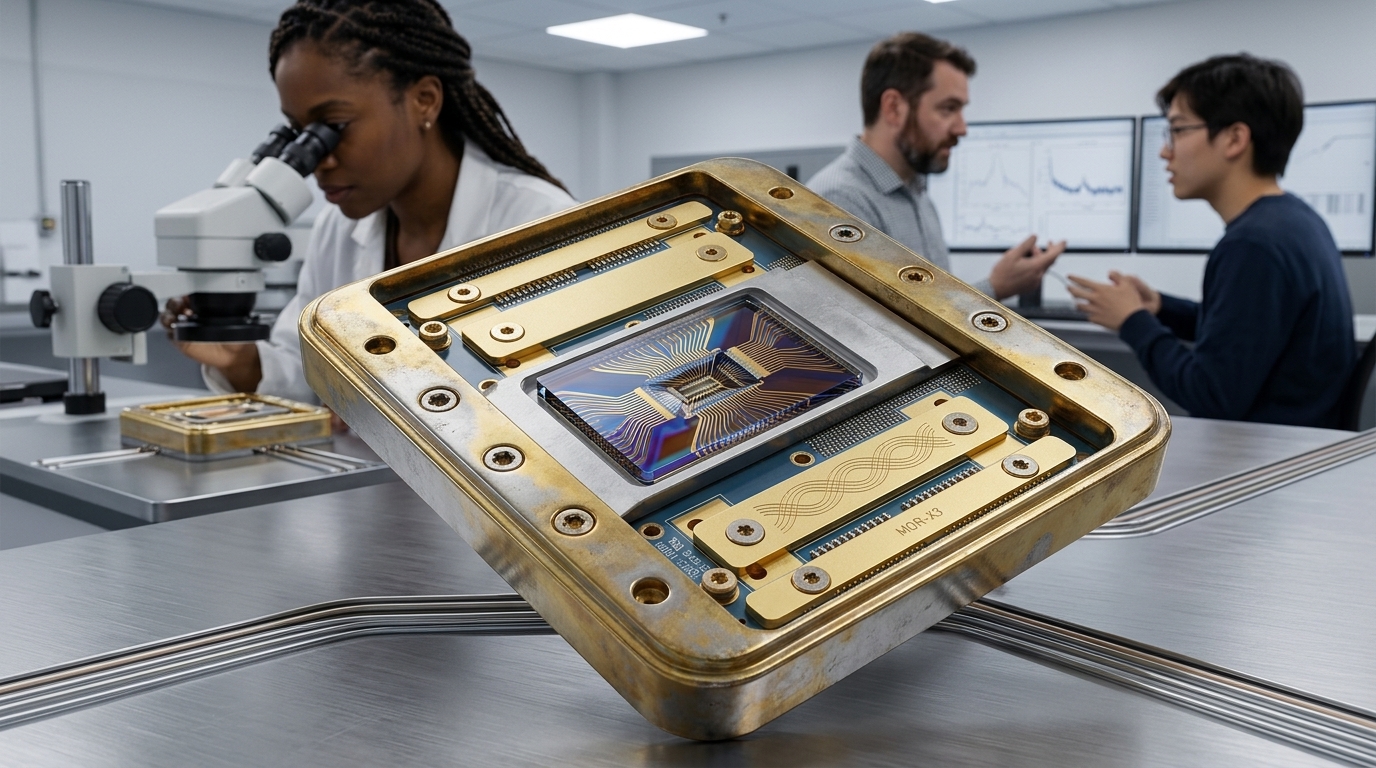
Quantum computing is no longer a theoretical promise confined to dimly lit physics labs; it has become a field of intense industrial competition. In June 2026, recent updates from Microsoft, Atom Computing, and EeroQ mark a critical turning point: the transition from Noisy Intermediate-Scale Quantum (NISQ) systems to stable, fault-tolerant computers capable of executing real-world algorithms.
The Microsoft and Atom Computing Alliance: Neutral Atom Dominance
Microsoft’s collaboration with Atom Computing has yielded results that many analysts deemed impossible just a few years ago. By utilizing neutral atom technology—where individual atoms are held in place by laser-light "tweezers"—the two companies have demonstrated a system with an unprecedented number of logical qubits. Unlike physical qubits, which are extremely vulnerable to environmental interference, logical qubits use error-correction codes to ensure computational accuracy.
Microsoft is integrating this technology into its Azure Quantum ecosystem, allowing researchers to simulate chemical reactions for material discovery at speeds thousands of times faster than traditional supercomputers. The use of neutral atoms offers a significant scaling advantage: it is far easier to maintain the stability of thousands of atoms in an optical array than it is to manufacture corresponding circuits of superconducting materials, as pursued by IBM and Google.
EeroQ: The Alternative Path of Electrons on Helium
While the spotlight often falls on giants, EeroQ, a Chicago-based startup, is making waves with its unconventional approach. Its technology is based on electrons trapped on the surface of superfluid helium. This method promises exceptionally high connectivity between qubits and much lower noise levels. Recent company updates indicate they have overcome significant hurdles in electron control, bringing their system to a stage where commercial viability is no longer a science fiction scenario.
EeroQ’s advantage lies in the purity of the system. Superfluid helium acts as the ideal substrate, allowing electrons to move without friction and maintain their quantum state for longer periods. This could lead to more compact quantum processors, reducing the cost and complexity of the required cooling systems.
The Criticality of Error Correction
The common thread in all these developments is the focus on error correction. For years, the industry measured progress by the number of physical qubits. However, quality now trumps quantity. Microsoft’s ability to run algorithms on "clean" logical qubits means we are approaching the point where quantum computers could break RSA encryption or solve the Haber-Bosch problem for fertilization, fundamentally altering the global economy.
Challenges remain, particularly in software and interconnects between different quantum modules. Nevertheless, the progress announced this month suggests that the "quantum winter" feared by some investors has given way to a warm spring of innovation.
"We are moving past the era of counting qubits and into the era of reliable quantum computation," noted a lead researcher at Microsoft Quantum.
As these technologies mature, the geopolitical implications of who controls the most advanced quantum stacks will become a central theme of international relations in the late 2020s.