The news that Peter Thiel’s family office has secured space at Miami’s 830 Brickell tower at record-breaking rental rates is more than just a high-end real estate transaction. It represents the definitive validation of a geographical and ideological shift that is redrawing the map of American power. Thiel, the co-founder of PayPal, Palantir, and Facebook’s first major outside investor, officially joins a select group of billionaires transforming Miami into the "Wall Street of the South."
The Symbol of a New Era: 830 Brickell
The 830 Brickell tower, a 55-story architectural marvel, is no ordinary office building. It is the first Class A+ office development to be built in Miami’s urban core in over a decade. Developed by OKO Group and Cain International, the tower has become a lighthouse for the giants of finance and technology. Thiel’s lease is reportedly priced at over $200 per square foot—a figure that would have been unthinkable in Florida just a few years ago, rivaling and even surpassing the rates of premier towers in Midtown Manhattan.
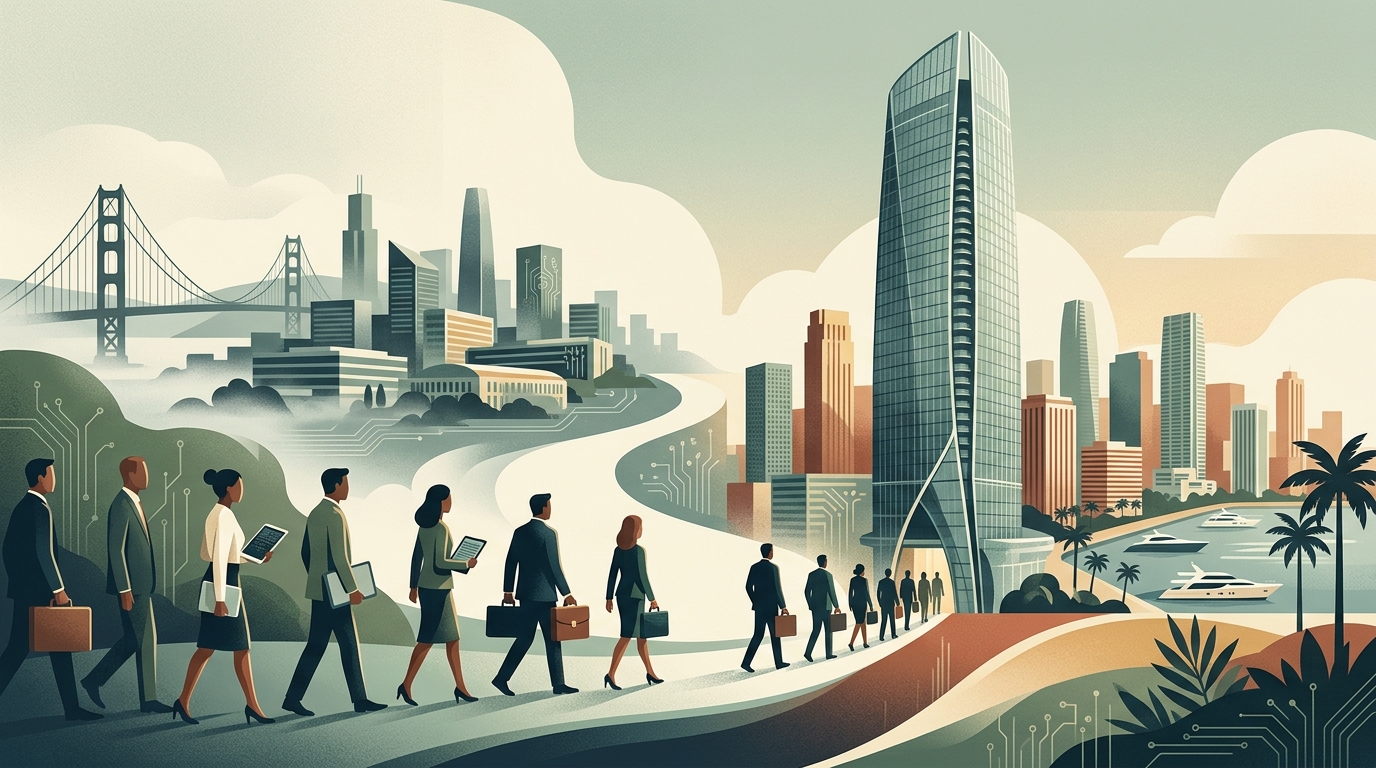
The tenant roster reads like a "Who's Who" of global capitalism: Ken Griffin’s Citadel, Microsoft, Kirkland & Ellis, and Marsh McLennan have all claimed their territory within its glass walls. Thiel’s presence, however, carries a unique weight. For decades, Thiel was the "philosopher-king" of Silicon Valley, the man who predicted the rise of social networks and big-data analytics. His departure from California and his significant investment in Miami signals the end of the Bay Area’s absolute hegemony.
The Ideological Exodus from Silicon Valley
Why has Thiel chosen Miami? The answer lies in a potent mix of tax incentives, political climate, and personal philosophy. Florida, under the leadership of Governor Ron DeSantis, has marketed itself as a bastion of freedom against what Thiel and others describe as the "woke bureaucracy" of California. The absence of state income tax in Florida is certainly a factor, but for individuals of Thiel’s net worth, taxation is merely the tip of the iceberg.
- Political Stability: A preference for an environment that favors deregulation and pro-business policies.
- Power Networking: The concentration of capital in Miami creates a new ecosystem where decisions are made at Brickell dinner tables rather than Palo Alto coffee shops.
- Infrastructure and Lifestyle: The rapid modernization of Miami’s amenities combined with a focus on public safety and climate.
Thiel has frequently discussed the concept of the "Network State"—the idea that future communities will be defined by shared values and technological networks rather than traditional geographic borders. His move to Miami can be seen as an experiment in building such a community, where the tech elite can operate without the constraints of traditional liberal strongholds.
Economic Implications and the "Manhattanization" of Miami
The arrival of Thiel and his peers has sent shockwaves through the local economy. While city officials celebrate the creation of high-skilled jobs and the massive influx of capital, long-term Miami residents are facing a harsh reality. The cost of living has skyrocketed, with real estate prices and rents making the city increasingly inaccessible to the middle class. The "Manhattanization" of Miami is now a visible reality: a skyline dominated by cranes and towers catering exclusively to the global 1%.
"Miami is no longer a city for vacations and retirees. It is the new control center for American capital," notes a local real estate analyst.
However, challenges remain. Climate change and rising sea levels pose an existential threat to Florida’s coastal infrastructure. There is a profound irony in the fact that while the tech elite invests billions in towers of glass and steel, the very ground they stand on is increasingly vulnerable. Yet for Thiel, a man who has always bet on the future, risk is part of the calculation. His presence at 830 Brickell is a definitive statement: Silicon Valley has been disrupted, and Miami is the new frontier.