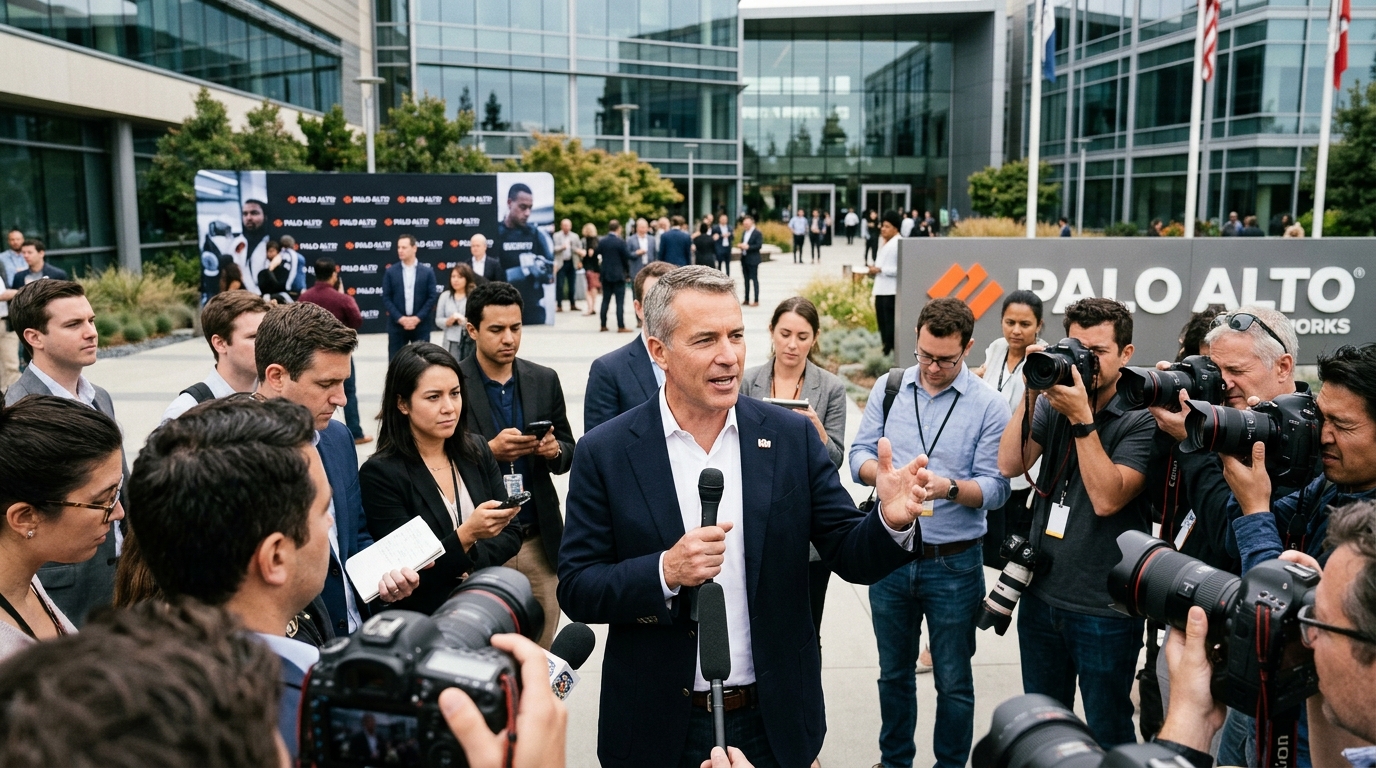
In the recent history of technology, we have rarely witnessed such a sharp pivot in corporate priorities as that triggered by the advent of generative artificial intelligence. While 2023 was the year of excitement and experimentation, 2026 finds executive suites in a state of alertness bordering on urgency. Nikesh Arora, CEO of Palo Alto Networks, recently confirmed to CNBC that customer meeting requests have surged as the need to fortify against AI-related risks has become the number one priority in boardrooms worldwide.
The Speed Trap and the Security Vacuum
The rush to integrate AI solutions to avoid falling behind competitors has created what analysts call "security technical debt." Enterprises have adopted Large Language Models (LLMs) and automated tools without first establishing protocols to protect their proprietary data. According to Arora, customers are no longer just asking for a product; they are seeking a comprehensive survival strategy in a world where attacks now occur at the speed of code, rather than human reaction.
"Artificial Intelligence is not just a productivity tool; it is a new attack vector that requires a radically different approach to defense," Arora noted during his interview.
The risks are multifaceted: from the leakage of sensitive corporate data through employee prompts into public AI models, to data poisoning and sophisticated phishing attacks generated by malicious AI systems. Palo Alto Networks is positioning itself as the indispensable intermediary in this new reality.
The Platformization Strategy: Answering the Chaos
One of Arora's most significant observations concerns the transition from disparate point products to integrated platforms. Historically, a large enterprise might have utilized up to 60 different cybersecurity vendors. In the AI era, this model is destined for failure. The fragmentation between different tools creates "blind spots" that AI can exploit in milliseconds.
- Data Integration: Palo Alto promotes the idea that to defeat an attacker's AI, you need a defender's AI that has access to all network data simultaneously.
- Automated Response: The time to detect a threat must be reduced from days to seconds, an achievement only possible through a unified platform.
- Cost Efficiency: Despite increasing complexity, consolidation under one provider offers economies of scale crucial in a volatile macroeconomic environment.
This "platformization" strategy appears to be paying off, as companies show a willingness to commit to long-term contracts with Palo Alto, viewing them as a strategic partner rather than just a software provider.
AI as a Double-Edged Sword
The irony of the situation does not escape industry experts. The very technology causing the insecurity is also the only one capable of curing it. Arora emphasizes that traditional cybersecurity methods, relying on static rules and human oversight, are now inadequate. Attackers are using AI to scan thousands of systems for vulnerabilities within minutes. Defense must be equally rapid and autonomous.
However, adopting "Defensive AI" brings its own set of challenges. There is the risk of false positives that can paralyze a company's operations, as well as the ethical dilemma of ceding control of critical infrastructure to algorithms. For Palo Alto Networks, the challenge is to prove that its "Precision AI" is reliable enough to be trusted with the keys to the digital kingdom.
Conclusion: A New Era of Responsibility
The surge in meeting requests reported by Arora is more than just a business win for Palo Alto Networks; it is a warning signal for the global economy. As AI becomes the connective tissue of modern business, cybersecurity ceases to be a technical IT issue and transforms into a matter of national and corporate security. A company's ability to protect its data and the integrity of its algorithms will become the ultimate competitive advantage in the coming years. As it turns out, the road to innovation must inevitably pass through the offices of cybersecurity experts.