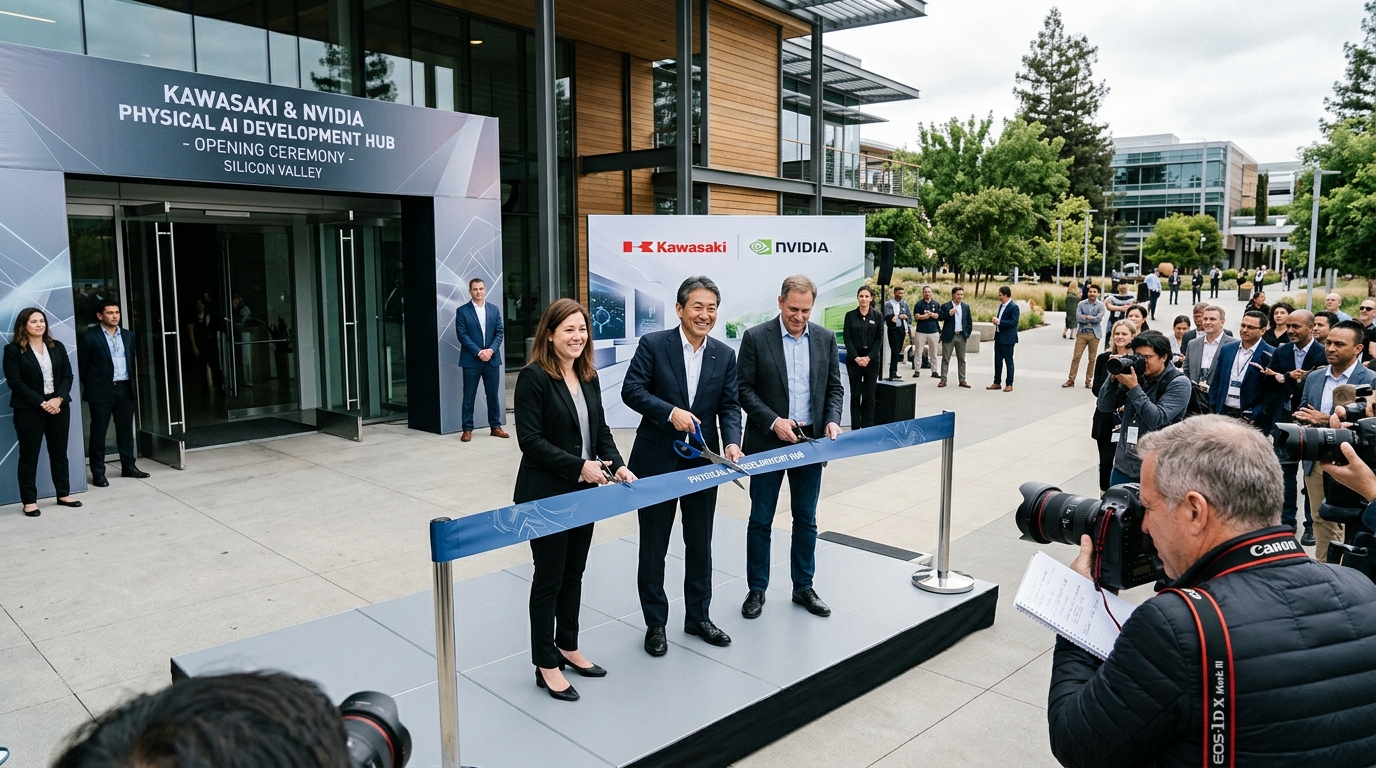
In an era where digital intelligence is beginning to manifest in physical forms, the announcement of a strategic partnership between Kawasaki Heavy Industries and Nvidia to establish a Physical AI development hub in Silicon Valley marks a definitive turning point. This is more than just another corporate agreement; it is the formal inauguration of a new industrial era where large-scale foundation models meet heavy-duty mechanical engineering.
The Shift to Embodied Intelligence
For decades, Artificial Intelligence was largely confined to the realms of data processing, image recognition, and language generation. However, "Physical AI" refers to systems that can perceive, reason about, and interact with the physical world autonomously. Kawasaki, a titan with a storied history in aerospace, shipbuilding, and robotics, recognizes that the future of manufacturing lies not in simple automation, but in true autonomy.
The new hub in Silicon Valley will act as an accelerator for integrating Nvidia’s cutting-edge technologies—such as the Omniverse platform and Isaac Robotics—into Kawasaki’s industrial robot lineup. The utilization of "digital twins" allows these machines to be trained in high-fidelity simulated environments before they ever touch a factory floor, drastically reducing development cycles and costs.
The Nvidia Ecosystem Meets Japanese Craftsmanship
Nvidia is no longer merely a chipmaker; it has become the architect of the operating system for the physical world. Through its Isaac platform, Nvidia provides the essential tools for creating robots that can "see" via computer vision and make split-second decisions in real-time. Kawasaki, for its part, provides the necessary physical infrastructure. Its robots, renowned for their durability and precision, will now be equipped with the "brains" required to perform tasks previously deemed too complex for machines, such as handling flexible components or navigating unstructured workspaces.
- Leveraging Nvidia Omniverse for photo-realistic, physics-accurate simulations.
- Implementing Reinforcement Learning to enable robots to learn complex skills.
- Developing systems that bridge the "Sim-to-Real" gap effectively.
Economic and Social Implications
This move comes at a pivotal moment for the global economy. Japan, Kawasaki’s home base, is grappling with an unprecedented demographic crisis, with an aging population threatening its industrial foundation. Physical AI offers a potential solution, allowing a smaller workforce to oversee fleets of intelligent robots. Simultaneously, in the United States, the trend of "reshoring"—bringing manufacturing back from overseas—requires extreme levels of automation to maintain cost competitiveness against lower-wage markets.
"Our collaboration with Nvidia is not just about technology; it’s about the future of human labor and industrial survival," noted Kawasaki executives during the launch.
Challenges and the Road Ahead
Despite the prevailing optimism, significant hurdles remain. Transitioning intelligence from a digital sandbox to the physical world involves immense safety and reliability risks. A glitch in a chatbot is a nuisance; a glitch in a multi-ton industrial robot can be catastrophic. The Silicon Valley hub will focus specifically on these issues: creating safe, predictable, and highly intelligent machines that will form the backbone of Industry 4.0.
In conclusion, the Kawasaki-Nvidia partnership signals the end of the era where robots were merely "blind" executors of pre-written code. They are now becoming perceptive partners, capable of adapting and evolving, forever altering the landscape of global manufacturing and the definition of the factory floor.