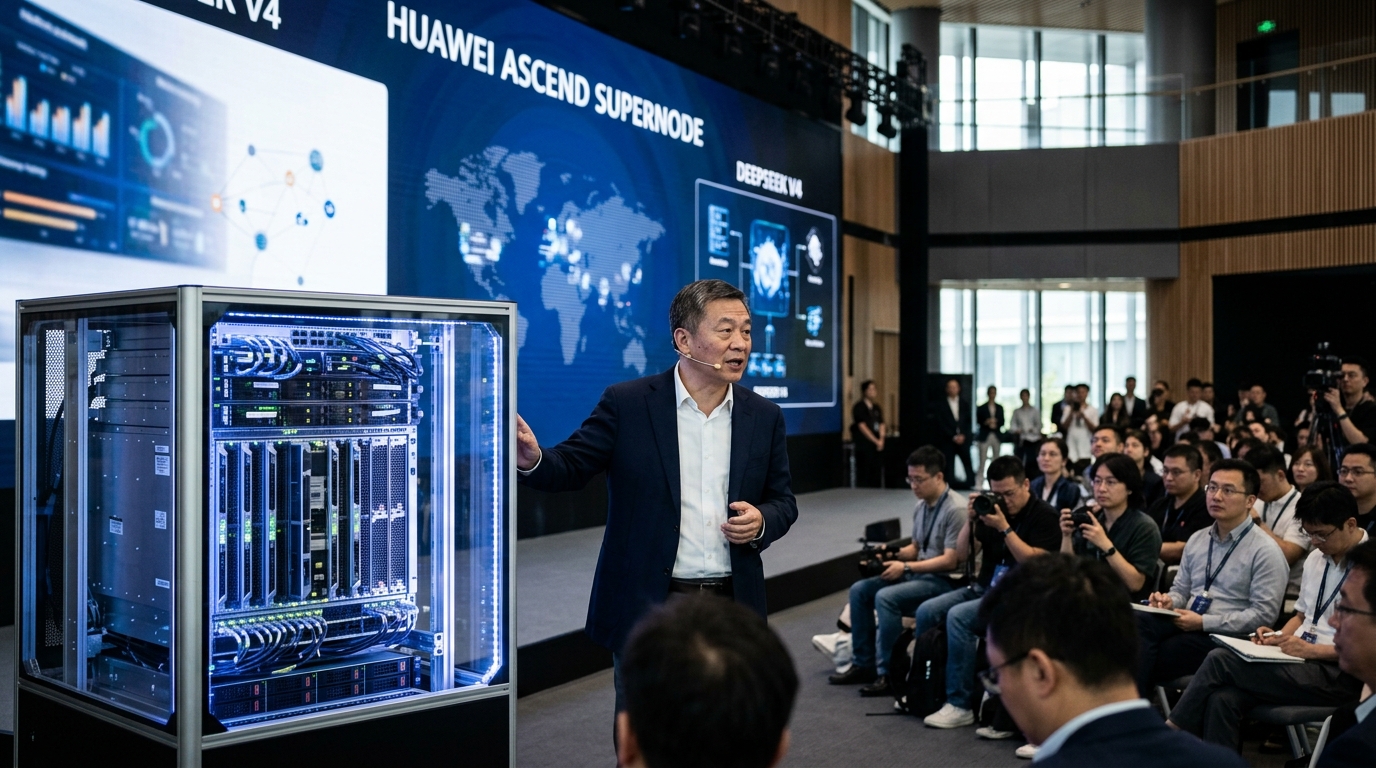
At the epicenter of the global technological rivalry, China is attempting a bold leap toward complete autonomy in the field of Artificial Intelligence. The recent news that Huawei is set to support the upcoming DeepSeek V4 model via its Ascend Supernode architecture is not merely a technical update; it is a strategic declaration of power. In an era where U.S. export restrictions on high-end semiconductors, such as those from Nvidia, are becoming increasingly stringent, the convergence of China’s leading hardware with its most efficient software creates an alternative ecosystem that can no longer be ignored.
The Supernode Architecture: Breaking the Memory Wall
Huawei’s Ascend Supernode is not a simple server but an integrated cluster architecture designed to address the most significant bottleneck in training Large Language Models (LLMs): the "memory wall" and interconnect bandwidth. By utilizing its HCCS (Huawei Cache Coherent System) interconnect technology, Huawei allows hundreds of Ascend 910B or 910C processors to function as a single, massive processing unit. This is vital for DeepSeek V4, which is expected to employ a sophisticated Mixture-of-Experts (MoE) architecture featuring hundreds of billions of parameters.
The technical challenge for Huawei has been to deliver performance comparable to Nvidia’s H100 systems despite limitations in chip lithography. Through the Supernode, the company manages to compensate for slightly lower individual core speeds with exceptionally efficient data flow management between nodes. This allows DeepSeek V4 to be trained with lower energy consumption and, most importantly, without reliance on sanctioned Western technology.
DeepSeek V4: The Market Disruptor
DeepSeek has already sent shockwaves through the global AI community with the release of V3, which proved that clever architecture could triumph over raw computational power. DeepSeek V4 promises to take this philosophy a step further. By focusing on "reasoning" and the ability to solve complex mathematical and programming problems, V4 aims to compete directly with OpenAI’s GPT-4o and Anthropic’s Claude 3.5.
The partnership with Huawei is symbiotic. While DeepSeek provides the algorithms that maximize hardware performance, Huawei provides the scale. For developers in China and emerging markets, this combination offers a cost-effective solution. The ability to run a world-class model on domestic hardware reduces operating expenses (OPEX) and eliminates the risks associated with dependence on U.S. cloud providers like Azure or AWS.
Geopolitical Implications and the "China Stack"
This move by Huawei signals the maturation of the so-called "China Stack" in AI. It is a fully vertically integrated approach: from Ascend chips and the EulerOS operating system to the MindSpore training framework and DeepSeek’s models. The success of this endeavor could lead to a bifurcated AI world, where the West follows the Nvidia/OpenAI path and the East follows the Huawei/DeepSeek path.
Analysts point out that if Huawei can prove that the Ascend Supernode can support DeepSeek V4 reliably at an industrial scale, the appeal of Chinese solutions will extend far beyond China’s borders. Countries in Southeast Asia, the Middle East, and Africa, which often find themselves in the crosshairs of U.S. diplomatic pressure, may see Huawei as a more stable and less politicized provider of AI infrastructure.
The Future of Innovation Under Constraints
Despite the progress, challenges remain. Access to advanced High Bandwidth Memory (HBM) remains an Achilles' heel for Huawei due to sanctions. However, the Chinese industry's ability to innovate around these obstacles is remarkable. DeepSeek V4 is not just a model; it is proof that creativity flourishes under pressure. Huawei is no longer just selling hardware; it is selling the promise of a sovereign and independent digital destiny.
Ultimately, the competition between the Ascend Supernode and Nvidia’s Blackwell systems will determine the pace of global AI progress. If China can deliver 80% of the performance at 50% of the cost, the market will react accordingly, forcing Western giants to rethink their pricing and access strategies.