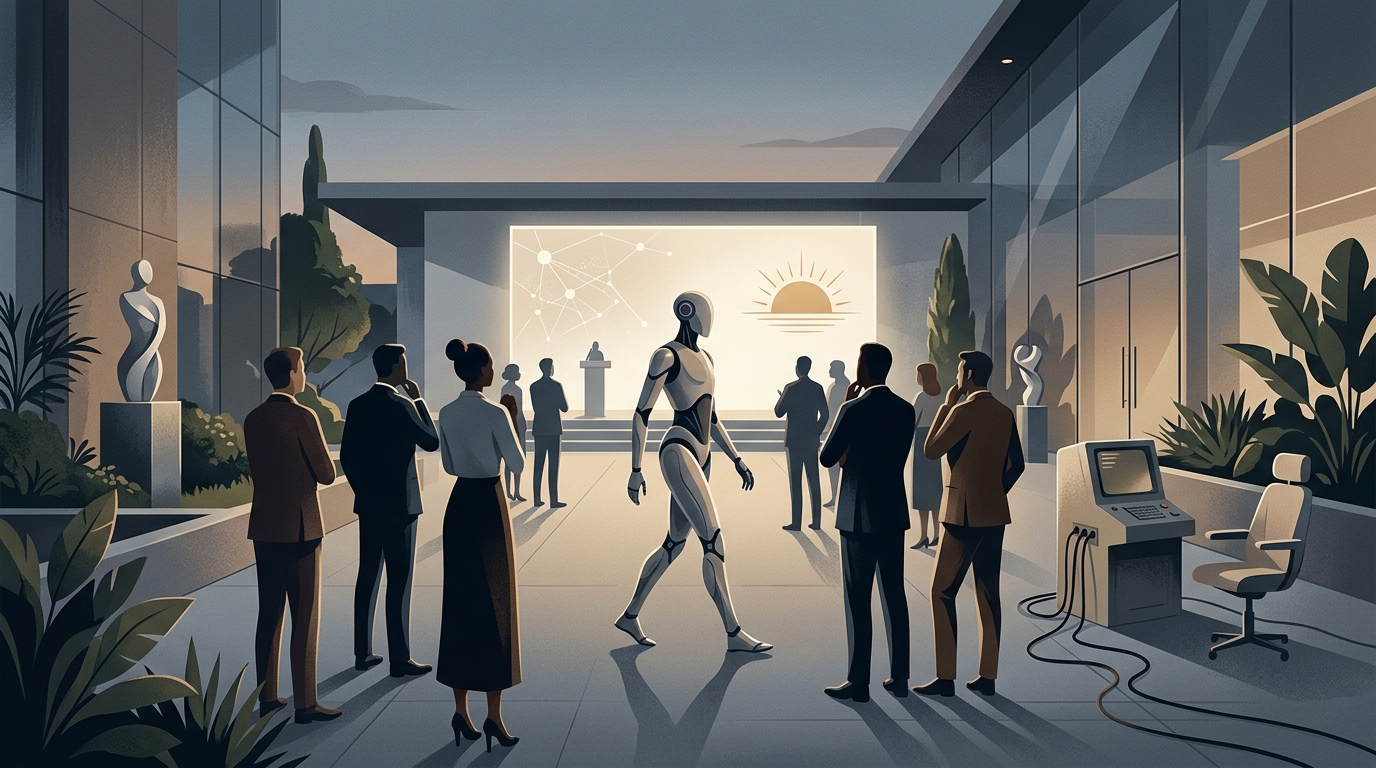
In the high-stakes arena of robotics, the line between true autonomy and a "digital puppet show" has often been uncomfortably thin. However, May 15, 2026, marks a pivotal moment as Figure, the leading developer of humanoid robots, decided to draw a definitive line in the sand. In a comprehensive interview with Bloomberg Tech, founder and CEO Brett Adcock addressed skeptics head-on: the recent livestream of a Figure robot sorting packages in real-time involved zero teleoperation.
The Authenticity Challenge in the Age of Skepticism
Public skepticism is not without merit. Historically, several industry players have been accused of staging demonstrations where robots were covertly controlled by humans wearing VR rigs, creating a facade of advanced intelligence. Figure, however, chose the harder path. The livestream, watched by millions on YouTube and X, was designed to prove that the company's end-to-end neural network model is finally ready for the field.
According to Adcock, the robot's ability to identify objects, calculate optimal movement paths, and correct errors in real-time stems exclusively from its onboard AI. "There is no human in the room, and there is no human in the cloud," he stated. This achievement is not merely a technical milestone; it is a statement of intent regarding the future of industrial automation.
The OpenAI Partnership and Cognitive Revolution
Figure's strategic partnership with OpenAI appears to be yielding results faster than anticipated. While robots of the past required thousands of lines of code for every specific movement, this new generation of humanoids "learns" through observation and reinforcement learning. This allows the robot to adapt to unstructured environments—such as a warehouse where packages are not always in the same position or possess uniform shapes.
Analysis of the livestream data shows a remarkable reduction in latency between perception and action. The robot does not "think" like a 1990s computer; it reacts with a fluidity that approaches human movement. This evolution positions Figure as a formidable competitor to Tesla's Optimus and Boston Dynamics' Atlas.
Economic and Social Implications
Adcock's insistence on the absence of teleoperation has profound economic implications. For a robot to be financially viable on a production line or in a distribution center, it must operate with minimal supervision. If a human is required to control a robot, costs double rather than decrease. Full autonomy is the "Holy Grail" that will enable global scalability.
In markets facing severe labor shortages in logistics, the arrival of such systems could reshape the employment landscape. However, this transition will not be without friction. The need for regulatory frameworks to ensure the safety of humans working alongside these autonomous machines is more urgent than ever. We are moving from a world of programmed tools to a world of collaborative agents.
Conclusion: The Road Ahead
Figure seems to be winning the trust of the tech community, at least for now. The transparency demonstrated through the livestream serves as a lesson for the entire industry. The question is no longer whether humanoid robots will enter our daily lives, but how quickly we can integrate this new form of "embodied intelligence" into our society. Brett Adcock promises that this is just the beginning, and if his claims regarding autonomy hold true, we are witnessing the most significant technological shift since the Industrial Revolution.