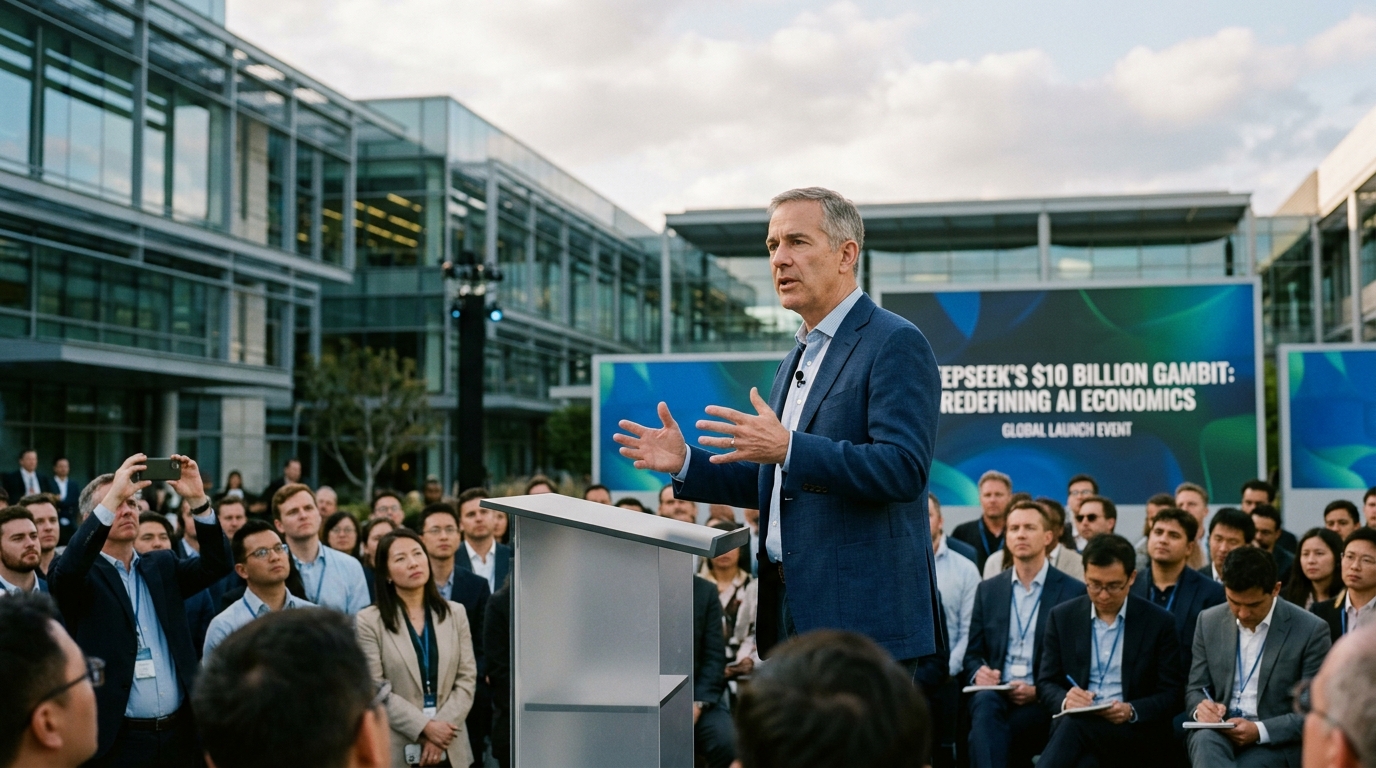
The news that DeepSeek, the Hangzhou-based AI laboratory, is seeking outside funding for the first time at a staggering $10 billion valuation is more than just a business headline. It is a tectonic shift in the global technological landscape. Until recently, DeepSeek operated under the wing of High-Flyer Capital Management, a quantitative hedge fund, remaining a relatively well-kept industry secret. However, the recent release of its DeepSeek-V3 and DeepSeek-R1 models has changed everything, proving that intelligence does not necessarily require multi-billion dollar budgets.
The Efficiency Revolution vs. Brute Force
For years, the dominant narrative in Silicon Valley, championed by OpenAI and Anthropic, has been the "scaling law": the more compute (GPUs) and data you throw at a problem, the smarter the model becomes. This led to an arms race where the cost of training a frontier model soared past $100 million. DeepSeek shattered this myth. It trained DeepSeek-V3 for approximately $6 million, achieving performance levels that directly rival OpenAI’s GPT-4o and Anthropic’s Claude 3.5 Sonnet.
This "architectural elegance," as many analysts call it, is built on innovations such as Multi-head Latent Attention (MLA) and DeepSeekMoE (Mixture of Experts). Instead of activating the entire processor for every query, the model engages only the necessary components, drastically reducing operational costs. For investors, a $10 billion valuation isn't just about the present; it's a bet that AI can become a sustainable, profitable business rather than a capital-intensive "black hole."
"DeepSeek has proven that clever design can defeat raw compute. It is the David that didn't use a sling, but a better mathematical algorithm," says a leading market strategist.
Geopolitical Chess and US Sanctions
DeepSeek’s rise is even more significant when viewed through the lens of US semiconductor export controls. China has been blocked from accessing Nvidia’s most advanced chips (such as the H100 and B200). Despite this, DeepSeek managed to optimize its software so effectively that it performs exceptionally well even on older or restricted hardware. This sends a clear message to Washington: hardware constraints may slow down, but they do not stop, software innovation.
Seeking outside funding at this juncture suggests the company is gearing up for aggressive global expansion. While US restrictions on investing in Chinese tech firms remain stringent, there is intense interest from Middle Eastern sovereign wealth funds and domestic Chinese giants. DeepSeek is no longer just competing for technical superiority; it is fighting for dominance in open-source standards, releasing its models freely and undermining the business model of the West’s closed-wall systems.
Challenges and the Market’s Future
Despite the hype, the path to $10 billion is not without hurdles. DeepSeek must prove it can maintain independence from the Chinese state, a major concern for international investors. Furthermore, the open-source strategy, while fueling rapid adoption, makes monetization a difficult equation.
- Inference Costs: DeepSeek offers its API at prices up to 20 times lower than competitors, forcing OpenAI to slash its own pricing.
- Safety and Censorship: As a Chinese entity, its models must comply with Beijing’s strict content regulations, which could hinder their acceptance in Western markets.
- Talent War: With new capital, the company aims to recruit top-tier researchers globally, offering compensation packages that rival those of Google and Meta.
In conclusion, DeepSeek’s move to seek capital marks the end of the era of "naivety" in AI. The market will no longer reward size alone, but efficiency and architectural ingenuity. If DeepSeek secures this valuation, it will solidify its position as a third pole in a world that, until yesterday, seemed to belong exclusively to California.