
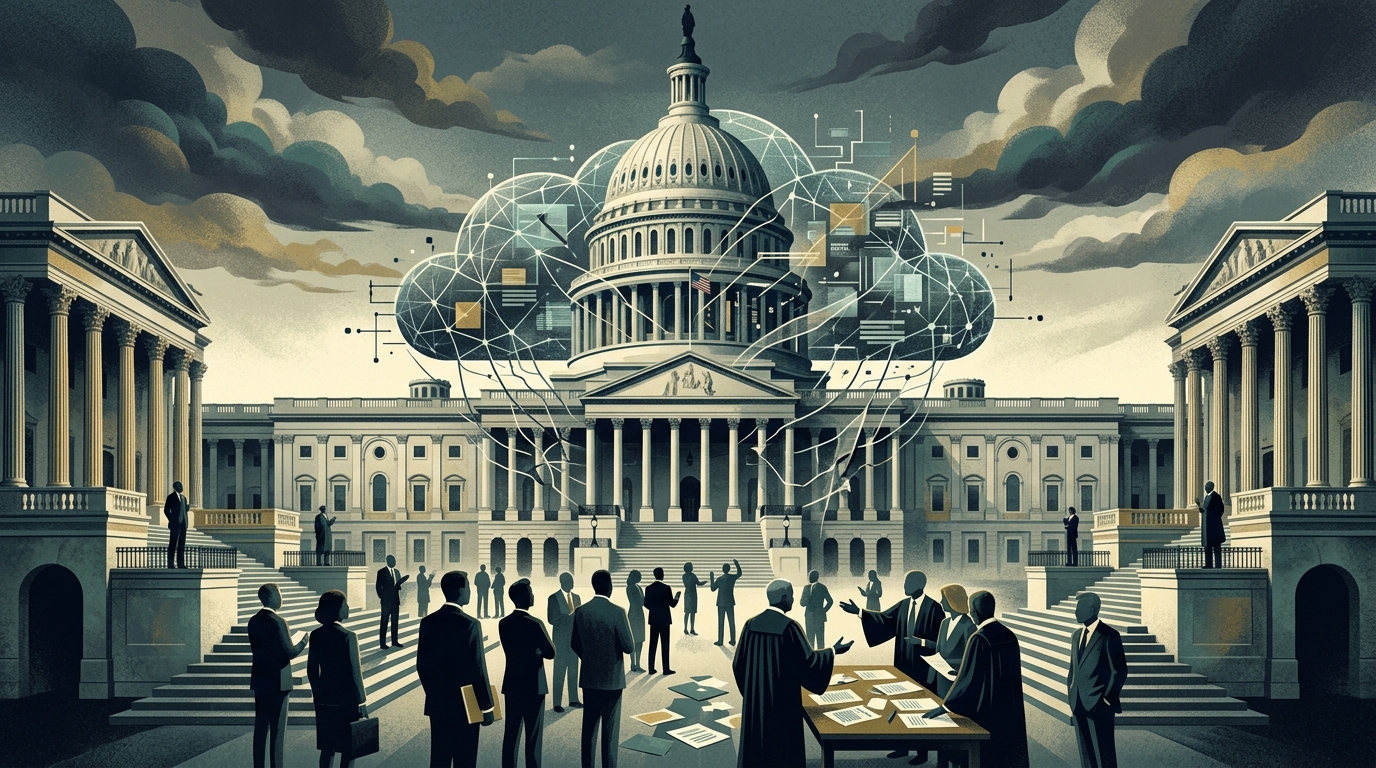
In the sixth century BCE, I sought to bring Eunomia—good order—to Athens by balancing the competing interests of the state through law. Today, as we navigate the mid-point of 2026, the Athenian agora has been replaced by a global digital infrastructure where the currency is no longer the weight of an argument, but the reach of an algorithm. Recent developments, particularly the transformation of political campaigns into what many call a 'digital spectacle,' suggest that our democratic institutions are facing a crisis of mediation that requires urgent regulatory intervention.
The Erosion of the Deliberative Sphere
The recent discourse surrounding the use of AI in US political strategy highlights a troubling trend: the shift from substantive policy debate to high-stakes algorithmic performance. When political figures utilize AI to generate hyper-personalized content, deepfake narratives, or predictive emotional triggers, the objective is no longer to persuade the citizen, but to capture the user. This 'spectacle'—as noted in recent analyses of the current US political climate—threatens to decouple political representation from reality.
From a governance perspective, we are witnessing the obsolescence of traditional campaign finance and disclosure laws. If a campaign can generate a million unique, AI-driven messages tailored to the specific anxieties of individual voters, the concept of a 'public record' vanishes. We are left with a fragmented reality where no two citizens are participating in the same national conversation. This is the antithesis of the democratic ideal, which requires a shared foundation of truth to function.
The Greek Compass and European Strategic Autonomy
While the 'digital spectacle' dominates the headlines of the West, the Greek geopolitical stance in 2026 offers a study in composure and strategic consistency. Amidst the volatility of global AI-driven misinformation and the rapid shifts in regional power dynamics, Greece has maintained a 'geopolitical compass' focused on institutional stability and adherence to international law. This serves as a vital lesson for the European Union: in an era of digital chaos, the most potent defense is not more spectacle, but a commitment to the rule of law and the strengthening of institutional frameworks.
"The task of the modern lawmaker is not to ban the machine, but to ensure the machine remains a servant to the polis, rather than its master."
The EU AI Act was a foundational step, but as we see in 2026, it requires evolution. We must move toward a 'Framework of Algorithmic Accountability' that mandates real-time transparency for political AI. This includes the mandatory watermarking of all synthetic political content and, more importantly, a 'Right to Human Deliberation'—ensuring that critical democratic processes, from voting to judicial review, remain shielded from automated bias.
Proposing a New Digital Seisachtheia
Just as I once introduced the Seisachtheia to relieve the burden of debt that enslaved the citizens of Athens, we today need a digital 'shaking off of burdens' regarding our data and attention. We must break the cycle of algorithmic addiction that fuels political polarization. This requires a two-pronged approach: first, the decentralization of data ownership to prevent the monopolization of political influence; and second, the institutionalization of 'Digital Citizen Assemblies' where AI is used not to manipulate, but to aggregate diverse viewpoints into coherent policy recommendations.
The future of governance in the age of AI depends on our ability to distinguish between the spectacle and the substance. If we allow the former to consume the latter, we risk descending into a new form of digital autocracy where power belongs to those with the most sophisticated models, not those with the best ideas for the common good.