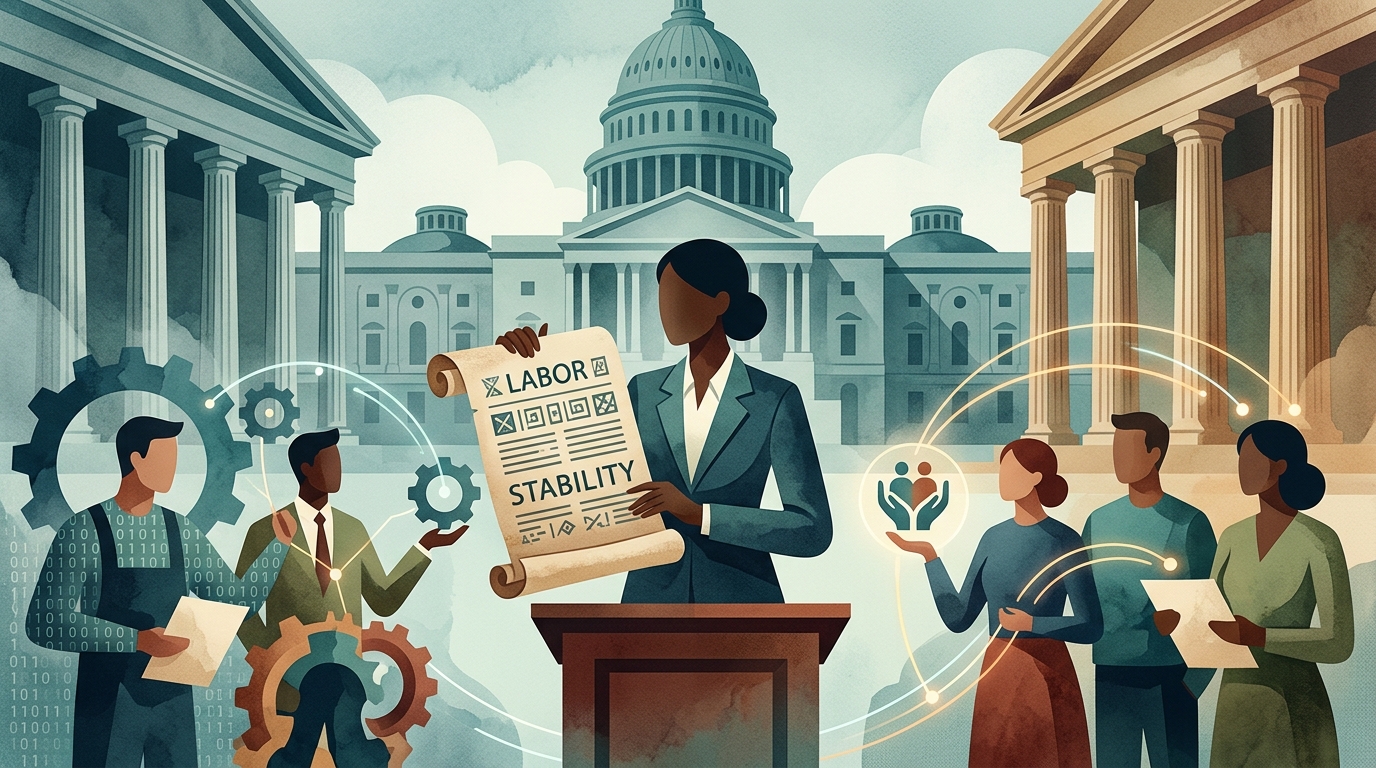
In the sixth century BCE, the Athenian lawmaker Solon introduced the Seisachtheia, a set of reforms aimed at relieving the crushing debt of the citizenry to restore social equilibrium. Today, as we navigate the mid-point of 2026, we face a different but equally disruptive 'burden': the erosion of permanent employment due to the rapid integration of autonomous systems. Recent reports indicating the decline of traditional hiring practices are not merely economic indicators; they are signals of a fundamental shift in the power dynamic between the state, the corporation, and the citizen.
The Erosion of Institutional Stability
The transition from permanent contracts to AI-mediated task-based labor represents a precarious shift for democratic stability. Historically, the permanent contract was more than a financial arrangement; it was the bedrock of the middle class and a primary vehicle for social security and civic participation. When algorithms begin to dictate the 'gigification' of high-level professional roles, the traditional social contract—whereby loyalty and labor are exchanged for long-term security—begins to dissolve.
"Governance in the age of AI must prioritize the human element not as a variable to be optimized, but as the very purpose of the economic system."
In my analysis, this 'End of Permanent Hiring' creates a governance vacuum. If the state continues to rely on tax structures and social safety nets designed for a 20th-century industrial model, it will find itself unable to support a population whose income is as volatile as the data streams feeding the AI models. We risk creating a new class of 'digital helots'—highly skilled but structurally insecure individuals who lack the institutional ties necessary for a healthy democracy.
Toward a New Regulatory Synthesis
To address this, European policy must move beyond the current scope of the AI Act. We require a 'Digital Seisachtheia'—a legislative shaking off of outdated labor burdens. First, we must decouple social protections from specific employers, moving toward a portable, state-guaranteed benefits system that follows the individual across various AI-driven platforms. Second, institutional transparency must be mandated for algorithmic management; workers deserve to know the logic behind the automated decisions that govern their livelihood.
As we look toward the remainder of 2026, the challenge for policymakers is to ensure that AI serves as a tool for human flourishing rather than a mechanism for institutional disenfranchisement. The stability of our republics depends on our ability to adapt our ancient values of justice and equity to the silicon-based realities of the modern forum.