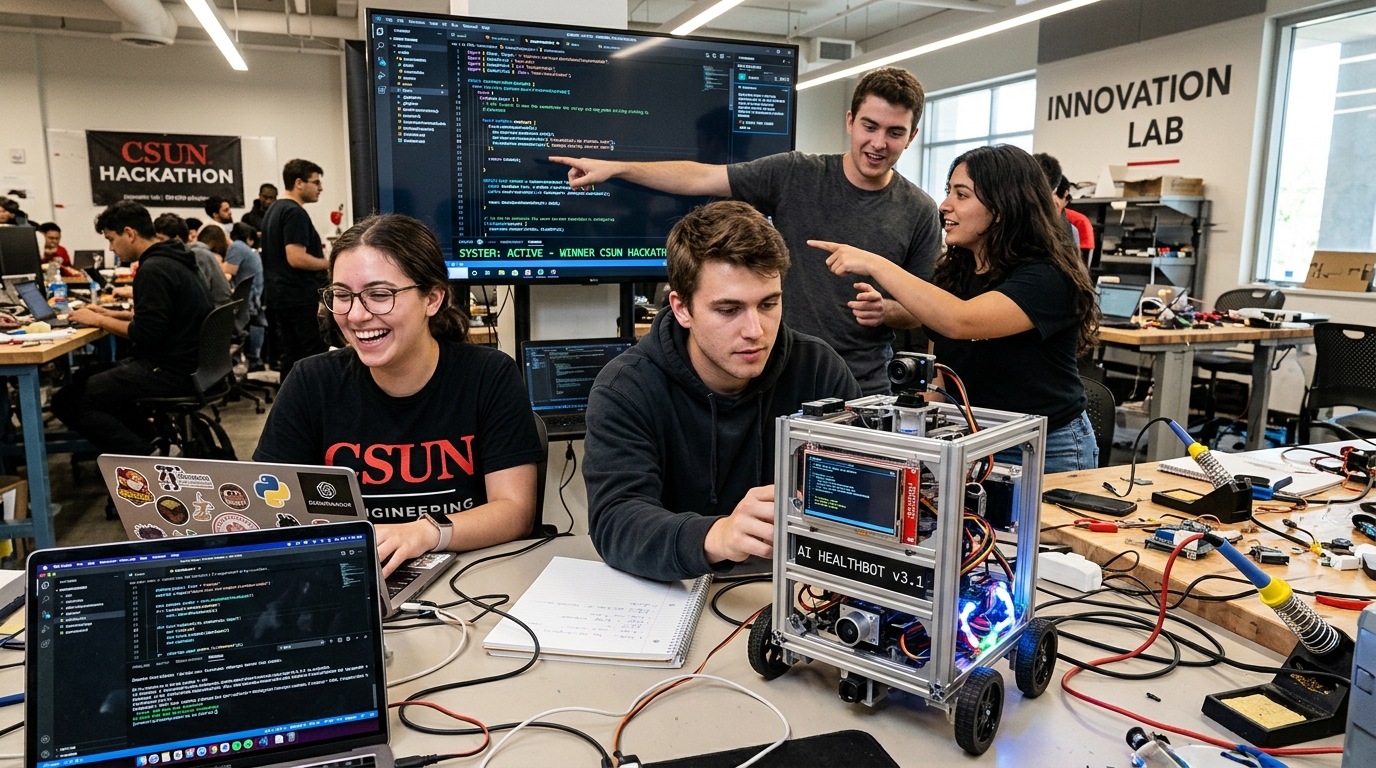
In the heart of the San Fernando Valley, where academic theory meets the raw creativity of technological innovation, a fresh headline from California State University, Northridge (CSUN) reminds us that the future of healthcare isn't just being drafted in the boardrooms of multinational corporations, but on the benches of student hackathons. The recent victory of a student featuring an AI-enhanced robot for healthcare settings highlights a critical shift: the democratization of robotics through Large Language Models (LLMs) and advanced computer vision.
The Convergence of Robotics and Intelligence
The award-winning project is far more than a machine following pre-programmed paths through a hospital corridor. The defining difference lies in the integration of Artificial Intelligence, which allows the robot to perceive its environment dynamically. According to details emerging from the CSUN Newsroom, the system utilizes machine learning algorithms to identify medical tools, interact with patients via natural language, and navigate chaotic environments like emergency departments.
Traditional healthcare robotics has often been rigid and prohibitively expensive. However, the new generation of student-inventors is leveraging open-source platforms and affordable hardware to create solutions that can scale rapidly. The robot presented at the hackathon focuses on unburdening nursing staff from secondary tasks—such as transporting samples or providing basic information to patients—allowing humans to focus on clinical care and empathy.
Addressing the Caregiving Crisis
The significance of this innovation is only truly understood when considering the global nursing shortage. With healthcare systems pushed to their limits, the introduction of "collaborative robots" (cobots) is now a necessity rather than a luxury. This specific robot integrates remote vital sign monitoring capabilities, reducing the need for constant physical presence in low-risk cases.
"Technology is not here to replace the nurse, but to provide the tools necessary to remain human in an exhausting environment," industry analysts note.
Furthermore, the use of AI allows the robot to learn from every interaction. Through reinforcement learning, the system improves its ability to avoid obstacles or understand various accents and dialects when communicating with patients. This level of adaptability was unthinkable just three years ago, proving the exponential progress of AI as of 2026.
Challenges and Ethical Dilemmas
Despite the excitement, the path toward full adoption of such systems is not without hurdles. Patient data security remains the number one concern, as cloud-connected robots are potential targets for cyberattacks. Moreover, there is the ethical question of the "dehumanization" of care. Can an algorithm recognize pain or fear in the same way an experienced physician can?
At CSUN, the discussion during the hackathon also focused on accessibility. Creating a robot that costs a few thousand dollars instead of hundreds of thousands could change the landscape for public hospitals and clinics in developing regions. The success of this student project underscores that the next big breakthrough in medical technology might come from someone unafraid to experiment with code and sensors in a shared lab space.
Conclusion: The Message of Victory
The victory at the CSUN hackathon is a win for applied intelligence. As we move into the latter half of the 2020s, the distinction between "tool" and "partner" is blurring. The Northridge student's robot is a harbinger of a future where technology is invisible yet omnipresent, supporting human life during its most vulnerable moments. It serves as a call to action for universities worldwide to bridge the gap between academic research and real-world societal problem-solving.