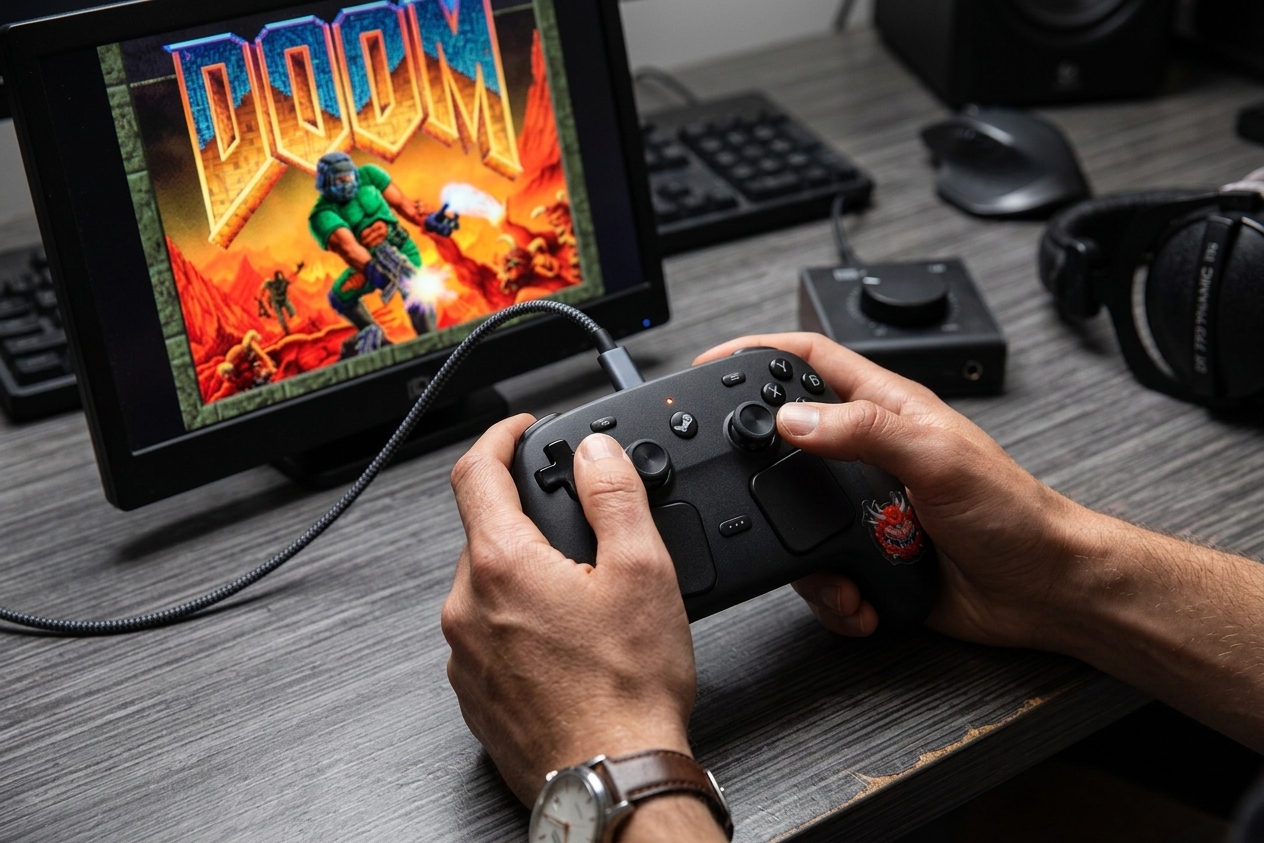
In the tech world, there is an unwritten law: if it has a processor, it must eventually run Doom. However, Valve seems to be taking this dogma a step further with the new Steam Controller. It is no longer just about whether a device can render the demons of Mars, but whether it can sing them. The recent revelation that the controller's haptic actuators can be programmed to produce specific frequencies, turning the device into a makeshift speaker, is not just a cute easter egg. It is a demonstration of technical precision that highlights the chasm between Valve and its hardware competitors.
The Physics of Vibration: How Hardware Finds a Voice
To understand how a game controller can reproduce the "Still Alive" theme from Portal or the iconic Super Mario Bros. 2 ground theme, we must look at the heart of haptic technology. Unlike traditional controllers that use Eccentric Rotating Masses (ERM) to create a general sense of rumble, the Steam Controller utilizes Linear Resonant Actuators (LRAs). These mechanisms are capable of extremely fast and precise movements, allowing for the control of frequency with mathematical accuracy.
When an actuator vibrates at a specific frequency—for example, 440Hz—it produces the note A4. By combining different frequencies and rhythms via software, Valve allows modders and developers to use the controller as a type of electromagnetic speaker. The result is a metallic, almost 8-bit sound that emerges directly from the player's palms. What began as a way to provide feedback for trackpad usage has evolved into a full acoustic experience that blurs the lines between touch and sound.
Valve's Philosophy: Open Systems and Community
The success of this quirk is not solely due to the hardware, but to Valve’s unique culture. While Sony and Microsoft keep their hardware protocols strictly proprietary, Valve encourages experimentation. The ability for the Steam Controller to "sing" was discovered and perfected largely by the user community through the Steam Workshop. This highlights a broader trend in technology: the value of a tool is no longer defined only by its intended use, but by its capacity to be redefined by the end-user.
"You aren't just buying a controller; you're buying a piece of programmable matter that happens to have buttons," says one of the modders involved in creating MIDI scripts for the device.
This approach has deep socio-political implications. In an era where the Right to Repair and hardware freedom are under pressure, Valve remains a beacon for those who believe the purchaser should have full control over their device. The ability to modify a controller's firmware to make it play music is the ultimate expression of ownership in the digital age.
From Doom to Immersion: The Future of Interfaces
Beyond the novelty, this technology has practical applications that could reshape gaming. The ability to produce such detailed vibrations means players can "feel" the texture of different surfaces within a game or perceive the direction of an enemy through touch alone. If the controller can reproduce a complex melody, imagine how realistically it can simulate the tension of a trigger or the friction of tires on wet asphalt.
In conclusion, the Steam Controller’s song is a reminder that innovation often hides in the details we take for granted. Valve hasn't just created an input tool, but a multi-sensory bridge between the digital and physical worlds. As we move toward 2027, the challenge for manufacturers will be to offer experiences that don't just appeal to the eyes, but to all our senses, turning the interaction with the machine into a form of art.