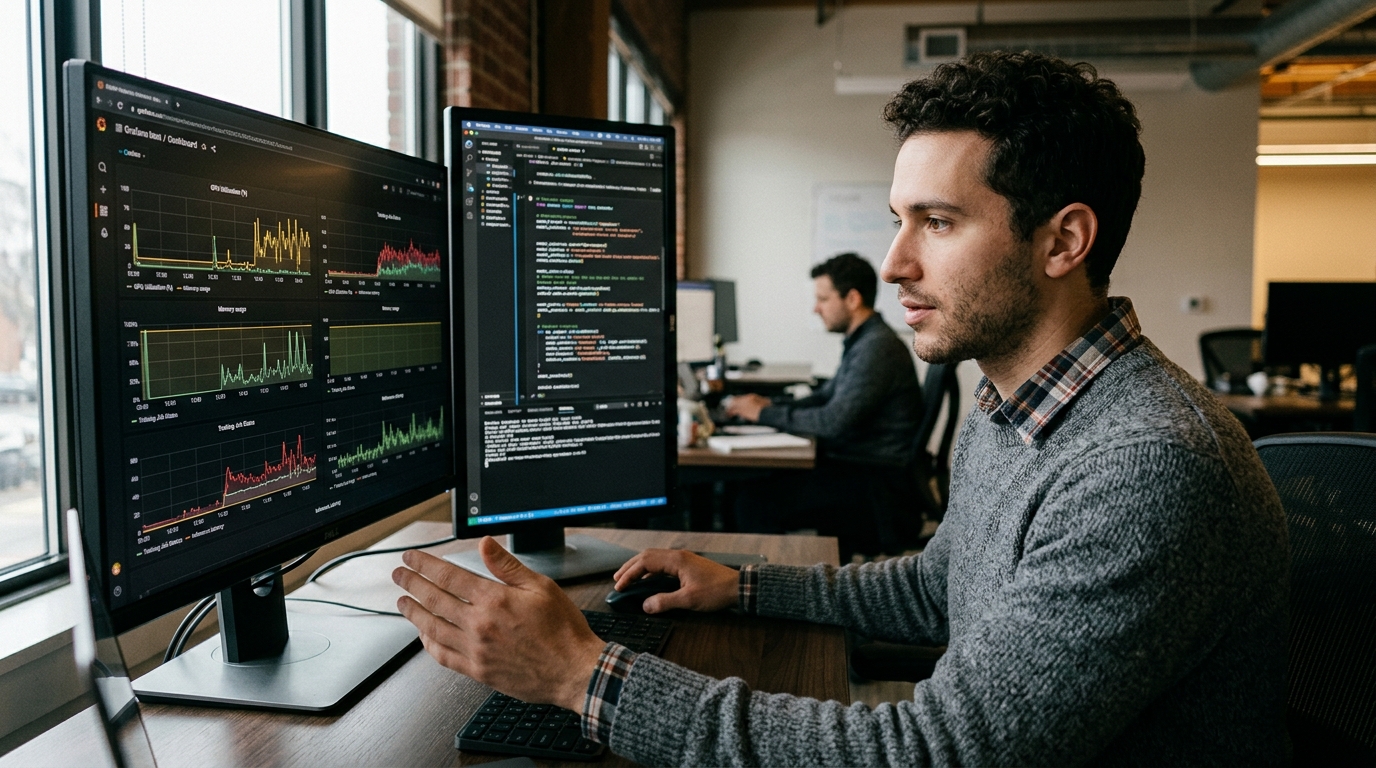
The era of "wild experimentation" with Large Language Models (LLMs) is drawing to a close, making way for a period of rigorous engineering discipline. Amazon Web Services (AWS), recognizing that the transition from prototype to production remains the biggest hurdle for enterprises, has announced a comprehensive suite of observability tools for Amazon SageMaker AI. This move isn't just about measuring speed; it's about fully understanding how a model interacts with data and users in real-time.
The Dual Challenge: Infrastructure and Semantics
Until now, monitoring AI systems has been fragmented. DevOps teams focused on GPU utilization, memory, and network latency, while data scientists worried about response accuracy and hallucinations. AWS's new approach unifies these two worlds. At the infrastructure level, SageMaker now provides deep analysis of Tensor core usage and power consumption, allowing companies to optimize costs in an environment where compute power remains expensive and scarce.
However, the real innovation lies in content observability. By integrating quality evaluation tools, developers can monitor metrics such as toxicity, relevance, and faithfulness of responses. This is particularly critical for Retrieval-Augmented Generation (RAG) systems, where the model must extract information from external sources without distorting their meaning.
Decoding RAG and Inference Quality
At the heart of modern enterprise AI applications lies RAG. Observability in SageMaker now allows users to see the entire journey of a prompt: from the moment it enters the system, through the retrieval of relevant documents, to the final synthesis of the response by the LLM. This transparency enables the identification of the exact point of failure. Is it the vector database failing to find the right document, or the LLM failing to interpret it?
- Hardware Metrics: Real-time monitoring of GPU utilization and memory bandwidth.
- Token Metrics: Analysis of Time to First Token (TTFT) and overall throughput.
- Quality Indicators: Automated accuracy assessment via SageMaker Model Monitor.
Strategic Importance for the AWS Ecosystem
This move by AWS is a clear response to competition from Microsoft (Azure) and Google (Vertex AI). By offering a "one-stop-shop" for model development, deployment, and monitoring, Amazon aims to make SageMaker the de facto operating system for enterprise AI. The ability to see inference cost per query combined with response quality gives CFOs the necessary visibility to approve larger AI investments.
"Observability is no longer a luxury; it is the safety net that allows AI to move from the lab into the real economy," market executives note.
Conclusion: Toward Self-Healing AI
The future outlined by these tools is the creation of systems that are not only monitored but also self-healing. With the observability data collected by SageMaker, businesses can create feedback loops where the system detects a drop in quality and automatically routes queries to a more powerful model or refreshes its knowledge base. AWS is not just offering a control tool, but the foundation for the reliable AI of tomorrow.