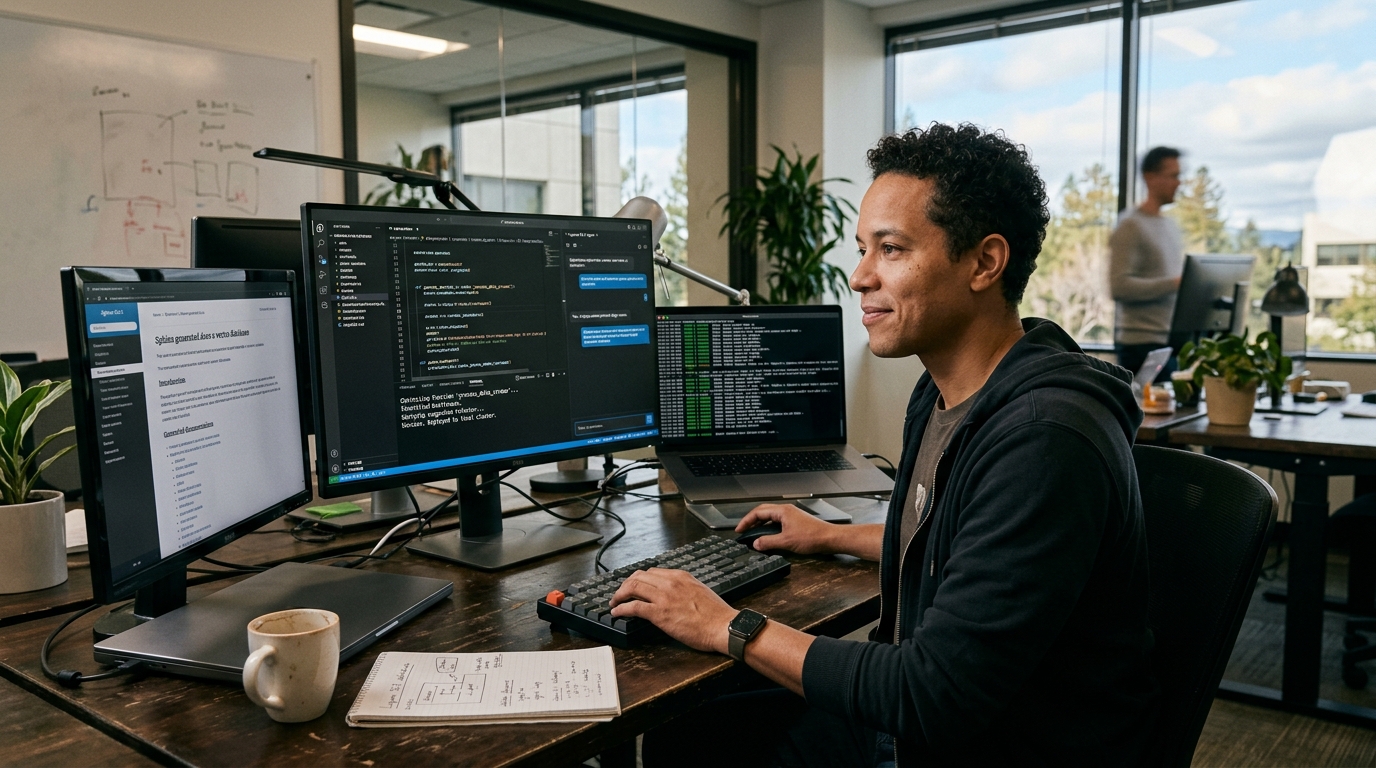
In the relentless AI arms race, where giants like OpenAI and Anthropic exchange blows with multi-billion parameter proprietary models, an American startup named Poolside has decided to disrupt the status quo. The release of Laguna XS.2 isn’t just another drop in the ocean of Large Language Models (LLMs). It is a calculated strategic move targeting the very heart of software engineering: local, agentic productivity.
Laguna XS.2 is offered as an open-weights model, allowing developers to run it directly on their local machines. This effectively dismantles two of the most significant barriers to enterprise AI adoption: the recurring cost of high-end APIs and the pervasive anxiety surrounding intellectual property. When code never leaves the developer’s workstation, security shifts from a theoretical concern to a built-in feature.
The Era of Agentic Intelligence
But what exactly does "agentic" coding entail? Unlike traditional models that act as sophisticated autocompletion engines, agentic models like Laguna XS.2 are designed to operate at the task level. They can decompose a complex problem, architect a solution, write the implementation, run tests, and self-correct. This evolution—from "write me a function" to "build me this feature"—represents the next great frontier in software development.
Poolside, backed by over $500 million in venture capital, is no underdog. With founders like Jason Warner, the former CTO of GitHub, the company possesses the pedigree to understand what developers actually need in their daily workflow. Laguna XS.2 is optimized to be lightweight yet formidable, enabling complex reasoning loops without the need for massive server farms.
Local Execution: The New Standard
The industry-wide pivot toward local execution is driven by a desperate need for low latency. For a developer in a "flow state," every millisecond spent waiting for a remote server's inference is a potential distraction. Laguna XS.2 promises near-instantaneous feedback, effectively turning AI into a seamless extension of the programmer’s own cognitive process.
"The true power of Laguna XS.2 lies not just in the code it generates, but in the autonomy it restores to the creator, free from the tethers of usage quotas or privacy trade-offs," industry analysts suggest.
Furthermore, Poolside is clearly playing the long game of ecosystem building. By releasing the model for free, they are capturing the mindshare of the developer community—the very people who will refine, fine-tune, and integrate Laguna into their personal toolchains. This "bottom-up" strategy has historically proven far more resilient than the walled-garden approaches of corporate titans.
Challenges and the Competitive Landscape
The path forward is not without hurdles. OpenAI’s GPT-4.5 and Anthropic’s Claude 3.5 Sonnet remain the gold standards for raw reasoning and context window management. The gamble for Poolside is whether a smaller, hyper-specialized model can truly outperform general-purpose giants in specialized coding scenarios.
- Specialization: Laguna XS.2 is "born in code," prioritizing logic over general trivia.
- Efficiency: Low VRAM requirements make it accessible to standard professional laptops.
- Openness: The potential for community-driven fine-tuning could accelerate its growth exponentially.
In conclusion, Poolside’s latest move signals a paradigm shift where AI ceases to be a remote service and becomes a local utility, as indispensable as a compiler or a text editor. As we look toward the future of the "AI Software Engineer," models like Laguna XS.2 are proving that sometimes, the most powerful tools are the ones you can carry in your pocket—or at least, on your local hard drive.