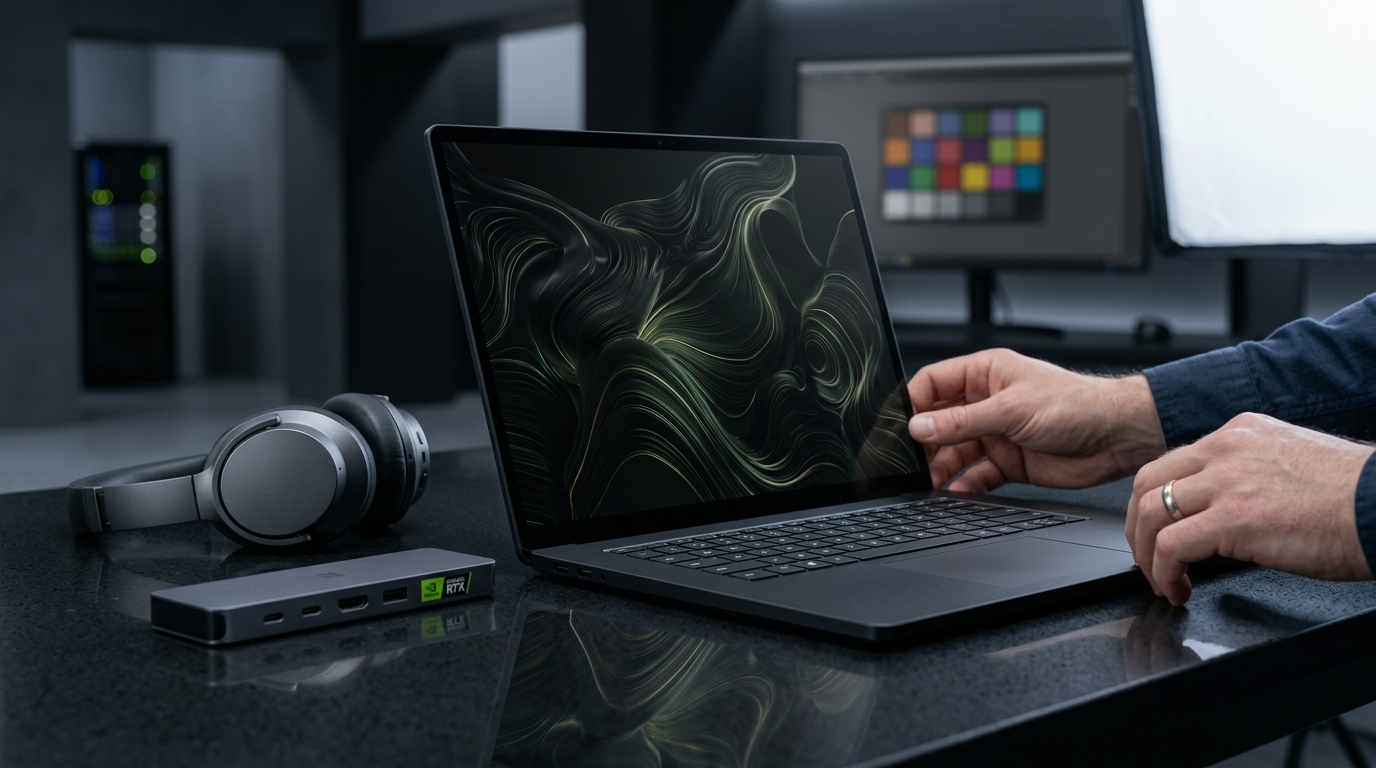
Technology history is a series of cycles, and today, Microsoft seems to be closing one of its most painful chapters. In 2012, the Redmond giant was forced to write off $900 million after betting on an Arm-based Nvidia chip that failed to deliver with the original Surface. Today, June 1, 2026, Microsoft has announced the Surface Laptop Ultra, a device that doesn't just aim to fix past mistakes but seeks to completely overturn Apple's dominance in the premium workstation market.
The RTX Spark Architecture: The Heart of the Revolution
The centerpiece of the new Surface Laptop Ultra is the RTX Spark silicon. This processor was born from a deep collaboration between Microsoft and Nvidia engineers, merging the efficiency of Arm architecture with the raw power of Nvidia’s Tensor cores. Unlike previous Windows on Arm attempts, the RTX Spark isn't a mobile chip trying to masquerade as a desktop processor. It is a 24-core beast, designed from the ground up for local Artificial Intelligence processing (Edge AI).
Nvidia has integrated a new processing unit called the "Neural Ray Engine," which enables real-time ray tracing with minimal power draw. For content creators, this means rendering tasks that once required a bulky GPU and a constant power supply can now be handled on a slim device with a battery life exceeding 20 hours. Microsoft claims the Surface Laptop Ultra outperforms the MacBook Pro M4 Max in generative AI tasks by a staggering 40%.
Software and Compatibility: The End of Compromise
The biggest hurdle for Arm-based laptops has always been software. With the Surface Laptop Ultra, Microsoft is introducing "Windows 12: Silicon Native." This OS version is fully optimized for the RTX Spark, offering an emulation layer for legacy x86 applications that is virtually invisible to the user. Prism 2.0, Microsoft’s answer to Apple’s Rosetta, allows apps like Adobe Premiere Pro and Blender to run at near-native performance levels.
Furthermore, Microsoft has baked Copilot Pro directly into the hardware level. The RTX Spark features a dedicated data bus for AI, meaning your personal data never needs to leave the device for processing. Privacy meets speed, as the laptop can run large language models (LLMs) with up to 70 billion parameters locally without noticeable latency.
Design and Ergonomics: The Luxury of Power
Design-wise, the Surface Laptop Ultra follows a minimalist philosophy. Its chassis is crafted from a "Titanium-Ceramic" alloy, offering extreme durability and light weight. The 14.5-inch PixelSense Flow display supports a 165Hz refresh rate and boasts the highest brightness ever seen on a Surface, peaking at 2,000 nits. It is clear that Microsoft is targeting the elite tier of professionals who refuse to compromise.
The starting price, however, reflects this luxury. With the base model starting at $2,499, the Surface Laptop Ultra is not meant for the average student or office worker. It is a statement of power—a tool for the architect, the data scientist, and the video editor who demand absolute freedom. Microsoft isn't just selling a laptop; it's selling a vision of a future where hardware and AI are inseparable.
Strategic Market Implications
This move also signals a major shift in Silicon Valley’s power dynamics. Intel, Microsoft’s traditional ally, finds itself in a precarious position as it watches its biggest partner turn to Nvidia for its flagship product. The Microsoft-Nvidia alliance creates a new gravity well that could force the entire PC ecosystem to accelerate the transition to Arm architecture. If the Surface Laptop Ultra succeeds commercially, it will be the definitive confirmation that the era of x86 processors in laptops is drawing to a close.