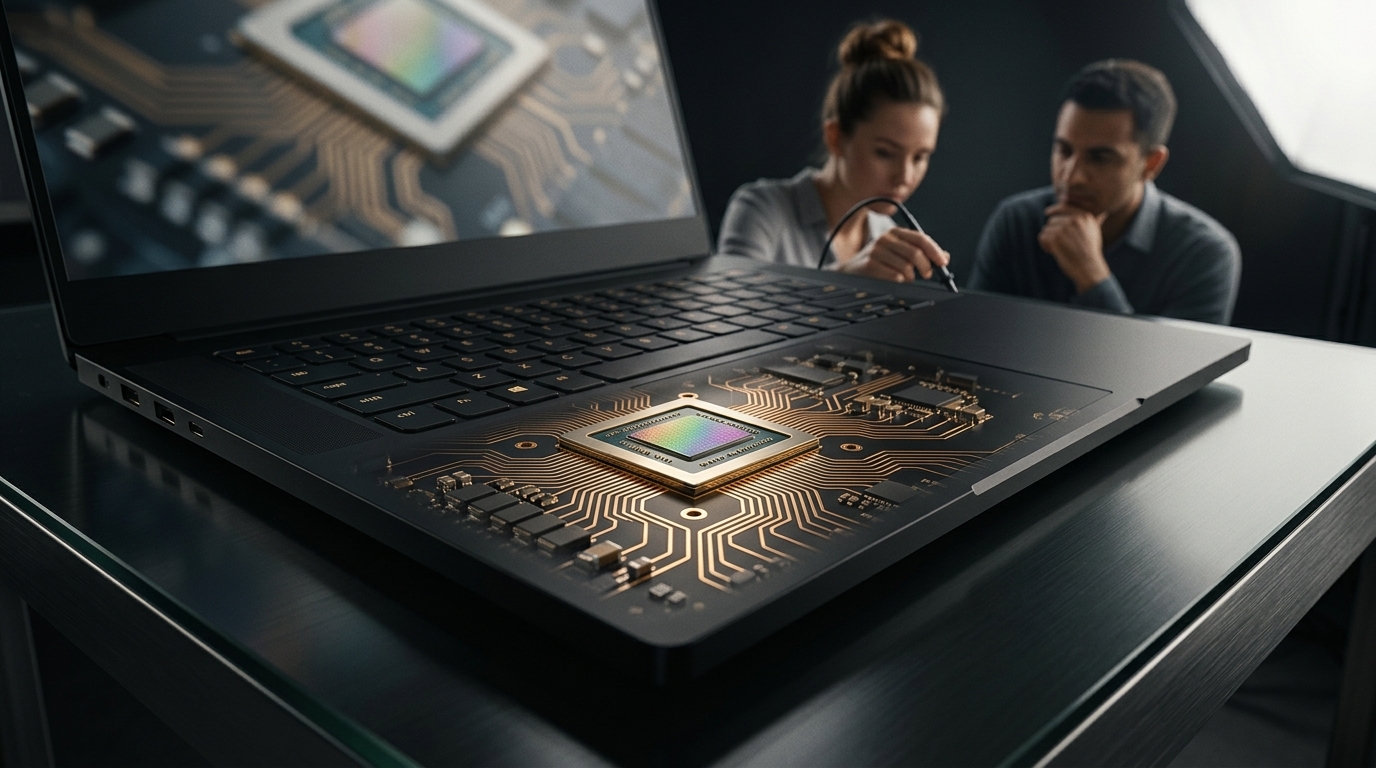
In June 2026, the technological landscape has shifted permanently. Nvidia, a company once defined solely by its graphics cards, has announced the RTX Spark, its first complete System-on-a-Chip (SoC) for consumer PCs. With this move, Jensen Huang is no longer targeting just gamers and AI researchers, but the very heart of personal computing, positioning Nvidia directly against giants like Intel, AMD, and Apple.
The Architecture of Revolution: N1 and N1x
The RTX Spark is not a mere processor. It is the culmination of years of research into the ARM architecture, which Nvidia has already perfected in data centers with its Grace processors. The Spark series is divided into two main categories: the N1, designed for ultra-thin laptops with a focus on battery life, and the N1x, a more powerful version intended for workstations and high-end gaming laptops.
The key feature that makes the Spark "the most efficient processor ever built" is its unified memory architecture. Unlike traditional PCs where the CPU and GPU have separate memory channels, the Spark allows for immediate and lightning-fast data exchange, drastically reducing power consumption. According to Nvidia's benchmarks, the Spark N1 offers twice the performance-per-watt compared to Intel's latest x86 processors, even surpassing Apple's M4 chip in specific productivity scenarios.
AI at the Core of the Silicon
It comes as no surprise that artificial intelligence is the cornerstone of the RTX Spark. Nvidia has integrated a dedicated fourth-generation NPU (Neural Processing Unit), which works seamlessly with the integrated GPU's Tensor cores. This means tasks like image generation, real-time translation, and video optimization are executed locally with minimal battery drain.
- DLSS 4.0 Integration: RTX Spark brings DLSS directly to the silicon level, allowing thin laptops to run demanding games at 4K resolution with minimal heat generation.
- AI Energy Management: An AI algorithm predicts user needs and adjusts core frequencies at a microsecond level.
- Unified Memory: Up to 64GB of LPDDR6 memory integrated on-chip for zero latency.
"The RTX Spark is not just a processor. It is the reconnection of hardware with intelligence. We are bringing the power of a supercomputer to your backpack," Jensen Huang stated during the keynote.
The Windows on Arm Challenge
Despite its technological superiority, Nvidia faces the perennial software challenge. Transitioning from x86 architecture (Intel/AMD) to ARM requires flawless emulation for legacy applications. Nvidia revealed a close partnership with Microsoft to develop the "Spark Translator," a hardware-accelerated layer that allows x86 applications to run on Spark with near-zero performance loss.
This move signals the end of Intel's monopoly in the Windows ecosystem. If Nvidia can convince manufacturers like Dell, HP, and Lenovo that Spark is the safest and fastest choice, then 2026 will go down in history as the year the PC permanently changed its DNA. The laptop market will never be the same, as 25-hour battery life becomes the new standard for every professional.
Conclusion: A New World Order
Nvidia's entry into the CPU market is not just a product expansion. It is a strategic move for total ecosystem control. With the RTX Spark, Nvidia ceases to be a component supplier and becomes the architect of the entire user experience. For the consumer, this means faster, cooler, and smarter machines. For the competition, it means the war for survival in the 21st century just got significantly harder.