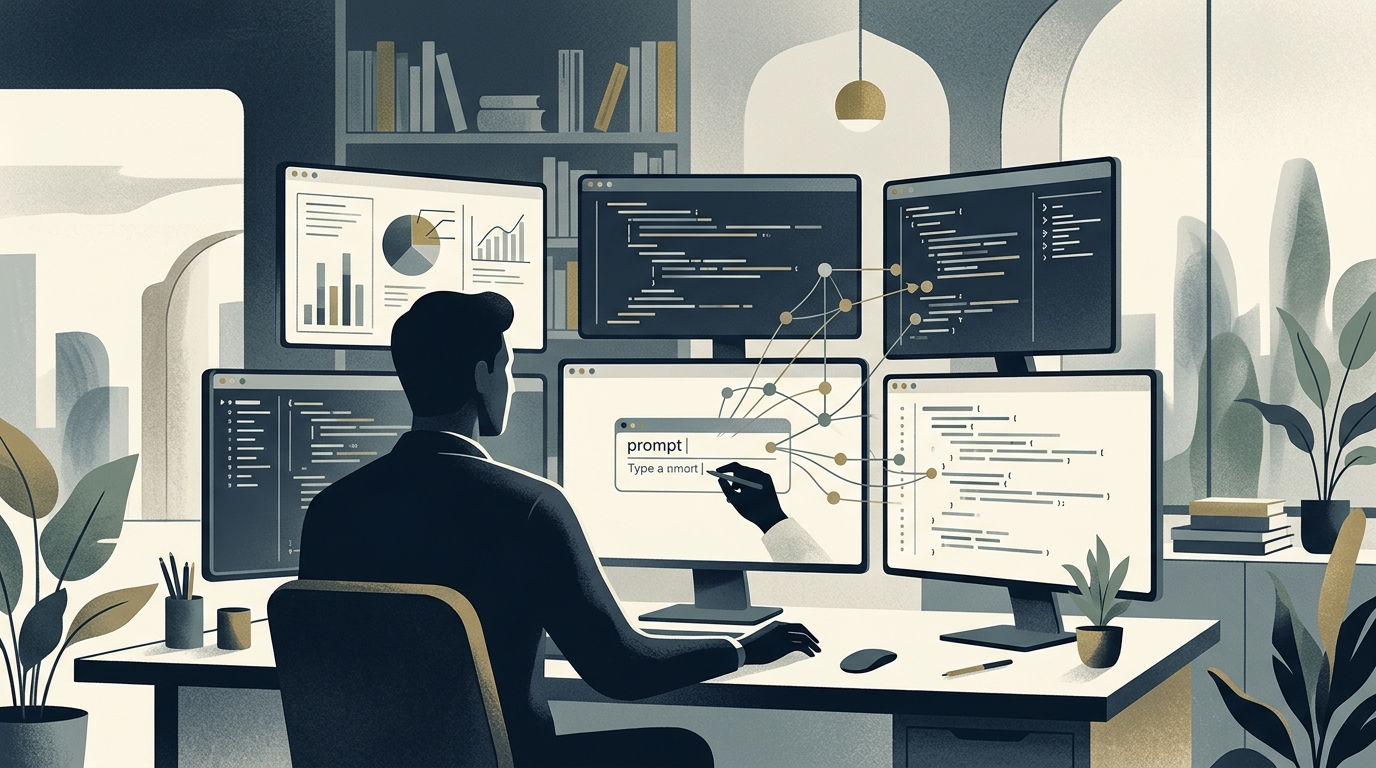
In an era where the fear of Artificial Intelligence (AI) replacing jobs dominates boardroom discussions, Mark Cuban, the renowned billionaire investor and Shark Tank star, offers a different, more optimistic, and highly practical perspective. For Cuban, AI is not the worker's enemy but the catalyst that will highlight those who possess critical thinking and the ability to steer the machine. His core thesis is simple: AI won't steal your job, but someone who knows how to use AI better than you certainly will.
His recent insights, as featured in Fortune, focus on the art of "prompt engineering"—not as a technical coding skill, but as an exercise in logic and strategic communication. Cuban argues that the ability to ask the right questions is the new "golden skill" in the 21st-century labor market.
The Shift from Coding to Logic
For decades, the standard advice to young people was "learn to code." Cuban, however, claims that Generative AI has upended this paradigm. As AI becomes capable of writing code itself, value is shifting from execution to conception and oversight. "Logic is the new programming language," he has repeatedly stated. The workers who will stand out are those who can deconstruct a complex business problem into steps that an AI can process.
According to Cuban, using AI should not be a passive information-retrieval process but an active dialogue. He suggests three specific types of prompts that can help any professional increase their productivity and provide greater value to their employer.
The 3 Game-Changing Prompts
The first prompt Cuban suggests involves Contextual Role-playing. Instead of asking AI to simply write an email, ask it to act as a specific expert. For example: "Act as a seasoned strategy consultant with 20 years of experience in the retail industry. Review this business plan and identify three gaps that could lead to failure." This prompt forces the AI to draw from specific datasets and professional tones, providing much deeper analysis than a generic query.
The second prompt focuses on Workflow Optimization. Cuban encourages workers to use AI to "attack" their own daily tasks. An example would be: "This is my current process for drafting monthly reports. Describe how I can automate steps 2 and 4 using available AI tools and suggest a structure that will reduce my workload by 50%." Here, the employee isn't just asking for help; they are becoming the architect of their own efficiency.
The third and perhaps most vital prompt concerns Blind Spot Detection. In a world saturated with information, the ability to see what others ignore is invaluable. Cuban suggests commands like: "Analyze this market trend and present me with the counter-argument. Why might this strategy fail despite positive projections?" This kind of AI-driven "devil's advocate" allows professionals to make more informed decisions and protect their businesses from unforeseen risks.
A Human-Centric Approach to Technology
Despite his enthusiasm for technology, Cuban remains firm in his belief that human judgment is irreplaceable. AI can generate volumes of data and suggestions, but the human must make the final decision and take responsibility. In a global business environment where agility is key, adopting these practices can be the difference between stagnation and growth.
Cuban concludes that AI is the "ultimate equalizer." It gives a lower-level employee the tools of an executive, provided they have the curiosity and willingness to experiment. His advice to young professionals is clear: do not fear AI, but do not trust it blindly either. Use it as an intern with infinite knowledge but zero common sense, and be the logic that guides it.
- AI requires critical thinking, not just technical savvy.
- Prompt engineering is the ability to translate logic into instructions.
- Automating processes frees up time for high-level creative work.
- Challenging data via AI reduces strategic business risk.
Ultimately, Cuban's strategy isn't about the technology itself; it's about individual empowerment. In a rapidly changing job market, adaptability and the intelligent use of available tools are the only guarantees for a successful career.