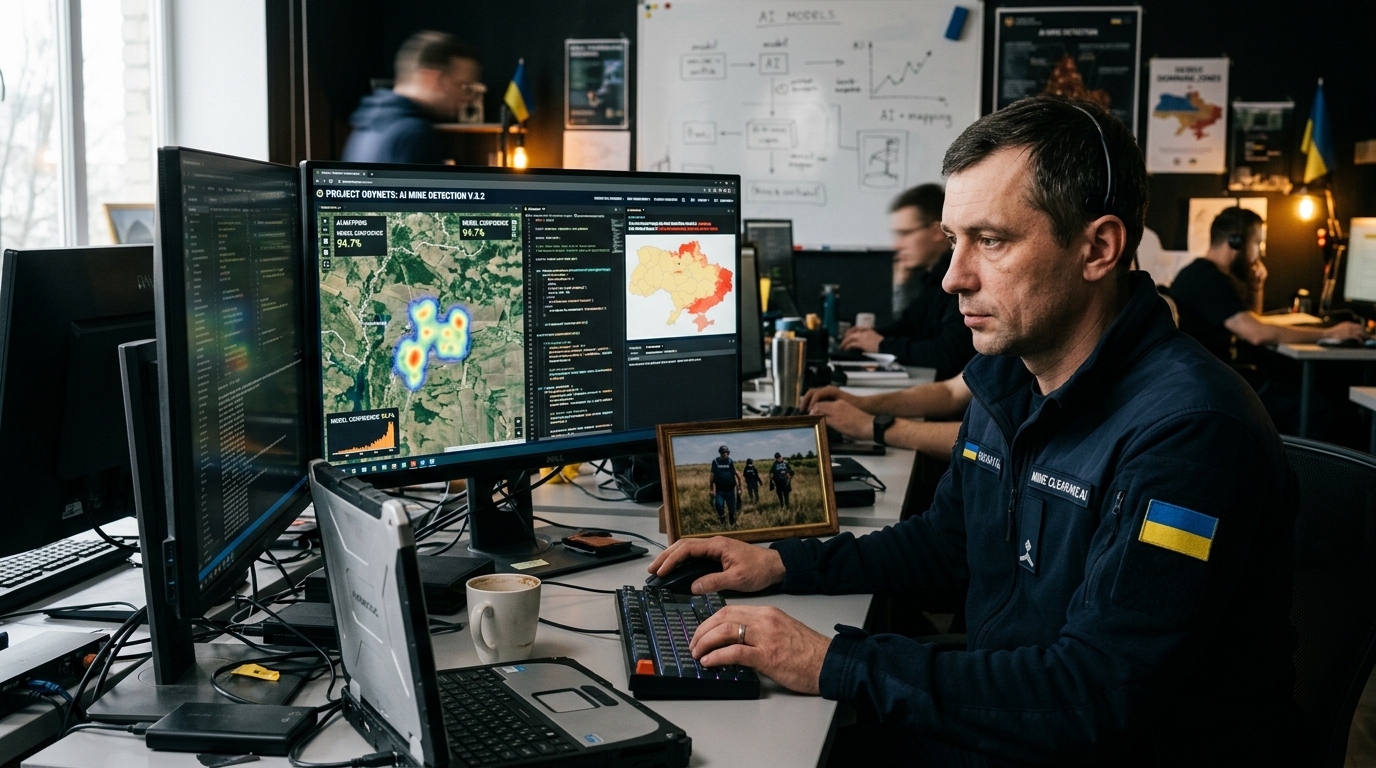
Ukraine is currently the most heavily mined country on Earth. With an estimated 30% of its territory contaminated by explosive devices, the challenge of demining is no longer just a matter of courage and manual labor; it is a titanic battle of data and technology. The integration of Artificial Intelligence (AI) into land clearance is not merely an innovation but a vital necessity for the country's survival and the restoration of global food security.
The Scale of Destruction and the Need for Speed
According to World Bank estimates, the cost of fully demining Ukraine could exceed $37 billion. Using traditional methods—humans with metal detectors moving centimeter by centimeter—the process would take decades, if not centuries. This is where Artificial Intelligence steps in. By analyzing satellite imagery, drone data, and historical conflict records, algorithms can map "suspect" areas with a precision that was unthinkable just a few years ago.
The use of Palantir’s platform, which works closely with the Ukrainian government, is a prime example. The system processes vast amounts of data to prioritize areas for clearance. It’s not just about finding a single mine; it’s about understanding where they are most likely to be based on Russian military doctrine, terrain geomorphology, and proximity to critical infrastructure.
Drones and Thermal Imaging: Seeing the Invisible
One of the most impressive applications of AI in Ukraine is the use of drones equipped with multispectral and thermal sensors. Mines, being made of metal or plastic, retain heat differently than the surrounding soil. During sunrise or sunset, these temperature differences become visible to thermal cameras. Machine learning algorithms are trained to recognize these thermal "signatures" and distinguish them from rocks or other debris.
- Automated Detection: Drones fly over hazardous zones without risking human lives.
- Real-time Analysis: Image processing is handled by AI models that have "seen" thousands of examples of mines like the PFM-1 (butterfly) or TM-62.
- Digital Mapping: Findings are instantly converted into digital maps that guide demining teams on the ground.
"AI doesn't replace the person who removes the mine from the ground, but it tells them exactly where to dig, reducing search time by up to 80%," says a specialist from the HALO Trust.
Challenges and Ethical Dilemmas
Despite technological progress, AI-driven demining is not without its flaws. "Noise" in the data—such as debris from shellings, destroyed vehicles, and shrapnel—can lead to false positives. Furthermore, the reliance on foreign tech giants raises questions about data sovereignty and the long-term sustainability of these systems once the conflict ends.
Moreover, there is the danger of over-reliance on technology. An algorithm's failure to detect a mine could be fatal for a farmer returning to their field under the false impression of safety. Human oversight remains the critical factor in certifying an area as "clear."
The Future: A Global Blueprint
The experience being gained in Ukraine is set to change how humanitarian operations are conducted worldwide. From Cambodia to Angola, the methods being tested today under the most adverse conditions will become the "gold standard" for clearing land of the remnants of war. Technology, often accused of automating destruction, finds its most noble purpose here: restoring life where death lurks beneath the surface.