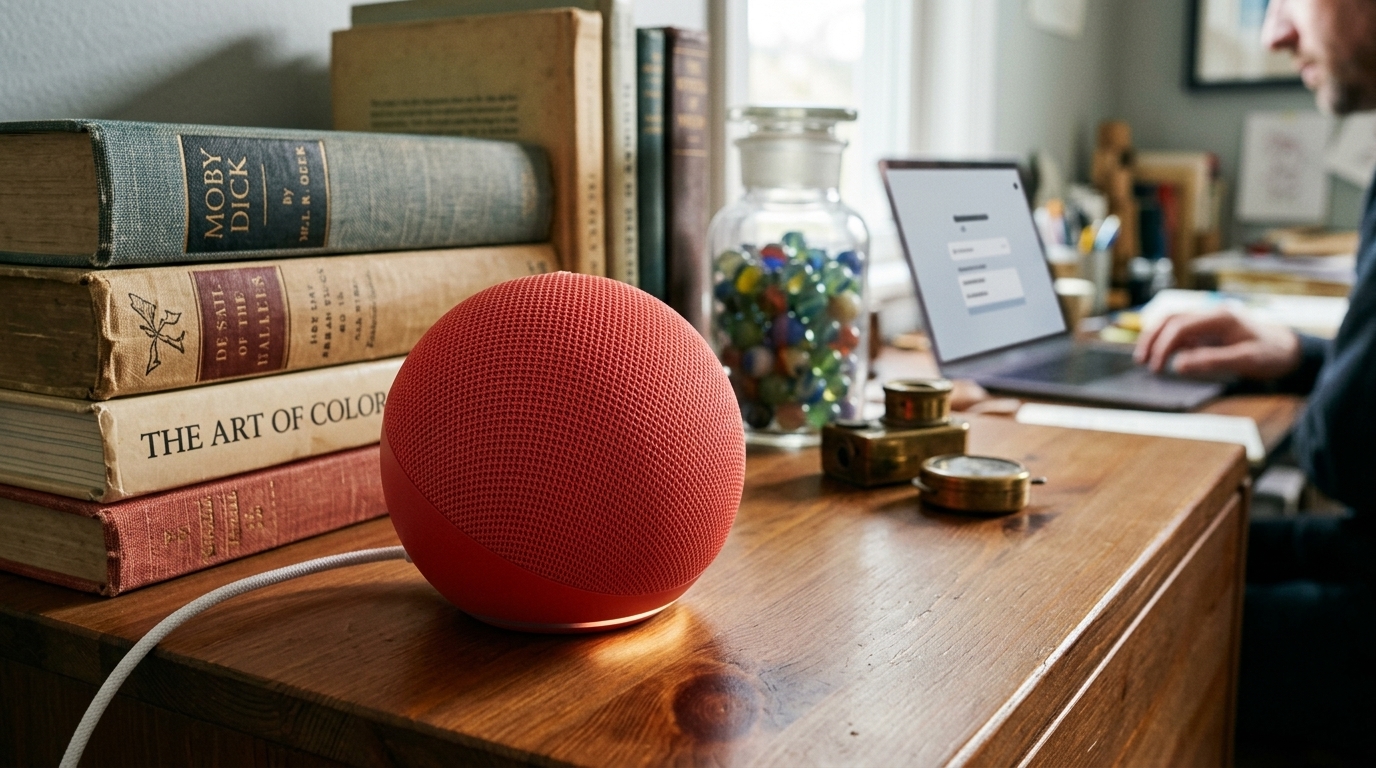
In the fast-paced world of consumer electronics, first impressions are often dictated by aesthetics, and the new Google Home Speaker manages to win that battle before you even plug it in. Featuring a minimalist design that looks more like a piece of contemporary sculpture or a high-end ceramic vase than a gadget, Google is clearly aiming for the heart of the modern home. However, as our extensive testing revealed, beauty is only skin deep. Beneath the elegant fabric and smooth contours lies a device that, while impressive in some key areas, remains frustratingly 'finicky' in others.
Design as an Aesthetic Statement
The Google Home Speaker doesn't try to hide. Instead, it seeks to be the centerpiece of the room. The choice of materials—a blend of premium textured fabric and smooth, matte plastic—conveys a sense of luxury that is rare in this price category. Google has understood a fundamental truth of the 2026 smart home: for technology to be welcomed into our personal spaces, it must be visually 'quiet.' The absence of garish logos and the use of soft, neutral tones allow the device to blend seamlessly with any decor, from Scandinavian minimalism to classic eclectic styles.
On top, the touch-sensitive surface provides an intuitive way to control volume and playback, though in our testing, it proved to be occasionally over-sensitive. A simple brush of the hand is enough to pause music, but the lack of physical buttons means it often triggers accidentally when you're just trying to dust the device. This emphasis on form over function is the first hint of the 'finickiness' that permeates the overall experience.
Sound and Acoustics: A Pleasant Surprise
When it comes to audio quality, the Google Home Speaker punches well above its weight class. The bass is full and robust without muddying the mid-tones, making it ideal for daily music streaming or catching up on podcasts. Even when the volume is cranked to 100%, distortion is remarkably minimal. The most impressive feat, however, is the device's ability to 'hear' the user through the noise. With music blaring at maximum volume, the 'Hey Google' wake word was recognized instantly, thanks to the high-sensitivity three-microphone array. This demonstrates exceptional engineering in noise cancellation and signal processing.
- Excellent bass performance for its compact size.
- Crystal clear vocal reproduction for podcasts and news briefings.
- Instant response to voice commands even in noisy environments.
The Trap of the 'Finicky' AI
This is where the cracks begin to show. While the hardware is nearly flawless, the software seems to be suffering from an identity crisis. Despite the integration of Google's latest Gemini models in 2026, the user experience remains inconsistent. There were moments when the device executed complex home automation routines with surgical precision, and other times when it failed to answer the simple question 'what time is it?', responding with the dreaded 'I'm sorry, I didn't understand that.'
"Technology in the home should be like air: essential but invisible. When a device requires you to repeat a command three times, it ceases to be an assistant and becomes a chore."
This inconsistency is exactly what we mean by 'finicky.' It's not that the device doesn't work; it's that you never know *when* it will work perfectly and when it will let you down. In the smart home ecosystem, reliability is the most important currency. If the Google Home Speaker fails to turn off the lights 10% of the time, the user will soon revert to the traditional physical switch.
Privacy and the Future of Ambient Computing
Another critical point is privacy. Google has included a physical mute switch for the microphones on the back—a move we applaud. However, the 'always-on' nature of the device continues to raise valid questions. In 2026, where voice data is the fuel for increasingly sophisticated AI models, having such a 'listener' in the living room requires a level of trust that Google is still struggling to fully establish. Is the convenience of voice control worth the potential data harvesting?
In conclusion, the Google Home Speaker is a beautiful piece of technology that offers a glimpse into the future but carries the baggage of the past. It is a device for those who value design and audio quality but have the patience to deal with the minor quirks of an AI that is still very much a work in progress. Google has built a great speaker, but the 'assistant' inside it still needs more polish to become truly indispensable.